Since the end of the year, large mobilizations have been taking place in Tehran, the Iranian capital, and other cities in the country, which have already become the biggest challenge for the theocratic regime, after the social outbreak of 2022. The trigger was a new devaluation of 16% of the national currency, the rial, in the month of December, which directly impacts the prices of basic products such as food, which in 2025 averaged a 75% increase.
In addition, the government of President Masoud Pezeshkian, who came to power promising reforms in the regime, presented Budget 2026 to parliament with strong fiscal adjustment measures, including an increase in the consumption tax (similar to Argentina’s VAT) of 12% and a meager salary increase for state workers equivalent to half the annual inflation (calculated at 46%).
A growing wave of protests
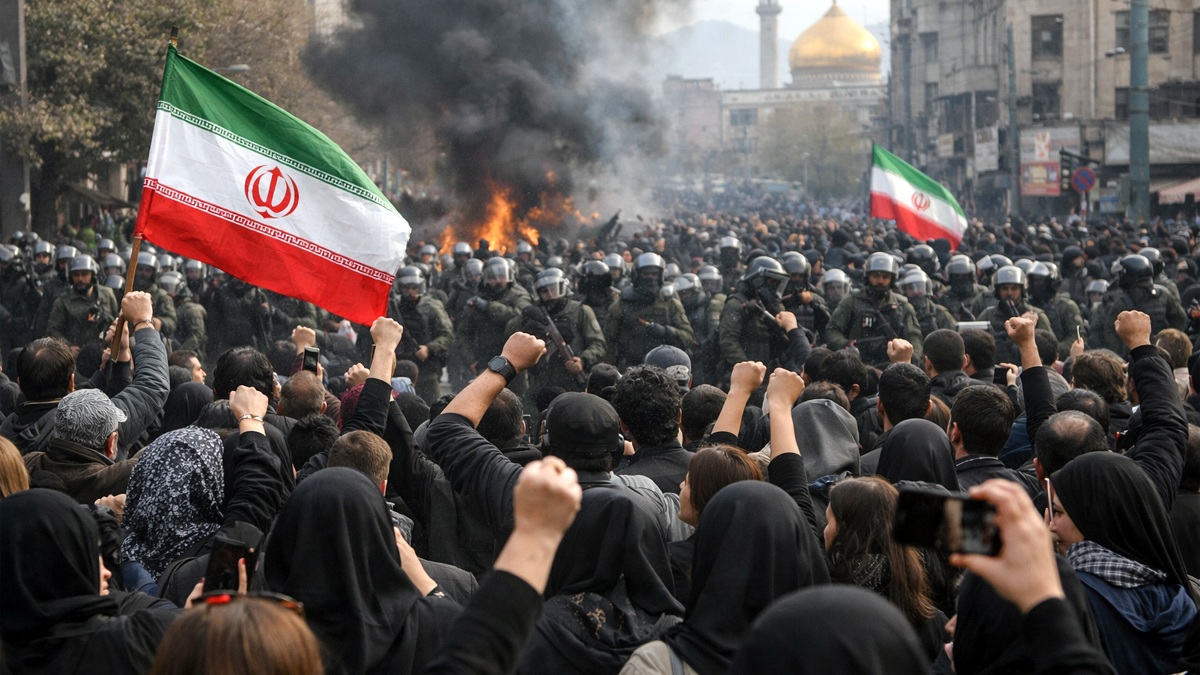
Merchants in Tehran’s Grand Bazaar, a gigantic shopping complex located in the center of the capital, launched a strike for the elimination of multiple exchange rates and against the regime’s corruption. But what began as an economic protest by one sector quickly became widespread and transformed into a questioning of all adjustment policies and the political regime. The streets of Tehran, Mashhad, Tabriz, Qom and many other cities were filled with young people, women and workers demanding the fall of the government and Ayatollah Ali Khamenei, the greatest exponent of the theocratic regime.
Amid the protests and fearing they would deepen, parliament reduced the VAT increase to 10% and doubled the future wage increase. Some paltry subsidies were also granted, around the equivalent of $7 per worker. But all without changing the essentials of the government’s policy and the regime, which is to unload the economic crisis on the backs of the working people.
Consequently, tens of thousands of people, fed up with the high cost of living, the repression and corruption of a political-clerical caste that lives like the rich, took to the streets again this Thursday under slogans such as “death to the dictator”, in reference to Khamenei.
As in previous days, the protesters resisted police repression, which has already claimed the lives of at least 50 people (some sources significantly increase this number), dozens of injuries and hundreds of detainees. There are even reports of several missing people. Furthermore, on this last day of protests, the regime cut off the internet throughout the country and a large part of communications with the aim of cutting off the flow of information and any possible coordination that protesters could make through social networks. Nobel Peace Prize winner Shirin Ebadi warned that the blackout could facilitate a massacre. Human rights organizations and the UN demanded an independent investigation and respect for the right to peaceful protest. However, some videos have gone viral where police brutality can be seen, for example charging against a hospital where some people tried to take refuge.
Repression is not new: within the framework of a theocratic and dictatorial regime in 2022, when the last large wave of protests broke out after the murder of Mahsa Amini at the hands of the “morality police” for wearing the hijab incorrectly, the regime unleashed a similar wave of violence.
This Friday, Khamenei himself issued a speech reaffirming the repressive policy and accusing “saboteurs in the service of the United States.” to the protesters. Along the same lines, the Iranian government has even threatened those who carry out “violent acts” with the death penalty. Despite everything, the anger is such that the repression is not enough to stop the mobilization. The drivers honk their horns in support, the pots and pans rattle, the gears continue and seem to be in an upward dynamic.
US imperialist cynicism and its true interests
For their part, US President Donald Trump, and his sidekick Marco Rubio, cynically spoke out “in favor of the brave Iranian people.” Trump even threatened last week with retaliation if there was a single death in the protests. As always, imperialism tries to use the hardships of the masses of dependent countries to impose or reinforce its economic and political domination.
It must be remembered that in June 2025 the US attacked the country in support of its strategic ally, the State of Israel, during the “12-day war” that it had with Iran, causing the death of more than a thousand Iranians, to stop the Persian nuclear program. Within the framework of the genocide that the Zionist State (with Yankee support) is carrying out in the Gaza Strip and the warlike policy it promotes in the region, Prime Minister Benjamin Netanyahu is also trying to take advantage of the situation to press for a regime change in Iran that will allow it to maintain its colonialist policy in the Middle East and subordinate Iran to imperialist interests.
If we look further back, the US (with fluctuations depending on whether Democrats or Republicans govern) and other imperialist powers, has been imposing economic sanctions on Iran since 2011, causing a significant drop in its main export product, oil, in addition to other impacts on state finances, being the main responsible for the economic crisis that the country is going through. This, together with the adjustment policies and the corruption of the local theocracy, are the fundamental cause of the hardships of the masses.
At its core, the US seeks to keep the Iranian regime at bay, and potentially force regime change and a puppet government, to ensure control over the region and dispose of its natural commons. As is happening today in Venezuela, after the military attack that kidnapped Nicolás Maduro and ended with Delcy Rodríguez as Trump’s puppet at the head of the government, Yankee imperialism does not seek to “defend democracy” or “human rights” either in Iran or in any country. Nor in the United States, where repression and trigger-happy actions have just claimed a new victim. On the contrary, as Trump himself has said publicly, in press conferences and interviews, what he seeks is access to oil and other common goods.
For its part, the opposition of Reza Pahlavi in exile, heir to the monarchy that ruled with an iron fist until the 1979 revolution, demands the support of the United States, and calls to continue with the mobilizations, but in a totally reactionary sense, to eventually regain its control over the country and subordinate it to the interests of imperialism.
The current protests are an expression of the Iranian people’s fatigue in the face of a deep economic and social crisis, a result of both the oppression of the theocratic regime and the pressure and siege of imperialism. The Pezeshkian government applies austerity and repression, taking care of the interests of the elite, at the expense of the great majorities while the United States and other imperialist powers only seek to impose a regime change functional to their own geopolitical and economic interests. The only progressive solution will be through the independent mobilization of the Iranian workers and people and their self-organization, which puts an end to the repressive regime and imposes a workers’ and popular economic plan.
Source: www.laizquierdadiario.com