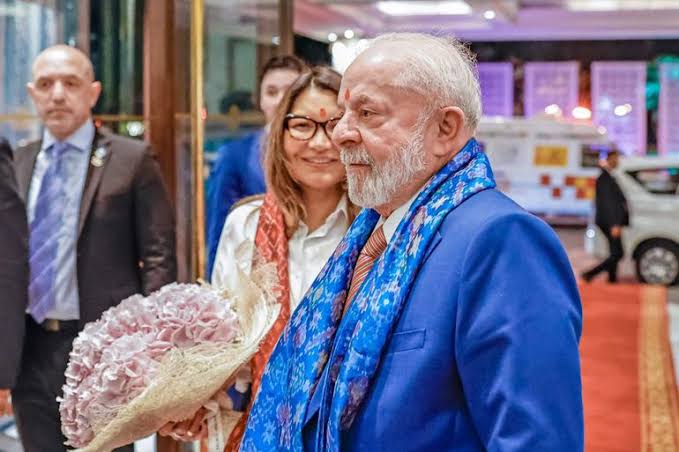
In a press conference held this Sunday (23), in New Delhi, after the end of his official mission to India, President Luiz Inácio Lula da Silva stated that the relationship between the two countries differs from international dynamics marked by the “law of the strongest” and hierarchical relations. According to him, Brazil and India share convergent needs, which makes it possible to build cooperation based on common interests, capable of expanding cross-investment and accelerating bilateral trade.
“It’s different with India. We are both needy. No one is superior to anyone else.” The president highlighted that, despite cultural, religious and linguistic differences, there are “many similarities in virtues and needs” between the two societies, which, in his assessment, creates a favorable environment for practical agreements and joint goals.
When comparing the relationship with India to other diplomatic scenarios, Lula stated that there are international negotiations in which a “tone of supremacy” predominates, in which stronger countries try to impose conditions on weaker ones. For him, this pattern does not occur in dialogue with the Indian government. “In other words, there is no tone of supremacy, the tone of the greatest, the tone of the great. It is the politics of equals. That is what gives me a lot of pleasure and a lot of optimism.”
According to the president, this dynamic manifests itself both in meetings with authorities and in meetings with businesspeople. He cited conversations with Prime Minister Narendra Modi and recalled previous visits to indicate continuity in the rapprochement strategy. In his reading, the mutual perception of common challenges and objectives facilitates the formulation of action plans and concrete goals.
During the press conference, Lula also commented on the evolution of bilateral trade. He stated that, on his first visit to India, the trade flow between the countries was around US$2.4 billion and that it currently reaches approximately US$15.5 billion. Despite the growth, he assessed that the volume is still below the potential of both economies. “It’s now reached 15 and a half billion, which is very little. Which is very little for two reasonably large economies. It’s very little.”
According to the president, the Indian prime minister mentioned the goal of increasing trade to US$20 billion by 2030. Lula stated, however, that he presented a more ambitious objective. “Because I told President Modi, we are going to reach 30 billion in 2030. It is a challenge that has been set. We will reach it.”
The Chief Executive explained that he usually makes goals public to transform them into verifiable political commitments. During the interview, he asked journalists to record the objective to monitor its execution. “I wanted to speak here to the press so you can take notes. I want you to take notes so I can follow.” According to him, public charging helps to mobilize government, diplomacy and the private sector around the established goals.
Another point emphasized was the role of the business sector in bilateral rapprochement. Lula stated that the strategy is not limited to state action and depends on the creation of bridges between Brazilian and Indian businesspeople. “Build partnerships between Indian businesspeople and Brazilian businesspeople, invite them to invest in Brazil and offer to invest in India.”
According to the president, economic cooperation must occur in a balanced way, without a logic in which one country only exports and the other only imports. The proposal presented during the trip points to joint projects and expansion of mutual investments in areas such as industry, agribusiness and services.
On the political level, Lula reiterated his defense of a less hierarchical international system. By criticizing the logic of supremacy and stating that, with India, “no one is superior to anyone else”, the president signaled his intention to strengthen partnerships between countries in the so-called Global South. According to him, relationships based on respect and convergent interests tend to produce more consistent and lasting results.
The trip to India was part of the diplomatic agenda aimed at diversifying economic and technological partners. For the Brazilian government, the Asian country is considered strategic in expanding foreign trade and attracting investments. Lula stated that the advancement of this cooperation will depend on the ability to transform commitments into concrete actions over the next few years.
Source: https://www.ocafezinho.com/2026/02/22/a-estrategia-de-lula-que-turbinou-o-comercio-bilateral-do-brasil-com-a-india/