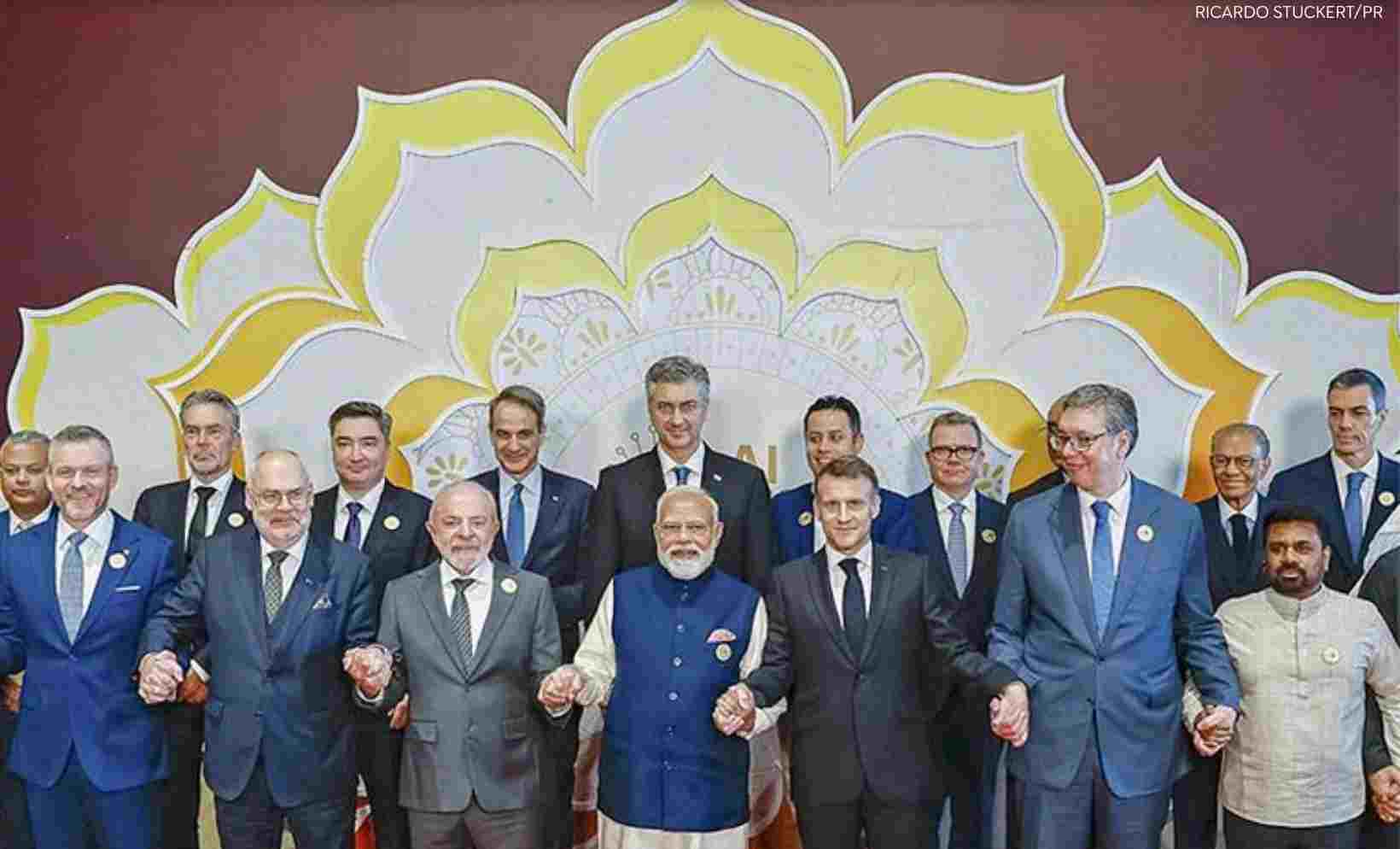
This Thursday (19/2), in his first official visit to India, the president participated in the Summit on the Impact of Artificial Intelligence and highlighted that false content manipulated by AI distorts electoral processes and puts democracy at risk
Speaking this Thursday (19/20), in New Delhi, India, at the Plenary Session of the Summit on the Impact of Artificial Intelligence, President Luiz Inácio Lula da Silva defended that the governance of artificial intelligence should be multilateral, inclusive and development-oriented. He warned that, without collective action, technology could widen historical inequalities and weaken democracies.
“The Fourth Industrial Revolution advances rapidly while multilateralism retreats dangerously. It is in this context that the global governance of artificial intelligence assumes a strategic role. Without collective action, artificial intelligence will deepen historical inequalities. Brazil defends governance that recognizes the diversity of national trajectories and ensures that artificial intelligence strengthens democracy, social cohesion and the sovereignty of countries”, stated Lula.
The president recalled that, according to the International Telecommunications Union, 2.6 billion people are disconnected from the digital universe. For Lula, it is imperative that nations deepen discussions on the topic, always taking into account that this is a process that needs to prioritize people.
“Putting human beings at the center of our decisions is an urgent task. The governance regime for these technologies will define who participates, who is exploited and who will be left out of this process”, stated Lula.
Dangers
Lula also warned of the dangers of the indiscriminate use of artificial intelligence, highlighting that its effects have enormous potential to threaten democracies and contaminate electoral processes. “Every technological innovation with great impact has a dual character and confronts us with ethical and political questions. False content manipulated by artificial intelligence distorts electoral processes and puts democracy at risk”, he highlighted.
“Aviation, the use of the atom, genetic engineering and the space race are examples of this phenomenon. They can multiply collective well-being or cast shadows on the destinies of humanity. The Digital Revolution and Artificial Intelligence raise this challenge to unprecedented levels”, continued the president.
“They positively impact industrial productivity, public services, medicine, food and energy security and the way we connect with each other. But they can also encourage extremely harmful practices, such as the use of autonomous weapons, hate speech, disinformation, child pornography, femicide, violence against women and girls and precarious work. Algorithms are not just applications of mathematical codes that sustain the digital world. They are part of a complex power structure”, highlighted Lula.
Regulation
Another point defended by the Brazilian president was the regulation of companies responsible for the main artificial intelligence platforms. “Computational capabilities, infrastructure and capital remain excessively concentrated in a few countries and companies. The data generated by our citizens, companies and public bodies are being appropriated by a few conglomerates, with no equivalent counterpart in generating value and income in our territories”, recalled Lula.
“When a few control algorithms and digital infrastructures, we are not talking about innovation, but about domination. The regulation of so-called Big Techs is linked to the imperative of safeguarding human rights in the digital sphere, promoting the integrity of information and protecting the creative industries of our countries. The current business model of these companies depends on the exploitation of personal data, the renunciation of the right to privacy and the monetization of flashy content that amplifies political radicalization”, continued the president.
Lula also highlighted that Brazil has strengthened discussions around a policy to attract investments in data centers, in addition to a regulatory framework for Artificial Intelligence. He recalled that, in 2025, the country launched the Brazilian Artificial Intelligence Plan, which expresses the commitment to improving people’s quality of life through more agile public services and greater stimulation of job and income generation.
Bletchley Process
The Summit in New Delhi is the fourth meeting of the so-called Bletchley Process, a series of intergovernmental meetings on the security and governance of artificial intelligence (AI), started in Bletchley Park, United Kingdom, in November 2023, and followed by the Summits in Seoul (“Seoul AI Summit”), in May 2024, and in Paris (“AI Action Summit”), in February 2025. This is the first time that a Brazilian president has participated in a high-level global event on artificial intelligence.
Brazil and India
The trip to India is Lula’s fifth to the Asian country and the second in the current term. The visit reinforces an unprecedented moment of economic and technological dynamism in bilateral relations between the two nations. In September 2023, Lula visited India accompanied by more than 100 Brazilian business delegations, who were in the country in search of trade and joint venture opportunities.
At the invitation of President Lula, Prime Minister Narendra Modi was welcomed on a state visit to Brazil on July 8, 2025, following his participation in the 17th BRICS Summit, held in Rio de Janeiro. On that occasion, the two leaders issued a Joint Statement identifying five priority pillars that should guide the bilateral relationship over the next decade: (I) peace, defense and security; (II) energy transition and climate justice; (III) food/nutritional security and agricultural trade; (IV) digital transformation and science & technology; and (V) industrial partnerships in strategic sectors.
In addition to exchanging official visits, Lula and Narendra Modi met four times in the last three years: on May 21, 2023, on the sidelines of the G7 Summit, in Hiroshima; on September 10, 2023, on the sidelines of the G20 Summit, in New Delhi, when they issued a Joint Communiqué; on June 21, 2024, at the G7 Summit, in Italy; and on November 19, 2024, on the sidelines of the G20 Summit, in Rio de Janeiro.
Agenda Bilateral
After the Summit, President Lula will carry out a bilateral agenda in New Delhi. He and Prime Minister Modi will have the opportunity to discuss the prospects for expanding bilateral relations in the economic and technological fields, as well as exchange views on the global situation. Leaders must address topics such as challenges to multilateralism and international trade, the need to reformulate global governance, including a comprehensive reform of the United Nations and its Security Council, the commitment to peace in Gaza and respect for the sovereignty of nations and democracy.
Business
In 2025, Brazilian trade with India reached US$15 billion, an increase of 25.5% compared to 2024 and the highest value recorded in the historical series. Exports were US$6.9 billion and India is the 10th destination for Brazilian exports. Imports were US$8.4 billion, which made India the 6th largest source of imports for Brazil. Brazil and India set a goal of increasing bilateral trade to US$20 billion by 2030 and began negotiations to expand the Mercosur-India Preferential Trade Agreement.
India is the most populous country in the world, with 1.4 billion inhabitants. It is the fourth largest economy on the planet, with a GDP of around US$4.2 trillion, and could become the third by 2030. According to data from the Food and Agriculture Organization of the United Nations (FAO), India is the second largest agricultural producer in the world in terms of production value, behind only China (by this criterion, Brazil occupies the fourth position), and the ninth country in agricultural exports (Brazil, the third).
Originally published by Agência Gov on 02/19/2026
Source: https://www.ocafezinho.com/2026/02/19/lula-defende-governanca-global-da-ia-se-poucos-controlam-algoritmos-nao-e-inovacao-e-dominacao/