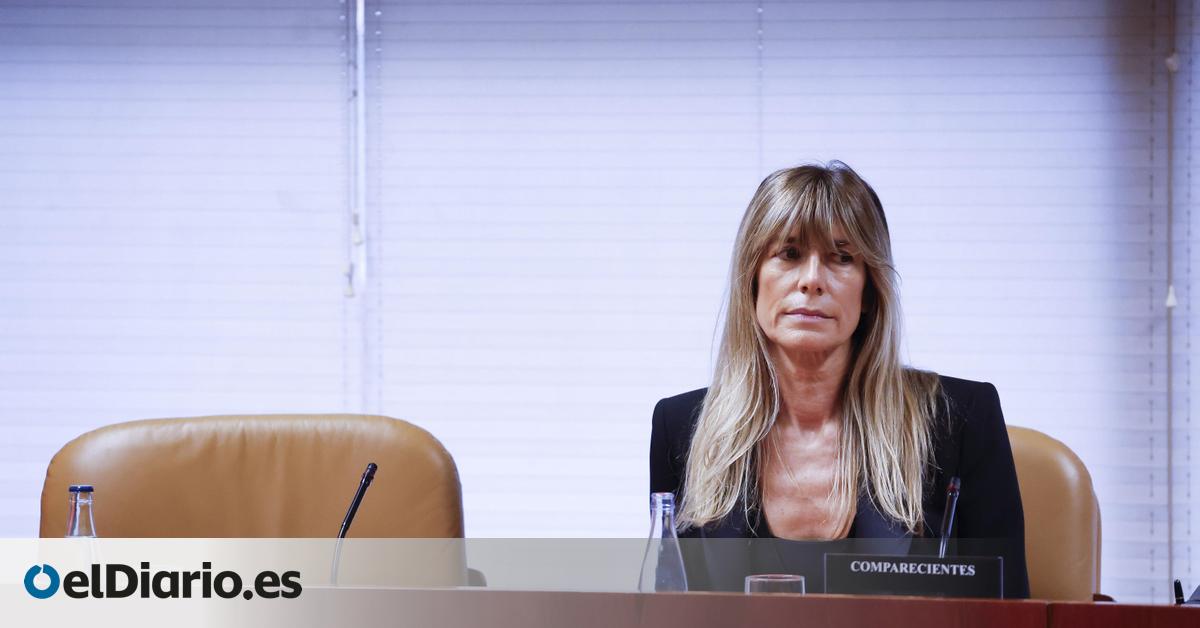
Judge Juan Carlos Peinado, who has been investigating Begoña Gómez for almost two years, insists that the investigation against the wife of the President of the Government end before a popular jury if it goes to trial. After the latest setback of the Provincial Court, the magistrate agrees to investigate and process in this way and jointly all the crimes that he attributes to Begoña Gómez and the rest of those investigated with the argument that they are “intimately intertwined.” He attributes crimes of influence peddling, business corruption, misappropriation, intrusion and embezzlement to them.
The magistrate summons Sánchez’s wife, his advisor Cristina Álvarez and the businessman Carlos Barrabés on April 1, in the middle of Easter, to inform them that it is appropriate to continue the procedure against them in this way. It is a summons in which those investigated can be represented by their defenses, so they are not expected to attend the court in person.
Peinado responds with this order to the resolution of the Provincial Court last January that annulled his previous attempts to send the case to the Jury Court due to lack of motivation to justify the change in procedure. The judges of the higher court reproached him for “only” mentioning the people he was targeting, but not giving a story that included the evidence he attributed to them. And they concluded, therefore, that the right of those investigated to effective judicial protection, which includes obtaining a duly reasoned resolution, had been violated.
In a new resolution, the magistrate points out the evidence collected during the investigation to try to justify again that the case should go to trial through the Jury Court Law. Thus, he accuses Begoña Gómez of taking advantage of her “institutional position” as the president’s wife to benefit from a “radical” change in her professional career. And to rely, for this, on the other two investigated: Juan Carlos Barrabés, a well-known entrepreneur in the Internet sector; and Cristina Álvarez, his personal assistant, a figure that all the wives of the presidents of the Government have had.
Among other aspects, the judge focuses on the fact that Begoña Gómez used the Moncloa Palace, which was her official home, to hold meetings about business and academic projects. He points out, for example, that the rector of the Complutense University, Joaquín Goyache, was summoned to Moncloa to propose the creation of the chair that Begoña Gómez ended up co-directing at that university, something that the judge considers “anomalous.” Peinado kept Goyache charged for more than ten months until the Provincial Court also forced him to remove him from the case.
Regarding Barrabés, whom he also received at Moncloa, the judge considers that his companies were a “key piece” in the development of that chair, for which Begoña Gómez did not receive any remuneration. The magistrate’s thesis is that the businessman was in charge of designing and developing the academic content of part of one of the master’s degrees linked to the chair. And that, in the same “time frame,” Begoña Gómez acted “in favor” of her “business interests.”
Peinado refers to the “letters of support or recommendation” in favor of the UTE linked to the Barrabés business group that Begoña Gómez signed. In reality, it was a “declaration of interest and support” in which she confirmed that the master’s degree she directed was going to collaborate with the training program that Barrabés was opting for. It was a standard letter: identical to the one signed by 32 other people. Among others, the director of the Employment Agency of the Madrid City Council.
In the summer of 2021, the Barrabés UTE was awarded two large public contracts from the state entity Red.es. The first file was awarded for 7.77 million euros and the second for approximately 4.4 million euros. The judge recalls that a report from the General Intervention detected “relevant irregularities” in these Red.es tenders. Among them, opacity, disproportionate use of subjective criteria and alterations in scores.
On the other hand, the judge devotes a large part of the record to trying to demonstrate how the advisor Cristina Álvarez acted as Begoña Gómez’s private assistant, which, in his opinion, constitutes a crime of embezzlement. The judge alludes to the “repeated intervention” of the Moncloa worker “in favor of the professional and academic activity” of Sánchez’s wife.
As indications, Peinado alludes to the emails that the advisor sent from her official account of the Presidency of the Government expressly acting “on behalf of Begoña” to seek financing and manage agreements with companies. And also to the statements of witnesses that “reinforce the conclusion” that Cristina Álvarez “was perceived by third parties not as a mere protocol assistant to the wife of the President of the Government, but as a person integrated into the work team of the chair and the technological project linked to the software.
Source: www.eldiario.es