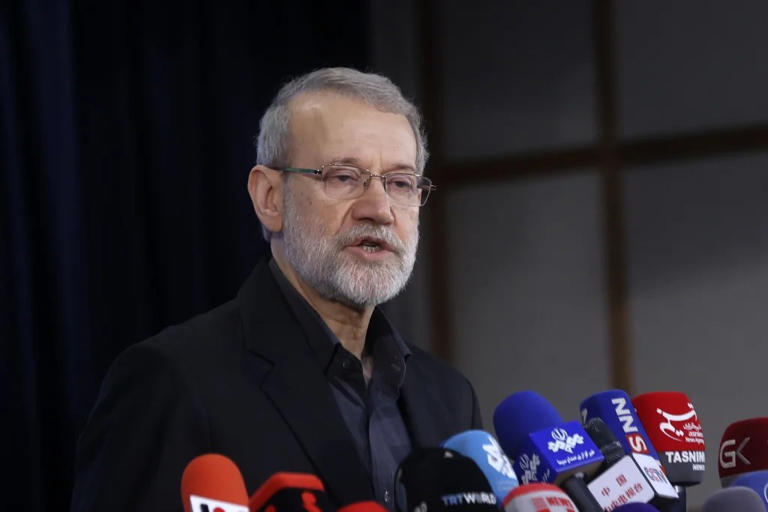
Israel’s Defense Minister, Israel Katz, said on Tuesday (17) that the country killed Iran’s top security chief, Ali Larijani, in a targeted attack. The statement, however, was immediately contested by Tehran, which classified the information as “rumors” and part of a propaganda strategy.
The Israeli allegation was made in an official video, in which Katz said he had received confirmation of the operation from military command. According to him, the offensive directly hit the Iranian security leadership, in yet another move in the campaign that Israel claims to be conducting to dismantle the adversary country’s command structure.
From the Iranian side, the response came in a tone of defiance. In a message attributed to Larijani and released by state TV, the leader stated: “enemies say they attacked me with terrorist attacks, but this propaganda will not weaken us, because they have nothing left but rumors.” In the same text, he added: “We attacked them, and now they are paying the price in the blood of Gaza.”
The divergence exposes not only the dispute over narratives, but also the informational war that accompanies the fighting on the ground. To date, there has been no independent confirmation regarding the death of Larijani — a figure considered one of the most influential in the Iranian regime and a key player in the Supreme National Security Council.
Information released by the Israeli press indicates that the attack had been planned in advance and postponed shortly before execution. The operation would have been reactivated after intelligence services identified Larijani’s presence in a property used as a hideout. Still, Iranian authorities did not recognize any loss at this level of the hierarchy.
Meanwhile, Israel has expanded its statements on the impact of the offensives. The country’s Defense Forces said they had also eliminated Gholamreza Soleimani, commander of the Basij paramilitary force, described as a “fundamental instrument” in Iranian internal repression. In a statement, the Army declared that the operation represents “another severe blow to the regime’s security command and control structures.”
The rhetorical escalation was accompanied by even more forceful statements from Washington. United States President Donald Trump stated that the Iranian regime was “destroyed” and that the country would no longer have relevant military capabilities. “They no longer have missiles to use, nor shots to fire,” he said, adding that the operation continues with “maximum force.”
Trump also raised doubts about Iranian leadership following reports involving Mojtaba Khamenei, who has not yet made recent public appearances. “I don’t know who is governing the country at the moment,” he said, commenting on possible negotiations. Despite this, international vehicles point out that indirect communication channels between the two countries remain active.
On the Iranian side, the speech is one of denunciation and threat. The Ministry of Foreign Affairs accused the United States and Israel of carrying out a “massacre”, alleging that hundreds of civilians were killed, including more than two hundred children. The government also warned that it could retaliate by targeting American interests in the Middle East, without detailing targets.
The intensification of the conflict already has visible regional effects. In Iraq, explosions were recorded near the American embassy in Baghdad, while a drone hit a hotel housing journalists and diplomats. In Lebanon, the death toll approaches 900, with more than a million displaced since the collapse of the ceasefire between Israel and Hezbollah.
At the same time, the global energy crisis is worsening. The closure of the Strait of Hormuz — a strategic route for transporting oil — took Brent crude oil back above 100 dollars. International pressure to reopen the crossing is growing, but US allies are resisting a military escalation, increasing Washington’s isolation in handling the crisis.
Source: https://www.ocafezinho.com/2026/03/17/israel-anuncia-morte-de-chefe-de-seguranca-do-ira-teera-rebate-e-acusa-propaganda/