Luisa has her portfolio ready for when she finally gets the papers and can start knocking on companies’ doors. While he works part-time, irregularly, in the cleaning sector, several job opportunities have arisen for projects in the field that he is passionate about, marketing focused on the Third Sector, but he had to reject them: without a residence card, he could not access a contract or register for Social Security. That is why she is looking forward to the activation of the regularization process announced by the Government: “With the employment permit, I will be able to move my portfolio, make up for lost time and start contributing,” she adds.
The Colombian woman is one of the nearly 500,000 people that the Government estimates meet the requirements to benefit from the new regularization. While the future beneficiaries, like Luisa, celebrate the measure and look forward to the moment of regularizing their situation to work within the system after years doing it clandestinely, the Popular Party has not been slow to react to criticize the initiative. Alberto Núñez Feijóo has defended that the measure will generate a “call effect” and will cause a “collapse of social services.” However, the economic and sociological analyzes after the 2005 regularization process show very different effects from those reported by the PP leader.
The sum of the contributions of the 600,000 regularized people then contributed to an increase in Social Security affiliations and swelled the public coffers with their corresponding contributions. A study published in 2021 by a group of researchers from the Pompeu Fabra University (UPF) concluded that each regularized immigrant then contributed a contribution of between 4,000 and 5,000 euros per year with salary taxes alone.
“The regularization of 2005 had a clearly positive effect. Applying the same criteria from then, the regularization will have a similar contribution to the State’s coffers, although it depends on how it is applied,” says Joan Monrás, professor of Economics at the UPE and one of the authors of the report.
In 2005, the number of affiliated foreigners skyrocketed in 2005 with Zapatero’s extraordinary regularization. “There was a first statistical effect on the Social Security records and the volume of employed people increased a lot,” commented Antonio González, economist from Economistas contra la crisis, who held the general secretary of Employment between 2006 and 2011, in an interview with elDiario.es.
At that time, presenting an employment contract was an essential requirement to request the papers through the process. “After two years, more than half of the immigrants were still in the formal sector,” says Joan Monrás, professor of Economics at the UPF and author of the article on the effects of the measure.
Furthermore, in general terms, the UPF study noted changes in the working lives of the affected people. “You can see how they moved to larger companies, with better salaries and have a positive evolution,” he indicates. The effect perceived by experts in 2005 coincides with the expectations narrated by Luisa: “My plan is to get a job in marketing in an NGO or a company and have decent working conditions,” says the Colombian.
For the economic and social studies center Funcas, the positive effect of regularization is immediate with regard to Social Security income. “The impact is always positive in terms of the lives of these people and the recognition of their rights,” says Raymond Torres, situation director of Funcas. “But, in addition, immigrants who are regularized will access a work contract. This implies that, of course, they will contribute resources to Social Security and studies show that the contribution, at least in the short term, is positive from immigration, because immigration is mainly labor-related and they will contribute even more than what they receive,” he maintains. The reason is also found in the majority profile of the migrants: “Generally, they are younger people than those who are already settled and, therefore, this represents a positive contribution in terms of social contributions,” he adds.
According to the Esenciales 2022 report, from the porCausa Foundation, each regularized immigrant would benefit the State with an estimated average net fiscal contribution of 3,500 euros per year. In total, according to the calculations of this organization, it would be between 790 and 950 million euros per year.
According to the Funcas expert, the measure also has a multiplying effect on the entire native population, because those who take advantage of the irregular situation of migrants push down working conditions. “By regularizing it, it improves the conditions of everyone in the sectors with the greatest presence,” he reasons. “It allows us to reduce the risk of unfair competition between companies and workers. There are informal work sectors that take advantage of this situation and, in some way, compete unfairly with other companies that employ people with an employment contract,” Torres details.
The economist and statistician Francisco Melis indicated in this analysis that the regularization of foreigners would increase public income by 2,000 million euros per year. According to the simulation by the elDiario.es data team, with 100,000 new hypothetical contributors receiving the minimum interprofessional salary, the State coffers would swell by 587 million a year. If there were 400,000, it would be 2,346 million.
In the Spanish case, experts point out that massive regularization can be a lifeline to weather the retirements of the baby boom generation. “A new process that allows for a more realistic calculation of the Gross Domestic Product and increases contribution income means a lower ratio of pension spending in the coming years,” explained Antonio González in a recent interview with elDiario.es. “No (it is positive) only because of the initial boost in collection, also with respect to the working-age population compared to the retired population, the age of having children,” adds Torres, who clarifies that this effect of increased birth rate does not always occur because migrants tend to adapt to the demographic dynamics of the host countries.
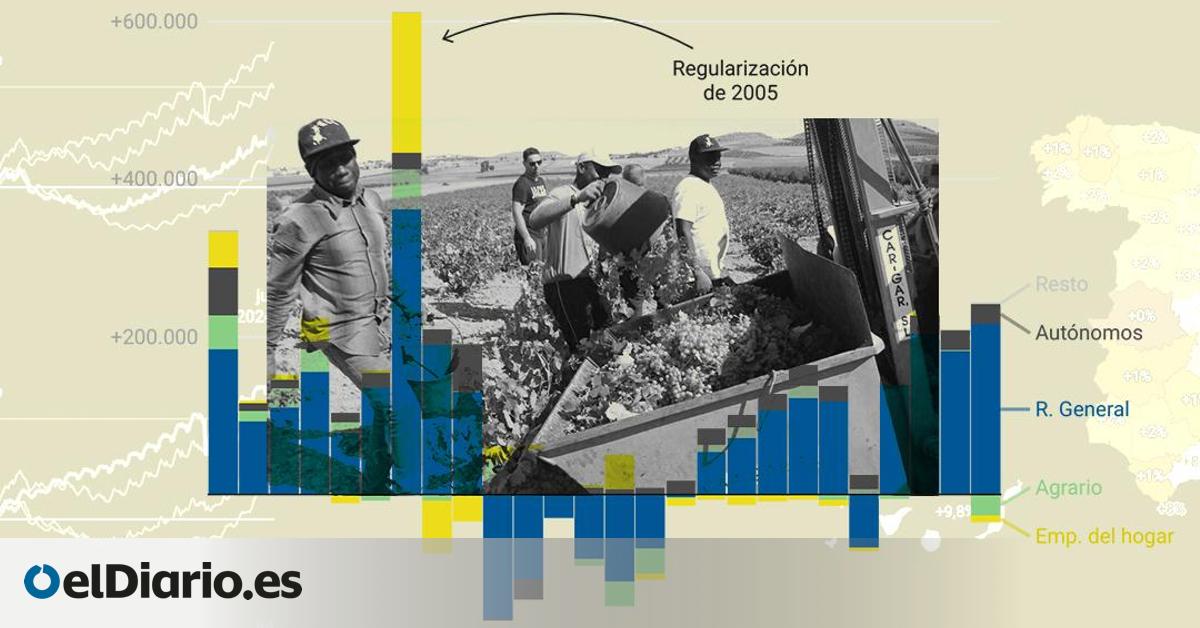
“To talk about pensions we have to analyze if the country is capable of giving them opportunities, development possibilities, if there are family policies or agreements so that they can return to their countries of origin,” considers Monrás. In fact, one of the groups that benefited most from the 2005 regularization was domestic workers, with low salaries and fewer rights than the rest of the working class. As can be seen in the following graph, 30% of the new affiliations corresponded to them.
Another of the arguments put forward in the last week by both the PP and Vox is the risk of a “call effect” linked to regularization. “There is no evidence,” says Joan Monrás. In their research they studied the evolution of non-EU migratory flows – and, therefore, affected by the measure – and community ones – who were not influenced: “We did not see any change, they continued arriving in the same proportions.”
For Torres, “the call effect can occur if a regularization is announced with the deadline after the announcement of the rule.” That is, if the rule had not introduced a requirement to have arrived in Spain before December 31, 2025, but instead left a few more months of margin, it could lead to an increase in the arrival of people trying to benefit. But it is not like that.
For the Funcas expert, it makes sense to debate a strategy for organizing the flows entering the country but, once these people are in the country, “it is good for the economy that they integrate.
The increase or reduction in the arrival of immigrants, therefore, is not determined by political measures like these, but experts point out that the economic context is usually more decisive. The case of the 2005 regularization illustrates this again. After the process by which some 600,000 people obtained their papers at once, the number of new foreign contributors remained stable in the first years after the regularization of 2005, while it fell to negative during the 2008 crisis and recovered from 2014. In the pandemic, it decreased again and, once overcome, it recovered the upward trend until reaching a new peak from 2022.
Monrás’s study indicates that the 2005 regularization did not have negative effects in terms of social spending or benefits, something that other works agree on. “The highest State expenses correspond to education, for those under 18, and health, for those over 60. By definition, immigrants usually arrive at some point between 18 and 30, so they consume few resources in education, and a proportion return to their countries of origin when they are older, so they also spend little on health. They contribute to net income,” he explains. It is an argument that the Minister of Inclusion, Elma Saiz, regularly uses: “10% of Social Security income comes from migrants (in a regular situation) while they only represent 1% of spending.”
The regularization processes have been promoted throughout democracy by governments of both the PP and the PSOE. Two of them were promoted by the Popular Party (2000 and 2001) and four by the Socialist Party (1986, 1991, 1996 and 2005).
“Empirical evidence shows that regularizations generate positive effects, for example, the 2005 one improved the labor integration and mobility of regularized people, increased tax collection and reduced informality,” defended the Ministry of Inclusion after the announcement of the measure.
Source: www.eldiario.es