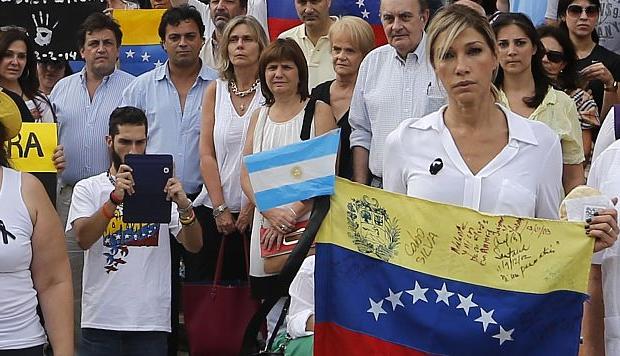
“Give me one Venezuela free and the oil I give them to you.” The phrase, launched lightly by Catherine Fulop from the comfort of his life in Argentina, it is neither naivety nor an emotional outburst: it is a positioning deeply political reactionaryalthough it is disguised as a “desire for freedom.”
When a public figure states that resources strategic of a country can be given away in exchange for a supposed liberation, he is not speaking from the pain of the people, but from a functional view of imperialism. This is not an isolated outburst: it is the same political lightness with which Catherine Fulop had already made aberrant historical comparisons, such as when she trivialized the Holocaust to comment on Venezuela. Saying that oil doesn’t matter is a fancy way of saying that it doesn’t matter who controls it, as long as one’s life isn’t affected. It is the same reasoning with which privatizations, adjustments and looting were justified throughout the region, always in the name of a freedom alien to the majorities.
He oil Venezuelan is not an abstraction nor a “damned” object that can be thrown overboard with grandiose phrases. It is territory, a history of popular struggles and also conflict, yes, but above all it is a loot coveted by USA and the powers that never hid their interest in controlling the world’s main crude oil reserve. To pretend that this interest does not exist (or worse, to offer it as a bargaining chip) is to deny centuries of plunder in Latin America.
Fulop’s statements are, to say the least, problematic, because there is nothing emancipatory in a discourse that erases poor men and women, migrants, workers and racialized people who pay the real cost of foreign interventions, economic blockades and “humanitarian” wars. Venezuelan men and women who do not need anyone to “give away” their resources. They need material conditions to live, political independence to decide their destiny and not to be dictated from Washington.
It is not freedom: it is surrender
Latin American history is clear: there was never an imperialist intervention that brought democracy, rights or well-being for the majority. What there was was devastation, indebtedness and dependence. Calling that “freedom” is not a conceptual error: it is an ideological operation.
Therefore, more than a personal opinion, Catherine Fulop’s words express something deeper and more dangerous: the naturalization that our common goods do not belong to us, that workers must be grateful for any external protection.
Catherine Fulop’s statements about “giving away Venezuelan oil” in exchange for freedom not only express a reactionary political position: they condense one of the most dangerous traps in the current debate on Venezuela. The same one that forces us to choose between uncritically defending the regime of Nicolás Maduro or endorsing (explicitly or covertly) imperialist intervention.
Criticizing Maduro does not enable looting
Nicolás Maduro’s regime cannot and should not be idealized. His government deepened agreements with foreign capital, repressed workers’ struggles and persecuted sectors of the critical left and the union movement. The concentration of power, the hollowing out of democratic mechanisms and the impoverishment of the majorities are facts that cannot be erased with anti-imperialist rhetoric.
But recognizing these limits does not imply or justify imperialist punishment or the delivery of strategic resources.
That is where Fulop’s speech becomes particularly harmful: because he uses a general criticism of the Venezuelan government to slip in a deeply reactionary conclusion, as we already said. As if Venezuela’s problem were the oil in Venezuelan hands, and not the permanent siege of the powers that seek to control it, particularly the United States and the Trump government. Sanctions, blockades and threats do not seek to improve the lives of the people, but rather to discipline a key country on the world energy map.
Defending Venezuela against imperialism does not mean closing ranks with the Maduro regime. But criticizing Maduro does not allow us to celebrate or justify external looting.
What is at stake is not an abstract slogan of freedom, but who decides on social wealth and for what country project.
Source: www.laizquierdadiario.com