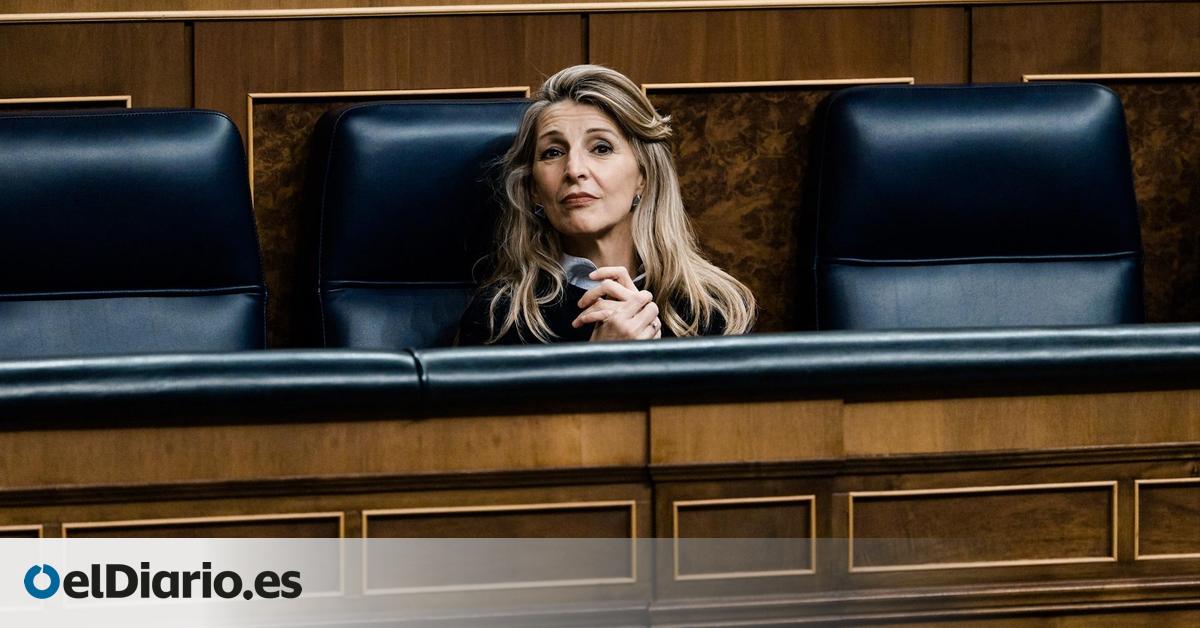
Yolanda Díaz will not be the candidate of the left in the next elections. He announced it this Wednesday in a letter that he published on his social networks. The second vice president puts an end to a stage that began in 2021, when Pablo Iglesias appointed her as leader of Unidas Podemos, and that will always have the legacy of having managed to unite the entire left in the same alliance on July 23 to revalidate the coalition government. “I look back and I am proud of everything we have achieved,” she says in a letter in which she sends a message: “There is much left to do, the pending task is to win the country.”
The vice president will maintain her positions in the Government until the end of the legislature but takes a step aside politically. Her farewell letter is a staunch defense of her work as Minister of Labor.
“We have done it with humility, with work and with enormous effort. We have achieved what they told us was impossible to achieve. When I began my role as minister I did it with one goal in mind, with a clear horizon: to serve the workers of my country. Every time I have felt that strength fail, every moment of doubt, every conflict, it has been the compass of the workers that has shown me the way,” he defends in the letter that he published this afternoon on his Bluesky account.
With this decision, he ends in some way consolidating the resignation he announced in June 2024 after the European elections, in which he departed from the organic leadership of the Sumar coalition, which was then trying to build a party front.
“I always had a lot of reluctance about the idea of being a candidate. Politics is hard, especially for women, but I do not regret having taken a step forward,” she says in the letter. “I look back and I am proud of everything we have achieved collectively and always working to improve people’s lives,” she adds.
Díaz makes it clear that he is not moving away from that work, that he will continue in the Ministry of Labor and that he will continue to contribute to the new coalition. “I am going to continue doing so, but today I want to announce to you that I will not be a candidate in the next general elections in 2027. It is a very thoughtful decision and one that I have communicated to my loved ones, to my entire political space and to the President of the Government,” she maintains.
“I took the step to lead Sumar in 2023 thinking about the enormous embrace of the workers of our country. We said then that without Sumar there would be no coalition government and we managed to revalidate a government that all the polls considered lost. These days I think all the time that that strength, that hug and that meeting is what we have to build and defend. I will continue working in the Government to fulfill that mandate of the polls and advance everything we have left to do,” he recalls.
Precisely on February 21, the parties launched a new coalition that aims to renew what Sumar meant on July 23. In this period, the formations that until now had considered that it was not the time to talk about leadership but to build a political project have taken center stage.
The vice president refers in her letter to that work and also alludes to the conversation sparked by Gabriel Rufián in recent weeks about a candidacy that incorporates the pro-independence left.
“While the Government must continue doing its work, paths are being opened again to breathe life and enthusiasm into the progressive space. We have seen it on February 18, with the pertinent and ambitious debate that Gabriel Rufián has opened and we have seen it on the 21st with the confirmation that the space that Sumar set up is still strong, with the vocation of majorities and the will for agreement and social progress. It is time to expand democracy and fill it with meaning and hope,” he states.
And he adds: “That is what we need. It is necessary for that energy, of which we see the first glimpses today, to grow.”
Yolanda Díaz is committed to now giving space to those parties so that they can continue working along the lines they have undertaken since last summer. “I also want to give space and time so that what is being born runs with the force it deserves, and accompany it, take care of it, promote it with all my energy and with the strength that conviction gives me. And I also want to take care of the progressive coalition government, because taking care of the best tool we have to continue gaining rights,” he tells them in his letter.
“I feel very proud of what we have done, but I am aware that there is still much to do. The pending task is to win the country. With clarity, with affection, with tenderness, without fear. As until now,” she concludes.
The 23J coalition as a legacy
Yolanda Díaz culminates a complicated period at the head of the left-wing space, first with Unidas Podemos and then with the construction of her own project, Sumar, which never functioned beyond the 23J coalition. The organic structure that he created as an instrumental party, Movimiento Sumar, remains, which today is one of the forces of the new coalition for the next general elections.
The second vice president took office after a successful period as Minister of Labor. Iglesias designated her as his successor when he left the Government to compete in the Community of Madrid against Isabel Díaz Ayuso, in 2021. The minister was then one of the most valued leaders of the Executive and the entire left. Iglesias’ aspiration at that time was for her to take over the leadership of the coalition to reverse the drop in support that the party had suffered recently.
But Díaz soon used her leadership to build her own project, which gradually distanced her from Podemos and her predecessor and friend, Pablo Iglesias. By the time the general elections arrived, relations were completely damaged and Ione Belarra’s party ended up agreeing to enter the coalition very reluctantly, pressured by the narrow electoral margins caused by Pedro Sánchez by calling the general elections early.
Yolanda Díaz got a unit that was stillborn. The first tensions between Podemos and the rest of Sumar’s parties already began to occur at the beginning of the legislature, when the Belarra party was left without spokespersons in the parliamentary group to the detriment of smaller forces such as Comuns, Compromís and even Més per Mallorca and Chunta Aragonesista.
The climax of the rupture had its origin in the formation of the Government. Podemos had set the repetition of Irene Montero as Minister of Equality as a condition for entering the new coalition Executive. Yolanda Díaz offered Nacho Álvarez, then Secretary of Economy in the purple executive, as Minister of Social Rights. But Belarra, who at that point had already lost political confidence in his Secretary of State, rejected the proposal. Álvarez left politics and Podemos was left out of the new Government. A few weeks later, he announced his departure to the Mixed Group.
Yolanda Díaz’s problems as a leader of the space continued despite the departure of Podemos. His team tried in those first months of the legislature to build a front of parties that included Sumar’s own militancy and also the rest of the political formations, but that process generated a multitude of confrontations with Izquierda Unida and Más Madrid, also with Compromís.
All these tensions galvanized in the formation of the electoral lists for the European elections, where the main parties in the coalition fought to obtain a starting position in a context of decline in electoral options. Too many parties for few positions that caused a total crisis in the space, which deepened after the results, with Izquierda Unida outside the European Parliament for the first time since its birth.
That night led Yolanda Díaz to resign as the organic leader of Sumar to focus on her work in Government, the place where she had until then harvested all her political capital. His departure little by little enabled the reunion between the formations of the parliamentary group and Sumar in the Government. These relations have been improving until culminating in the event on February 21. The vice president already gave clues about her next moves when she was absent. “It is the time of political formations.”
Now the parties will have to deal with a no small issue: the absence of clear leadership. With the departure of its main reference for five years, the space on the left needs a face or several faces to enhance the ballot that the progressive electorate votes in the next general elections.
Source: www.eldiario.es