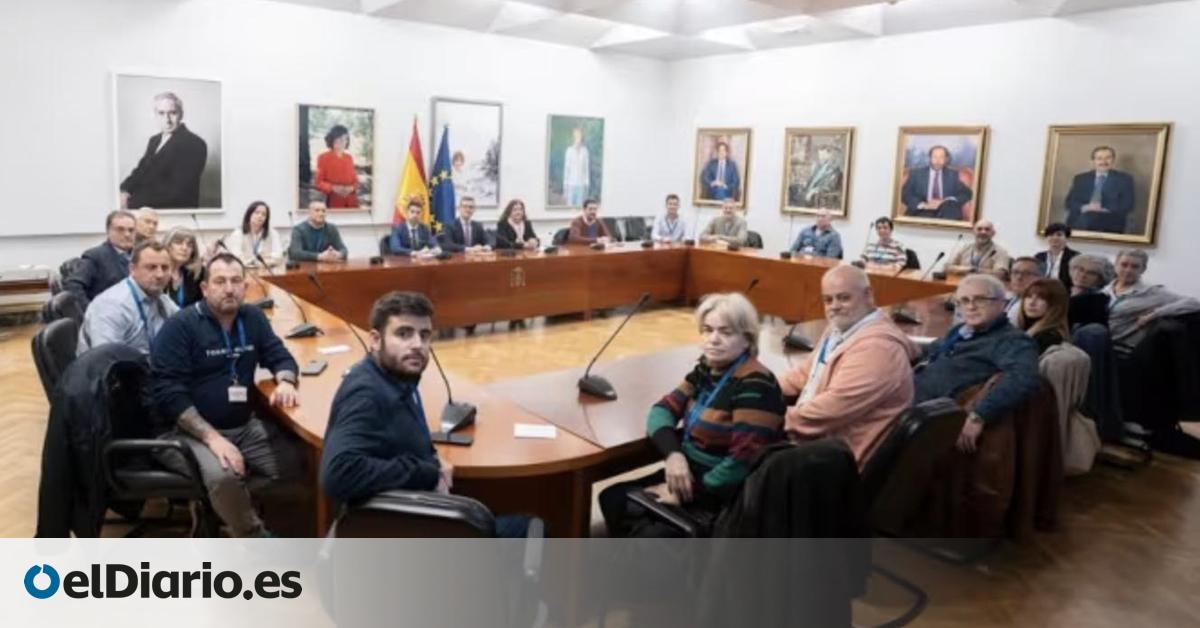
Historic agreement for reparation for victims of clerical pedophilia. As elDiario.es can advance, the Minister of the Presidency, Justice and Relations with the Courts, Félix Bolaños, and the presidents of the Episcopal Conference (Luis Argüello) and CONFER (Jesús Díaz Sariego) have agreed on the creation of a mixed Church-State reparation system, with the participation of the victims and the arbitration of the Ombudsman, Ángel Gabilondo. In practice, it means that the Church ceases to have total control over compensation to those who could not resort to judicial means. The pact will be sealed this morning with the signature of the parties.
This fulfills the main demand of the associations of victims of the Church, who this Friday will be received by Bolaños at the ministry headquarters to be informed of the details of the agreement, which, according to the sources consulted, will facilitate the reparations going at a good pace.
Negotiation sources have shown their satisfaction after the signing of the agreement, which represents the fourth that the Ministry led by Bolaños reaches with the bishops, after the resignification of the Cuelgamuros Valley, the pact for registrations and the agreement to modify the Concordat so that religious institutions would pay the ICIO (tax on special contributions and on constructions). An agreement for which Bolaños has had the support of the Secretary of State, Pietro Parolin, and which could pave the way for Leo XIV’s trip to Spain next June.
Keys to the agreement
The agreement, to which elDiario.es has had access, offers several areas of security for survivors. The first, that the victims will not have to go through the filter of the episcopal commission and its controversial PRIVA plan again, if they do not wish to, which in more than a year of operation has barely compensated fifty survivors of pedophilia, with compensation that has ranged from 3,000 to 100,000 euros, re-victimizing forms and without the participation of the victims or their representatives in the process. In principle, a period of one year (extendable) is established so that prescribed cases can be presented to the institutions. Those victims who, benefiting from the PRIVA plan, have not been satisfied with the final resolution may also request a review of the amounts paid.
Secondly, the signature, by bishops and religious, that, in case of discrepancy, the final decision will fall to the State, through the Victims Unit of the Ombudsman, in charge of making a final decision. Thirdly, both CEE and CONFER undertake to pay the agreed amounts in the event that the responsible diocese, institute or religious entity does not do so.
The new system, agreed upon after more than a year of tough negotiations (and interested leaks) between the Government and the Church, and complies with the recommendations included in the report carried out by the Ombudsman, which will be the institution in charge of preparing the proposals for recognition and comprehensive reparation for the victims. The agreement, as claimed by the institution led by Ángel Gabilondo, refers to the victims whose processes have expired and, therefore, cannot resort to judicial proceedings.
How will the new redress mechanism be implemented? Unlike what has happened to date, in which the victim had to necessarily go through the Church’s filter, from now on the procedure will start before a processing unit of the Ministry of the Presidency, Justice and Relations with the Courts, who will transfer the case to the Victims Unit of the Ombudsman. It will be this public body that will make a proposal for reparation (symbolic, restorative, spiritual and/or economic), depending on what is requested by the victim, who will be able to state their needs from the beginning.
Once the proposal has been prepared, it will be sent to the PRIVA plan, dependent on the Church, which will make its own evaluation. If there is agreement between the parties, the proposal will be final. If the victim or the Church show their disagreement with it, a Mixed Commission will be convened, with the participation of the victims’ associations (another great achievement of the agreement), which will deliberate until a unanimous agreement is reached. If the disagreement persists, it will be the Ombudsman, through the Victims Unit, to adopt a final resolution, which the Church will have to comply with on time.
From “few or no cases” to acceptance of reality
On the part of the Church, the signing of the pact represents the recognition of the failure of its management regarding the drama of pedophilia. And the fact is that the bishops have gone, in recent years, from denying the existence of the problem (“there are few or no cases,” today’s President Argüello even said) to commissioning an audit – never published, despite having cost 1.2 million euros – to Cremades, while systematically preventing the participation of the victims, or the State being able to intervene in the compensation of survivors of abuse in the Church. Finally, they unanimously approved the PRIVA plan (Comprehensive Reparation Plan for Victims of Abuse) to compensate survivors of pedophilia whose cases had expired.
A plan that was launched without taking into account the victims, who were not represented in it nor are they part of the decision-making process, and in which the Government did not participate either, because the bishops understood that theirs should be a “unilateral” path, without taking into account (as requested by the Cremades audit, the Executive and the victims) the recommendations of the Ombudsman, who proposed the creation of a special administrative body, a kind of mixed Church-State commission to recognize and compensate the victims. In short, the proposal finally agreed upon.
From the beginning, the Church refused to collaborate by providing resources. At the beginning of last year, Félix Bolaños warned the EEC that the Executive would not allow bishops to unilaterally compensate victims of abuse. However, months passed and the victims still had no answers. In fact, the main victims’ associations chose to stop considering the Spanish Church a valid interlocutor after a meeting with the Vatican’s Tutela Minorum Commission, which agreed to negotiate directly with them. Now, finally, they achieve a mixed commission in which they will be represented from the beginning, and the guarantee that, in case of discrepancy, it will be the Ombudsman who will make a decision that the Church will be obliged to comply with.
All information at www.religiondigital.org
Source: www.eldiario.es