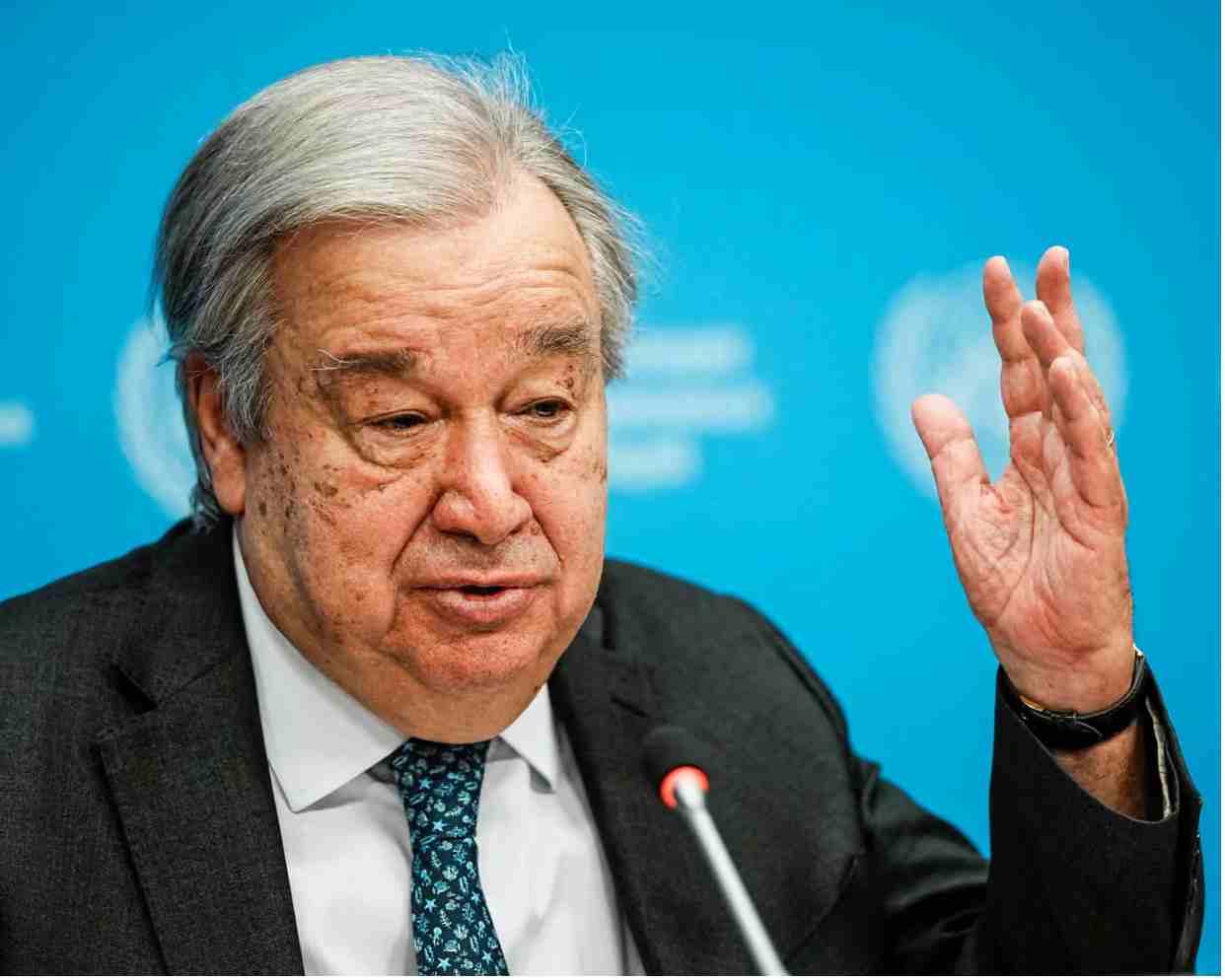
António Guterres, head of the UN, warns that global accounting systems must attribute true value to the environment
In a speech addressed to global leaders and policymakers, United Nations Secretary-General António Guterres called for a radical transformation in the way the global economy is run and accounted for.
After a meeting of economists organized by the UN, Guterres warned that the current system, which rewards pollution and waste, is leading the planet towards an environmental and social disaster.
The core of his criticism is the world’s obsession with the growth of the Gross Domestic Product (GDP), an indicator that, in his words, “shows us the cost of everything and the value of nothing”.
Guterres argued that while destructive practices such as deforestation and overfishing artificially increase GDP, the true environmental and human cost remains invisible in national accounts.
“We need to truly value the environment and go beyond gross domestic product as a measure of progress and human well-being,” he said.
For the secretary-general, this urgent review of “existing accounting systems” is a matter of future survival, requiring that financial decisions be based on something more substantial than a “momentary snapshot of profits and losses”.
This vision is shared and is being operationalized by a panel of renowned experts convened by Guterres, which includes Nobel laureate Joseph Stiglitz and economists Kaushik Basu and Nora Lustig.
The group, which met at a UN conference in Geneva titled “Beyond GDP”, is on a mission to develop a new set of indicators of economic success. The objective, as explained by Lustig, is not simply to replace GDP, but to complement it with metrics that assess whether development is in fact “improving human well-being, promoting equity and safeguarding sustainability”.
The initiative gains urgency in the face of a sequence of interconnected global crises. A report by the group, published late last year, highlighted how the “triple planetary crisis” — climate change, biodiversity loss and pollution — has been worsened by economic shocks, from the 2008 financial crisis to the Covid-19 pandemic.
Kaushik Basu warned that the nationalist fixation on GDP growth, often decoupled from the well-being of the majority of the population, only fuels “hypernationalism, inequality and polarization”.
Guterres’s call echoes and amplifies a growing debate in academic and political circles about economic alternatives. Currents of thought such as “doughnut economics”, which proposes a safe space for humanity between planetary limits and basic social needs, and “degrowth”, which defends a planned reduction of unnecessary production in rich countries, have been gaining strength.
Jason Hickel, a prominent degrowth advocate, supports the move beyond GDP but argues that deeper systemic change is needed.
“The dominance of GDP is not an accident. It occurs because GDP measures what is valuable to capital. It is the structure of capitalism that ultimately needs to be overcome.”
The timing of this reflection is crucial. The UN’s warning comes shortly after the publication of an independent report warning that current economic models are fundamentally flawed for ignoring the catastrophic impacts of climate change, which could lead to a global economic collapse.
The message is clear: the transition to a model that values human well-being and the health of the planet is no longer an ideological choice, but a practical imperative for global security and stability. Guterres’ call represents a direct challenge to the status quo, demanding that humanity redefine the real meaning of progress before it is too late.
With information from The Guardian on 02/09/2026
Source: https://www.ocafezinho.com/2026/02/09/economia-global-precisa-ir-alem-do-pib-para-evitar-desastre-planetario/