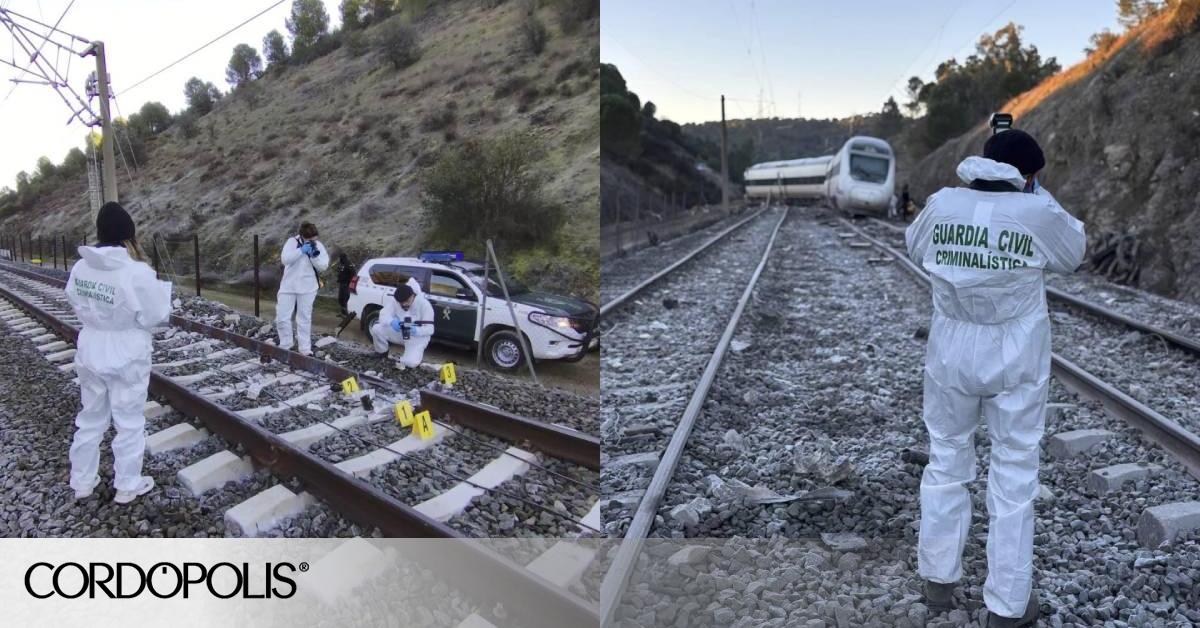
The first report from the Civil Guard on the investigation of the most serious high-speed accident in Spain, which on January 18 caused the death of 46 people and injured 155 in the municipality of Adamuz (Córdoba), keeps several hypotheses open: from the previous breakage of the track rail, to a failure in the welding without even ruling out “sabotage” or a “terrorist” action on the infrastructure.
The report 36/2026 directed by the Senior Staff of the Civil Guard in Córdoba, to which this newspaper has had exclusive access, was delivered at 10:00 in the morning of February 5 before the Investigative Court number two of Montoro, which is in charge of investigating the judicial case. The document is a summary of the investigation by the armed institute, in which all hypotheses are opened without ruling out any while waiting for the opening of the two black boxes of the accident trains, the Iryo from Malaga to Madrid and the Alvia from Madrid to Huelva, the arrival of all the requested documentation and the expert opinion of specialized technicians.
The report specifies that the accident occurred exactly at kilometer 318,693 of the Madrid-Seville high-speed line in the municipality of Adamuz, near the hill known as Majaharta. The exact time of the incident ranges from just four seconds. The accident, according to the Civil Guard, occurred between 19:43:37 and 19:43:41 on January 18. The Iryo was traveling towards Madrid when it partially derailed and invaded the opposite direction with its rear cars. The Alvia crossed paths with the Iryo at that moment, at an exact speed of 208 kilometers per hour.
All of these data, along with the identity of the victims, are the only accurate data in an incident that is still being investigated. They have been obtained thanks to Renfe’s technical records, provided by the Railway Accident Investigation Commission (CIAT). The security cameras of the Adamuz technical station have also been analyzed. The images do not show the collision or how it occurred, but they do give “indications” about the exact time at which it occurred.
All possible causes
The report insists that at the moment the hypotheses regarding “the cause or causes” that gave rise to the accident cannot be ruled out. But it does list each one of them and all the investigations that have been carried out to clarify them, in addition to the “measures pending resolution” to “confirm or rule out each one of them.”
The first of the hypotheses focuses on “a problem in railway infrastructure” with three derivatives: “a defective manufacturing rail or rail”, “a defective weld” or the “general state of the assembly”.
The Civil Guard identifies the rail that could have broken, marked with the Ensidesa inscription of the year 2023 and R350HT grade steel in the Madrid direction. The agents have asked Adif for all available data on the batches of rails used in the section of the accident.
Regarding the possible defective welding, the Civil Guard has carried out numerous procedures. The analysis focuses on the welding of the 2023 rail that joins another from 1989. The court has been asked for an analysis of four samples of the welding and even information to the CGT union for its complaints about the alleged non-compliance with the distances between welds executed in the section.
A general condition of the complex is also being reviewed. The agents are looking at the sleepers, the ballast, the rail, the clips and more welds of the entire section that Adif renewed.
The second hypothesis is that a previous train could lose a piece that in turn damaged the infrastructure. Data has been requested about the status of the trains that circulated in the area to see if any pieces have been lost or not. Documentation is being received.
The agents do not close although they seem to rule out human error as a cause. Toxicological analyzes have been carried out on the train drivers (the one on the Alvia died instantly) and statements have been taken from all the personnel who were with them. It is the hypothesis that loses the most strength.
The fourth hypothesis is that of “other causes” in which it refers to “sabotage” or “terrorist” action, a lack of prevention, another lack of maintenance or the use of inappropriate materials in the work.
As for sabotage, it is where the investigation has focused the most, with numerous requests for reports. The Civil Guard has requested laboratory reports on whether there is technical capacity to determine “the presence of mechanical traces” that indicate the “use of a cutting tool” or the presence of “explosive or corrosive substances.” The studies have not yet been carried out and we are waiting for them to be able to rule out this hypothesis.
Source: cordopolis.eldiario.es