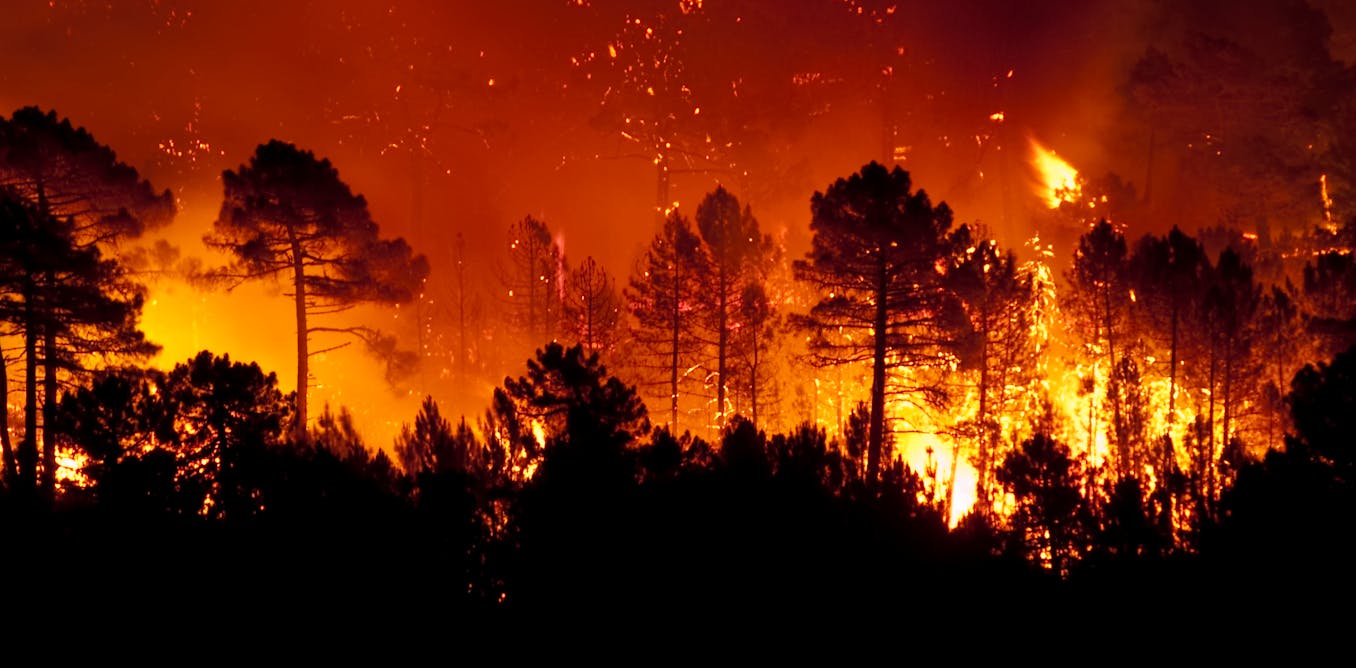
In Chile and Argentina, forest fires have become a reality where, year after year, thousands of hectares of native forest are burned or pine and eucalyptus monocultures are burned, affecting, in both cases, the communities surrounding the fire sources, often losing their homes, animals, sources of income, etc.
Climatic conditions that favor the spread of fires, such as heat waves, strong winds and prolonged droughts, are not an isolated phenomenon. However, the problem is not limited to the climate crisis alone; The economic model based on the uncontrolled exploitation of natural resources, such as forest plantations, has created the perfect scenario for these disasters.
The reality of Chile
For decades, the Chilean State has promoted a forestry model based on monocultures of pine and eucalyptus, highly flammable species that have displaced the native forest and transformed large territories into true sources of fire risk. This scheme, subsidized with public resources and functional to large forestry companies, has even advanced into areas close to urban areas, increasing the danger for entire communities. Instead of facing the structural causes of the problem, such as the regulation of the forestry model and greater financing for the prevention and fight of fires, the government has responded with repressive measures such as the curfew, blaming alleged intentional fires and avoiding questioning a productive model that deepens the socio-environmental crisis.
Testimonies from affected communities and analysis by experts show that, during the military dictatorship, forestry companies such as CMPC and Arauco, with the complicity of the regime, burned native forests and homes to expel the population and appropriate their territories, devastating ecosystems and the social fabric. This dispossession process allowed the expansion of monocultures of highly flammable exotic species, which today explain the increase in the frequency and intensity of forest fires in the central-southern area and Wallmapu, keeping communities at permanent risk.
The use of fire as a tool of dispossession made it possible to expel peasant and Mapuche communities from their territories and consolidate the forestry model for the benefit of large economic groups such as CMPC, from the Matte group, and Forestal Arauco, from the Angelini group. This power was built under the aegis of the civil-military dictatorship, which promoted the privatization of land, subsidized the expansion of monocultures with public resources and repressed all resistance, through frameworks such as Decree Law 701. Far from being accidental events, the fires were part of a structural policy of dispossession that the State has sustained in democracy, deepening an extractivist model that keeps rural communities and Mapuche territories exposed to permanent fires.
The reality of Argentina
In Argentina, provinces such as Neuquén, Chubut and Río Negro have been the scene of devastating fires, deepened by adjustment policies. In 2024, Javier Milei’s government subordinated the National Fire Management System to the Ministry of Security and cut the Environment and National Parks budget by more than 65%, affecting both fire fighting and prevention. This orientation is not exclusive to the ruling party: different political sectors accompanied the definancing to prioritize the payment of the external debt, while the provincial governments endorsed these cuts and promoted real estate businesses, even in the face of a drought scenario that increased the risk of fires.
The fires make way for the reconversion of land use and new businesses on devastated territories, such as real estate, forestry, tourism and extractive projects. In this context, the Forest Law appears as one of the few barriers against speculation, which is why the Government seeks to make it more flexible while maintaining firefighting underfunded. This policy is not accidental: the lack of resources and the precarious conditions of the brigade members contrast with military spending, showing that abandonment in the face of fire is functional to the economic interests that profit from the devastation.
Furthermore, there is an extreme relationship between forest fires and the forced displacement of Mapuche communities and popular sectors; they are part of a policy that frees up territories to hand them over to billionaires and large economic groups. Faced with this, it becomes urgent to demand all the necessary resources to fight the fire and guarantee the reconstruction of the affected families. The offensive against the Land Law, which limits the foreignization of rural land, aims to deepen the dispossession and delivery of strategic common goods such as lakes, aquifers and native forests, in a country where millions of hectares are already in the hands of foreign capital.
Forest fires are not isolated events, but the structural result of an economic model based on dispossession and capitalist accumulation. Faced with a tragedy that repeats itself year after year, the response must be radical: organization from below, unity of struggles and demand for political responsibilities. More subsidies or repressive measures are not useful, but dismantling the forestry business through the expropriation of the lands of large companies and their restitution to the communities. Only in this way is it possible to move towards territorial and environmental justice, putting life, nature and workers above profits.
Source: www.laizquierdadiario.com