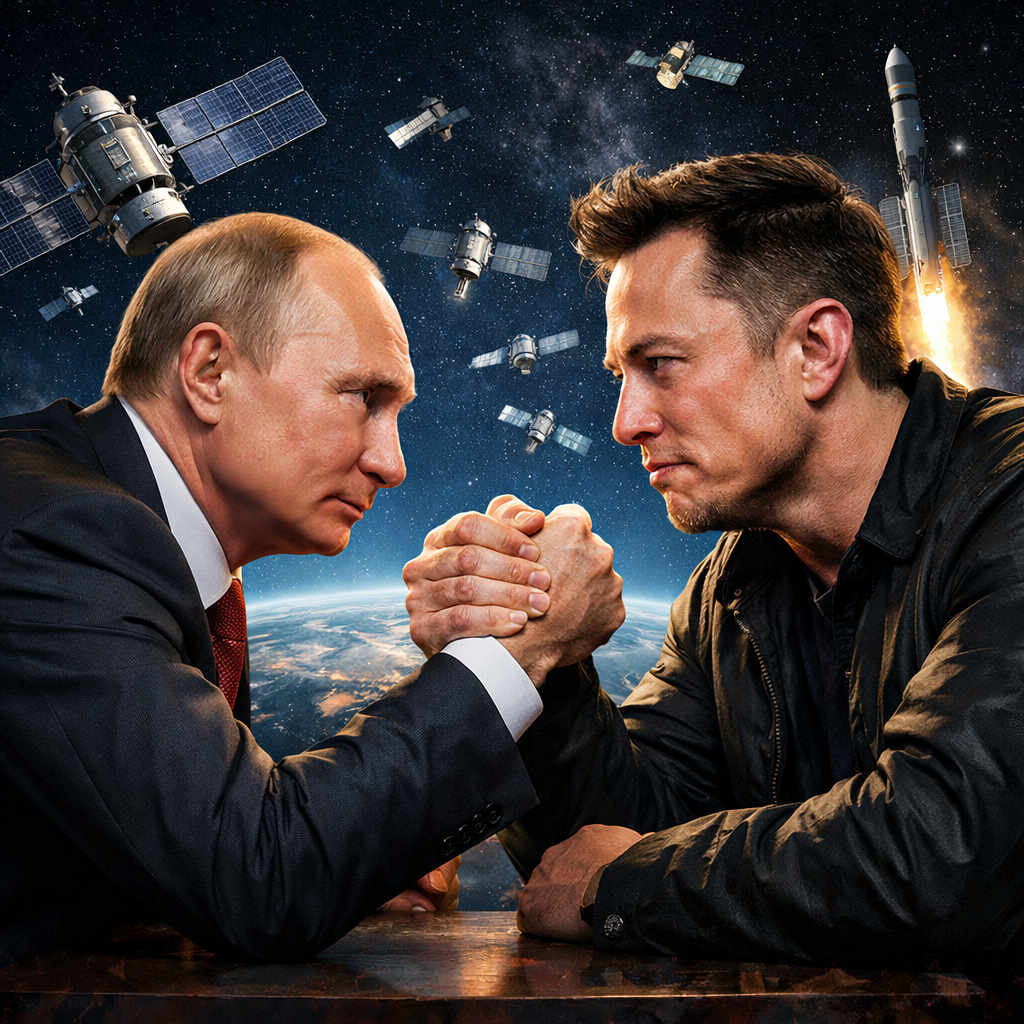
Russia took a strategic step in the space sector by launching 16 internet satellites in low orbitin a movement that has a declared objective: to compete for space with the Starlink network, from the company SpaceX, controlled by Elon Musk.
According to Reuters, the launch is part of a project led by Russian aerospace company Bureau 1440, which seeks to build a constellation of satellites capable of providing high-speed internet on a large scale.
“Russia launched 16 low-orbit satellites […] to build a rival to Starlink,” Reuters reported.
The project, known as Dawnis part of a broader strategy to guarantee technological sovereignty and reduce dependence on infrastructure controlled by Western companies. The Russian proposal envisages expansion to hundreds of satellites in the coming years, with potential for global coverage.
The initiative takes place in a scenario dominated by SpaceX. Starlink, created by Elon Musk, already has thousands of satellites in operation and has consolidated its presence in several countries. However, the Russian advance introduces a new pressure factor in this market.
The very conception of the Russian system makes direct confrontation clear. The project was structured as a national and competitive alternative to Starlink, with the ambition of competing not only for users, but also for strategic influence over global digital infrastructure.
This point is central. The dominance of satellite internet networks is no longer just a commercial issue and now involves sovereignty, military communication and data control. In this context, Russia’s entry into the sector represents a concrete threat to the hegemony built by Musk.
Furthermore, recent history reinforces this dispute. After episodes in which access to Starlink was restricted in conflict scenarios, Russian authorities began to treat the creation of their own system as a strategic priority, avoiding dependence on foreign companies for critical communication.
The launch of satellites, therefore, is not just a technological advance. It is a geopolitical movement that places Russia as a direct competitor to Elon Musk in space — and opens a new phase in the dispute for control of the global internet.
Source: https://www.ocafezinho.com/2026/03/24/saiba-como-a-russia-chamou-musk-para-a-briga-direta-pelo-controle-da-internet-mundial/