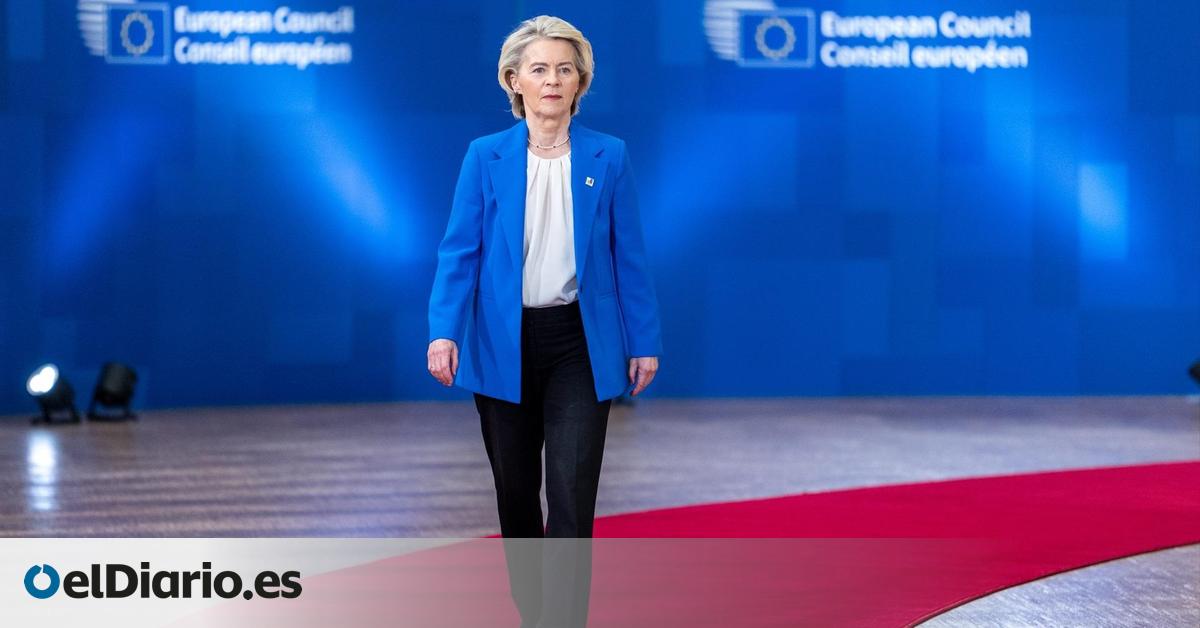
The European Union fails in its attempt to use the 180 billion euros of frozen Russian assets to finance Ukraine in its war with Russia. After more than 16 hours of negotiation this Thursday, the EU was unable to bend the arm of Belgium, a country that has vetoed the use of Russian immobilized assets that are deposited in the company Euroclear, based in Belgium. As a solution, the EU managed to close an agreement at 3 in the morning to lend 90 billion euros to Ukraine guaranteed by the community budget.
The day discovered how the new poles of power in the EU are being formed. Germany came out as the big loser of the summit, since both the president of the European Commission, Ursula Von der Leyen, and the German chancellor, Friedrich Merz, saw how their main projects fell apart: the approval of the Mercosur trade agreement was delayed and Russian immobilized assets were not going to be used to finance Ukraine. Meanwhile, the Prime Minister of Italy, Georgia Meloni, is the winner of the last European Council of the year, since she has been fundamental both for the delay in the ratification of the trade agreement, with the support of France, and for the winning option of the joint loan.
Belgian Prime Minister Bart De Wever came to the Council with the premise that Europe would face the “ultimate geopolitical embarrassment” if the leaders of the 27 failed to reach an agreement to finance Ukraine. De Wever repeated Belgium’s conditions for supporting the reparations loan: liquidity guarantees, protection against countermeasures and shared risks in the face of threats from Russia.
“The most realistic and practical solution”
But when De Wever put on the table that he would only give his approval with the “unlimited risk assumption” of the EU countries in the face of the threat of litigation and retaliation from Russia, a group of countries changed the course of the negotiation and decided that it was not viable to accept this proposal. In fact, along with Italy, which had been warning for weeks that the Russian assets proposal did not convince it, France has also taken a position against it. French President Emmanuel Macron assured that the joint EU loan for Ukraine is “the most realistic and practical solution.”
“Ukraine has won… Europe has won, and financial stability has certainly won. A solution has been found for Ukraine, which was the essential thing,” commented the Belgian prime minister.
Among the senior managers of the European institutions, there was consolation that the summit had been managed to close with a financial response for Ukraine, which urgently needs billions of euros in the first quarter of 2026 to defend itself against Russia.
“We have secured an agreement that we can meet Ukraine’s financing needs for the next two years. The Commission proposed two solutions; both legally sound and technically viable. Member States have decided to support EU borrowing in the capital markets… we will do so based on enhanced cooperation,” Von der Leyen explained.
The president of the European Commission added, in an attempt to make light of the defeat, that “the EU reserves the right to use Russian cash balances to finance the loan” to Ukraine. Merz also tried to convince journalists that the loan will ultimately be backed by frozen Russian assets, but the final agreed text of the summit only states that “these assets will remain frozen and the Union reserves the right to use them to repay the loan, in full compliance with EU and international law.”
Furthermore, in the 90 billion loan formula it has been allowed to reach unanimity in the agreement that “any mobilization of resources from the Union budget as collateral for this loan will not have an impact on the financial obligations of the Czech Republic, Hungary and Slovakia.” These three countries, with links to Russia, have already repeatedly positioned themselves against the use of EU funds to finance Ukraine against the Russians.
Meanwhile, Russia continues to pressure not to use its assets, which the EU approved to be frozen in perpetuity so that they can be used to pay for Ukraine’s reparations. Last Monday, the Russian Central Bank filed a lawsuit before the Moscow Arbitration Court against Euroclear for damages caused by the “direct or indirect” unauthorized use of the 180 billion euros in blocked assets. This Thursday, the Russian monetary authority announced a new round of lawsuits against European banks “for the blocking and illegal use of their assets.”
The threat of international lawsuits reaches European institutions. The central bank also said last week that it will challenge any unauthorized use of assets by the European Commission “in all available competent authorities, including national courts, judicial bodies of foreign states and international organisations”.
Zelensky: “It really strengthens our stability”
The Ukrainian president, Volodymyr Zelensky, thanked the EU leaders on social media this Friday for the agreement adopted the day before to finance Ukraine with an additional 90 billion euros over the next two years. “It is significant support that really reinforces our stability,” says Zelensky, who was present at the European Council meeting where the decision was made and tried unsuccessfully to convince Belgium to withdraw its opposition to the use of funds frozen to Russia.
“It is important that Russian assets are frozen and that Ukraine has received guarantees of financial security for the coming years,” also assures the Ukrainian president, who had said the day before that if the EU did not approve allocating Russian assets to kyiv, his country would have “a big problem” to continue financing its defense war against Russia.
Source: www.eldiario.es