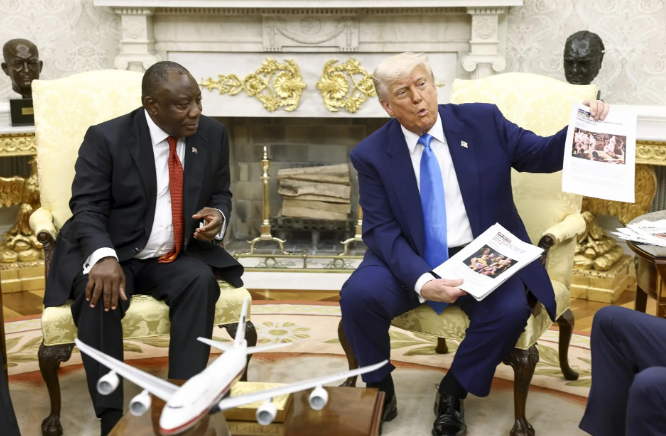
When justifying the veto, Trump revived allegations rejected by experts about the persecution of Afrikaners, expanding a conflict that mixes ideology, diplomacy and domestic politics
The relationship between the United States and South Africa, already marked by increasing tension throughout the year, entered a new and dramatic chapter after US President Donald Trump announced that Pretoria is officially banned from participating in the 2026 G20 summit, scheduled to take place at his golf club in Miami, Florida. The decision, revealed by Trump on his social networks, provoked a strong reaction from the South African government, which classified the measure as punitive, disrespectful and fueled by disinformation.
South Africa reacts to measure considered insulting
The South African presidency stated that it received Trump’s announcement with indignation. According to Cyril Ramaphosa’s government, American conduct during this year’s summit — organized in Johannesburg, the first held on the African continent — had already been “unusual and unfriendly”. Washington chose to boycott the meeting, claiming that white Afrikaner farmers were being violently persecuted in the country, a narrative rejected by Pretoria as unfounded and distorted.
The absence of the US at the meeting led to a delicate diplomatic episode: the G20 flag transfer ceremony, traditionally held at the end of each edition, had to take place discreetly at the South African Ministry of Foreign Affairs, as the American delegation simply did not attend. Trump, however, accused South Africa of refusing to hand over the flag to the US embassy representative.
Faced with the repercussions, the Ramaphosa government declared that it took note of Trump’s “regrettable statement” and again rejected the accusations of persecution of white farmers. In a statement, he reinforced that the American president continues to make decisions “based on misinformation and distortions about our country”.
Trump turns the G20 summit into a stage for political dispute
The announcement of South Africa’s exclusion comes just as the US assumes the rotating presidency of the G20. Trump declared on Truth Social that Pretoria “is not worthy of membership in any organization” and ordered the immediate suspension of all payments and subsidies destined for the African country.
The measure represents yet another aggressive gesture by Washington against a historic partner, in a move that analysts have seen as part of the Trump administration’s ideological shift since its return to the White House. The 2026 summit, which will be held at his golf club in Doral, Florida, has been treated by the president almost as a personal event, reinforcing the politicization of a forum created to promote international cooperation.
Boycott, climate and development: the backdrop of friction
The diplomatic crisis is not limited to protocol disputes. The White House openly opposed South Africa’s emphasis on issues affecting developing nations — including combating climate change — in the Johannesburg summit’s final declaration, which the US refused to sign.
Pretoria, in turn, sees American behavior as an attempt to weaken the Global South agenda at a time when emerging countries are seeking a greater voice in multilateral forums.
Accusations about Afrikaners reignite historical wounds
Trump has insisted on the narrative that white Afrikaner farmers are being murdered and having their land confiscated in South Africa. Experts, international organizations and even representatives of the Afrikaner community themselves reject this version, classifying it as disinformation.
The group, descended from European colonizers — mainly Dutch, French and German — was a pillar of the apartheid system, a white supremacist regime that was in force until 1994. Today, around 2.7 million Afrikaners live in a country of 62 million inhabitants, with different realities and political positions. Many even opposed apartheid.
Even so, Trump has used the issue to justify controversial measures. Last month, it announced that it will reduce the annual number of refugees accepted by the US to 7,500, reserving most places for white South Africans. In May, the government took in a group of 59 Afrikaners as refugees, after saying they were under threat in their home country.
Tensions fueled by new American foreign policy
Since his return to power, Trump has portrayed South Africa as an “anti-American” country, especially due to its diplomatic ties with China, Russia and Iran. The rhetoric has served as fuel for decisions that have isolated Pretoria and deteriorated a relationship that was once strategic.
South Africa’s exclusion from the next G20 summit could have unpredictable consequences — both for the bloc and for the political balance between developed and emerging countries. For many diplomats, the episode signals a worrying scenario: the world’s largest economy appears to be using the G20 presidency not to strengthen global cooperation, but to deepen ideological disputes.
Meanwhile, South Africa is trying to maintain its position on the international stage, remembering that, despite the pressure, it will continue to defend its role in the group and the development agenda that it considers essential for the future of the planet.
With information from SCMP*
Source: https://www.ocafezinho.com/2025/11/27/crise-se-agrava-apos-trump-excluir-africa-do-sul-do-g20/