For the first time under the Milei government, the Chamber of Deputies met with a general strike in rejection of the labor reform that was being voted on. It was the distinctive feature of the day that began with pickets in various parts of the country, and continued throughout the day with demonstrations in front of Congress.
Thus, a massive rejection of the labor reform was expressed in the streets, and in Congress the government had a tortuous path of negotiations. He had to eliminate an article – that of sick leave – and risk time by returning to the Senate for its final sanction. Until the last moment he maintained negotiations with the governors who provided him with help. He had to put together an engineering of supports to take each step: the quorum for some, voting in general for others, in particular others.
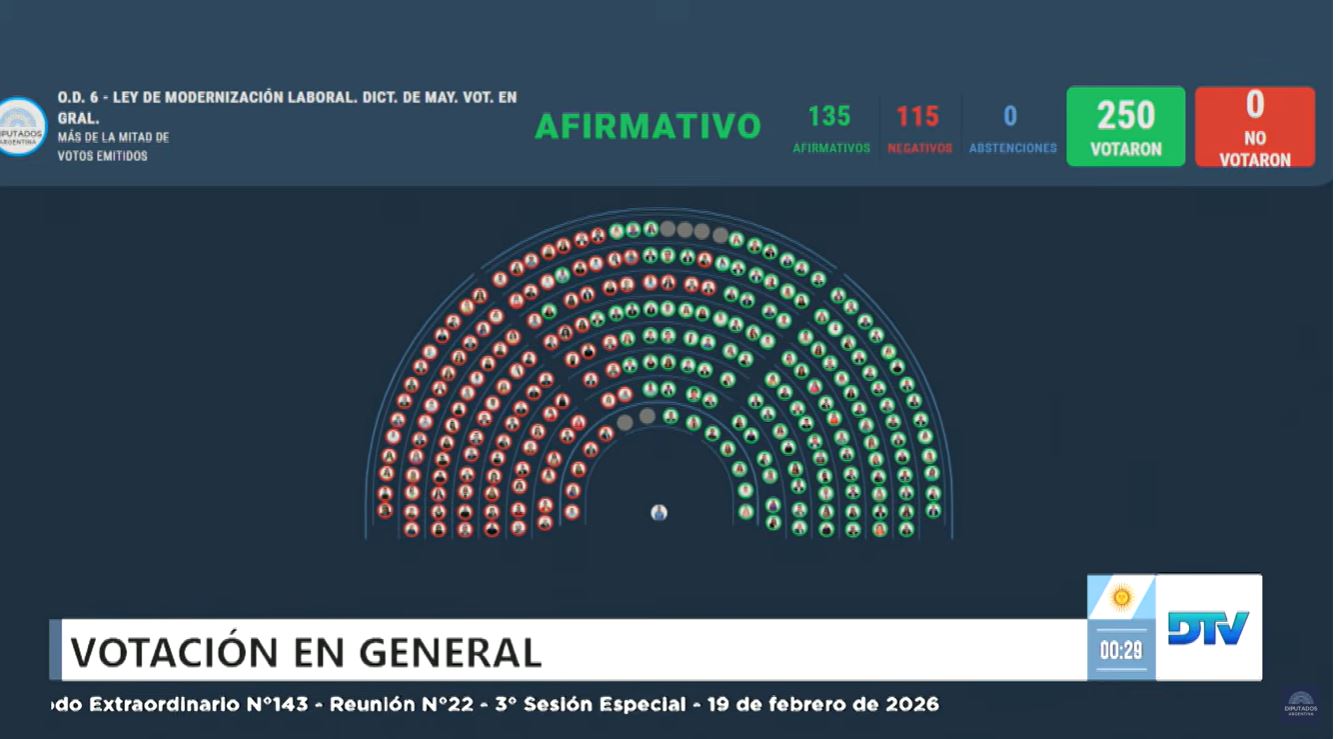
In the general vote, among the affirmative were Freedom Advances which contributed 94, and was joined by the former Together for Change of the PRO (12), UCR (6) and Banfi (1) and MID from Zago (2). Was 6 of United Provinces who also scored positive as those from Santa Fe (Sacaglia and Nuñez), two people from Cordoba from the PJ of Llaryora (Basualdo, Gutierrez), Capozzi (Rio Negro) and the Jujueño from the UCR Jorge Rizzotti who responds to Governor Sadir.
Of the Peronist governors the two were decisive Tucumán by Osvaldo Jaldoformer members of Unión por la Patria (Medina and Fernández). The third member of the block, Javier Noguera, after collaborating with the quorum, withdrew and was absent at the time of the vote.
He made his contribution Gustavo Sánez, governor of Saltawith its 3 deputies (Vega, Biella, Outes); and Governor Passalacqua’s missionaries (Arrua, Herrera, Ruiz, Vancsik) who make up Federal Innovation. Gerardo González, a former libertarian, also voted in favor of this bloc.
Complete the list of allies of the thousands in their crusade against the workers the governor of Santa Cruz, Claudio Vidalwho ordered his deputy (Garrido) to accompany despite his union extraction. Also his pair San Juan, Marcelo Orregoand finally the support of the governor of Neuquén, Rolando Figueroa (Maureria).
Against labor reform were Union for the Homelandthe complete bench of the Left Front (Bregmsan, Del Caño, Del Plá and Pitrola), Civic Coalition (2), 9 United Provinces (Juliano, Lousteau, Coletta, Avila, Paulón, Farías, Arrieta, Zigarán), Natalia de la Sota from Córdoba, Miguel Angel Pichetto and Nicolás Massot, Marcela Pagano, Álvarez and Fernández from Puntanos.
Los 3 Catamarcans of Governor Jalil’s PJin the general vote they opted for rejection despite having been key to enabling the session by providing a quorum. Without them the session would not begin.
Once again the image was that of a Congress armored and repressedmeeting and voting against the people. The thing is that Javier Milei’s government could only move forward with the approval of the labor reform in both chambers, preventing an open debate towards the population, in extraordinary sessions, and with an express procedure so that its content and implications are not known. Only in the days after the half-sanction in the Senate did the rejection and anger grow in less than a week. Mileism knew that it had to step on the accelerator and treat her in the most complete secrecy. The only defenders they got to defend the initiative were from business chambers.
Concealment was not the only condition for this result: collaborationists were central. In such a broad law with 218 articles, different sectors were predisposed to negotiate “theirs.” One was the leadership of the CGTwho maintained a direct line with Patricia Bullrich without stirring the hornet’s nest, allowing time to pass in Milei’s favor. She was so badly off that she was forced to call a general strike. Others were the governors. In the hallways, there were deputies who detailed how the Executive Branch improved the offer to, for example, settle debts from the provincial pension funds (especially in the case of Córdoba and Santa Fe). In this way the government managed to “convince” some of the doubters with the Work Assistance Fund.
Finally in the vote in particular The government managed to maintain all the titles, even those that seemed tighter like the Labor Assistance Fund (FAL) and the one who repealed professional statutes such as that of the journalist. In the FAL title they had 130 in favor, 117 against and 3 abstentions. In title XVI, which attacks the freedom of expression of journalism and the financing of INCAA, the vote was the closest of all: 126 in favor, 119 against and 4 abstentions.
What is already certain is that it will have to return to the Senate to accept or reject the change to article 44, which was eliminated and does not change sick leave. Patricia Bullrich went ahead and called before the Deputies meet, the commissions that must rule again on the text. It is part of the ruling party’s reckless treatment. Time is short and the final sanction could only arrive on February 27 with the session in the Senate. One day before the extraordinary ones end. Two days before Javier Milei gives his opening speech of the legislative year in Congress and can celebrate the labor reform and the juvenile penal regime.
There remains a more immediate fight on February 27 with the Senate session. Once it is definitively sanctioned, another stage will begin, the dispute over its application.
Labor reform in Deputies, a general vote was 135 in favor and 115 against. There is a thread with the particular vote and what is voted on in each Title👇
— Jesica Calcagno (@Jesi_mc) February 20, 2026
Source: www.laizquierdadiario.com