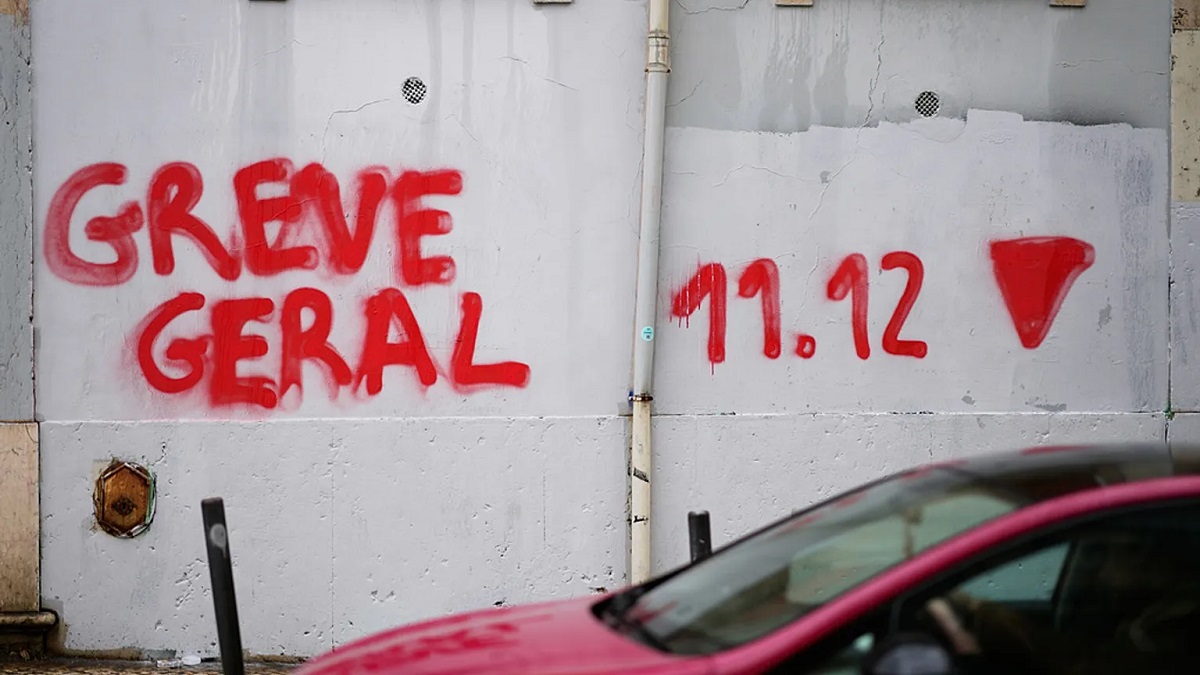
Portugal joins the dynamic of class struggle that is beginning to appear in Europe, whose vanguard or epicenter we could say is Italy. A fundamental, strategic actor with revolutionary potential, is once again raising its head (after years of blows from neoliberalism – today in crisis -), in many cases forcing the bureaucratized leadership of the unions from below to call for fighting measures.
December 11 strike
It is already anticipated that this general strike will be felt in transportation, health and education and starting this Wednesday night there will be pickets with the double objective of making the demands visible and helping the strike to expand.
The intention of the government of Prime Minister Luís Montenegro, belonging to the center-right Social Democracy and leading the conservative government coalition of the Social Democratic Party -PSD- and Social Democratic Center Party -CDS-, is to get parliament to approve the modification of 100 articles of the current Labor Code. A labor reform that the Portuguese Government presents as something that will make it possible, thanks to greater flexibility, to hire workers. But the reality, if this change is approved, will facilitate layoffs, promote temporary work and weaken acquired rights. In addition to reinstating the “individual hour bank”, which would allow the working day to be extended up to 50 hours per week with a maximum of 150 overtime hours per year, without additional payment. On the other hand, it restricts union organization in workplaces where there are still no delegates.
That is why the General Confederation of Portuguese Workers (CGTP, led by the Communist Party) and the General Union of Workers (UGTP, with great influence from the Socialist Party), had to come out to announce these forceful measures, in addition to mobilizations in cities such as Lisbon, Porto, Braga, Coimbra, Évora and others.
The international media refers to the last general strike called by both centers, 12 years ago, when what was known as “the troika”, the European Commission, the European Central Bank and the IMF in 2012 gave a million-dollar loan to that country, to “save it” from the economic crisis in which it was mired (a crisis that had as its “mark of origin” the economic crisis of capitalism of 2008), but which in reality was a rescue that, as always, was accompanied by greater submission from Portugal, more adjustment and flexibility for working people. Now the government of Montenegro intends to double down. One of the first responses from workers and youth will be felt this Thursday the 11th.
Tiago Oliveira, Secretary General of the CGTP, regarding this labor reform and the reference to the “troika” policy in 2012: “Who was in the Government in 2012? They are exactly the same protagonists who today promote this review of labor legislation. The argument changes, but the objective is the same. In 2012 they used the pretext of the troika to cut rights. Today, in full employment and with an economy that the Government itself says is growing, they use the discourse of productivity and modernization. To do what? Exactly the same: remove rights, increase precariousness, deregulate the working day labor, attack the right to strike and facilitate dismissals.
Some public services, such as schools and waste collection, have planned 2 days of strike – until Friday the 12th. That day the Democratic Union of Nurses of Portugal also calls for a strike, also against the labor reform and for its collective labor agreement, for its part the central, regional and local Public Administration will also stop on Friday the 12th.
The key to this fight that begins against a completely reactionary labor reform is unity from below, that large sectors of the working class, youth and women can impose on the union centers to hit all together as a single fist until these policies of the right-wing government of Portugal are defeated.
This Thursday the 11th is the first warning that they are moving.
Source: www.laizquierdadiario.com