Polls and experts predict victory for the ultra-right candidate, José Antonio Kast. However, last-minute errors and poor participation in the debate could give new impetus to leftist Jeannette Jara.
One day before the second round of the presidential elections in Chile, the polls – whose publication is prohibited on the eve of the election, but which are commented on behind the scenes – indicated a clear advantage for the ultra-right candidate José Kast over the communist and former minister Jeannette Jara, supported by the current president, Gabriel Boric.
If favoritism is confirmed, Kast, 59 years old, is expected to become the most right-wing leader in the country since the end of Augusto Pinochet’s regime (1973-1990), after a campaign strongly marked by the themes of public security and immigration.
His victory would mark the country’s biggest political shift in decades and add to a growing wave of right-wing governments in Latin America, as outrage generated by issues such as crime and immigration have replaced demands for greater equality and become central issues for many voters.
In the first round, on November 16, Jara and Kast obtained around a quarter of the votes each, with a slight advantage for the leftist. But, as the third, fourth and fifth placed candidates were also right-wing, votes are expected to flow to Kast, which would give him the 50% needed to guarantee victory.
“Window of opportunity” for the left?
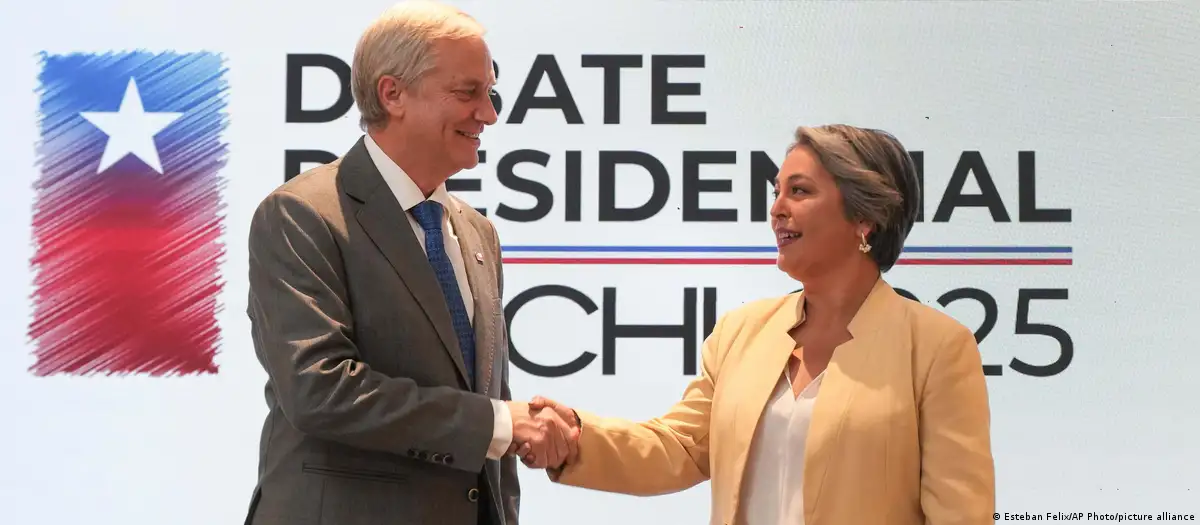
Analysts agree that his victory is all but certain, although recent mistakes in his campaign and his poor performance in the December 3 debate have added some tension — among the errors are a statement by a member of his party in favor of pardons for child rapists and Kast’s inability to explain his plan to expel foreigners.
Some observers do not rule out that, in a race that seems practically decided, a small window of opportunity for last-minute surprises may still open.
Contrary to what one might think – given that the second round features a woman affiliated with the Communist Party and a man who founded the far-right Republican Party – the second round, on December 14, will not be a battle between extremist positions. Although centrist candidates were resoundingly defeated in the primaries and in the first round, centrists still retain some power and certainly have a lot to say.
Jara came out ahead in the first round, but total votes from the right could defeat her in the second round | Rodrigo Arangua/AFP
“The perception is that both candidates tend to move towards the center,” Olaf Jacob, Chilean representative of the Konrad Adenauer Foundation, linked to the conservative German Christian Democratic Union (CDU) party, to which Federal Chancellor Friedrich Merz belongs, told DW. “I think there will be no alternative. Whoever wins will have to moderate their position, because the composition of Parliament does not allow very radical positions”, said the expert. For him, the question that arises is whether this movement towards the center is genuine or whether it is more related to circumstantial electoral needs.
“Kast’s victory would be disruptive”
“The polarizing tension is directed towards the extreme right,” Jorge Saavedra, professor at Diego Portales University and PhD in Communication and Media from the University of London, explained to DW. According to the expert, a victory for Jara would mean, in practice, the continuity of the current social-democratic government led by President Gabriel Boric. “A victory for Kast would indeed be disruptive, it represents a very extreme path in several areas.”
Saavedra cites as an example the idea that Kast has been promoting in his campaign, of an “emergency government”. In his statements, the candidate often refers to a crisis that the South American country would experience, which he attributes directly to the current center-left government.
This scenario would require the formation of an executive branch that can respond to this “emergency”, with a focus on normalizing the functioning of the State and combating crime and lack of growth. “That’s their offer. They don’t have a proposal for the post-emergency phase. That’s not surprising considering their references: [presidente da Hungria] Viktor Orbán, [presidente dos EUA] Donald Trump, [presidente de El Salvador] This book [ex-presidente do Brasil] Jair Bolsonaro.”
Security and immigration
In any case, for Saavedra, the possibility of total polarization disappears in the face of the containment wall offered by a fragmented but moderate Parliament. “The new Parliament will not be so different from the one President Boric had, and certainly in its final decisions it will not act from a stance of media stridency, but rather as a kind of moderator of the debate. No one will be able to implement very extreme measures, no matter how much they wish,” said the academic.
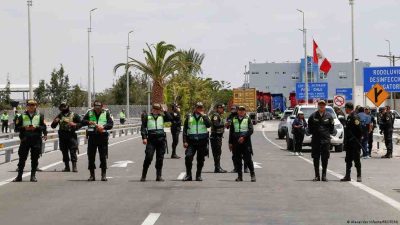 For many Chileans, one of the country’s biggest problems is immigration associated with crime | Alexander Infante/Reuters
Two topics that practically monopolized conversations during the presidential campaign were immigration and insecurity. Despite being one of the countries with the lowest crime rates in the Americas, public perception in Chile points to a kind of crisis that, in the first round, provided fertile ground for proposals such as the militarization of cities or the construction of prisons in the desert, and for phrases such as “criminals will have to choose between jail and the cemetery”, uttered by candidate Evelyn Matthei in the first round of the elections.
“There is a perception that insecurity is associated with immigration”, says Jacob, for whom the winning candidate will have to act quickly. “If we manage to control or reduce the perception of insecurity among the population in the short term, I believe that many problems will be solved”, says the representative of the Konrad Adenauer Foundation.
“Something extraordinary had to happen”
Jacob uses a calculator to answer whether Kast’s victory in the second round would really be guaranteed, as predicted by research, experts and even everyday conversations. “If we only count the votes from the right in the first round, we already have more than 50%”, he argues. According to the expert, Jara’s objective would be to lose by less than 20 percentage points.
“The chances are small. Very small, in fact,” adds Saavedra. “What Jara will do is close the gap by a few points, but she won’t win. Maybe with two more weeks of campaigning she could do it, because Kast made significant and unforced errors in the last few days, but something extraordinary would have to happen for the Republican not to win”, he adds.
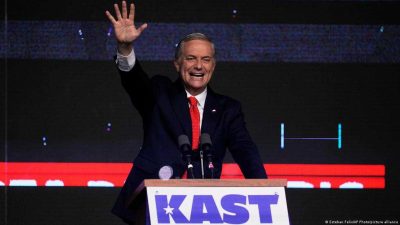 If elected, Kast is expected to become Chile’s most conservative leader since the military dictatorship | Esteban Felix/AP Photo/picture alliance
The academic points to another factor that played a very relevant role: the fact that Jara was a member of the Communist Party. “This awakens perceptions related to the neoliberal formation of ordinary Chileans, this idea that I work, I earn my money and I don’t want to give it to anyone. People confuse the possibility of a communist president with redistribution and don’t see it from the perspective of social rights”, he observed. He predicts Kast will be in trouble if he wins.
“I think he will have a very difficult first semester facing opposition,” he said. “What he has done so far is not to show himself as the hard-line supporter of Pinochet that he is, and when he wins this will be evident; there will be regressive measures in many areas, and this will generate a very quick reaction in different sectors.”
Kast’s trajectory
The 59-year-old lawyer and third-time presidential candidate lost the second round of the 2021 elections to Boric. Founder of the far-right Republican Party, Kast has put immigration and security at the top of his agenda, with proposals to mass deport illegal immigrants and build maximum security prisons.
Son of a lieutenant in the German Army who went to South America after the Second World War, his father’s affiliation with the Nazi Party hurt him in the last election, as did the fact that his brother served as minister during the dictatorship of General Augusto Pinochet.
Originally published by DW on 12/13/2025
Source: https://www.ocafezinho.com/2025/12/13/chile-podera-ter-governo-mais-a-direita-desde-a-era-pinochet/