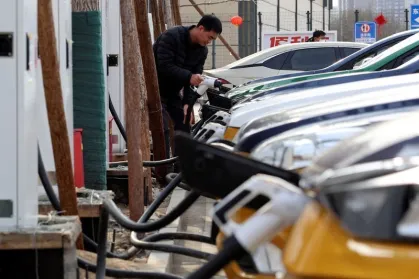
Sector faces headwinds with decline in the US, cooling in China and easing of rules in Europe
After a decade marked by dizzying growth, the global electric vehicle market will enter 2026 at its slowest pace since 2020. According to projections from specialized consultancy Benchmark Mineral Intelligence, global sales are expected to rise just 13% this year, reaching 24 million units. This number represents a significant slowdown compared to the 22% increase recorded in 2025.
This change in speed does not happen by chance. For the first time, three of the sector’s main pillars — the United States, Europe and China — show signs of exhaustion in the initial momentum of the energy transition in transport. As Beijing gradually reduces its subsidies, Washington reverses stimulus policies and Brussels eases its decarbonization schedule. The result? A scenario of uncertainty that forces automakers to rethink strategies.
US brakes, Europe hesitates and China slows down
In the United States, the reversal is the most drastic. Electric car sales are expected to fall 29% in 2026, reaching just 1.1 million units — well below the record 1.5 million reached in 2025. The main cause is linked to politics: with the Trump administration eliminating tax incentives for electric cars, American consumer enthusiasm quickly cooled.
Read also: Profit, politics and oil hold back the energy transition
In Europe, the picture is different, but equally challenging. Although sales are still growing — 14%, to 4.9 million units — the pace is less than half that observed in 2025, when the market advanced 33%. The European Union’s decision to ease the ban on gasoline cars from 2035 removed the regulatory pressure that was accelerating the change in behavior of automakers and consumers.
In China, the world’s largest market for electric vehicles, growth continues, but is losing momentum. Benchmark projects 15.5 million units sold in 2026, compared to 13.3 million in 2025. However, this is far from the exponential leaps of recent years, when sales went from 1.1 million in 2020 to more than 13 million in just five years.
The rise of BYD and the fall of Tesla
A symbolic milestone in this new phase came this week: data confirms that Chinese BYD overtook Tesla as the world’s largest electric vehicle manufacturer in 2025. The achievement is largely due to the company’s aggressive pricing strategy and international expansion, which brought affordable models to Europe and other emerging markets.
This Chinese offensive has put pressure on traditional automakers, forcing them to rethink not only their prices, but also their own electrification schedules. Meanwhile, the deficient charging infrastructure in several regions of the world continued to keep consumers away from 100% electric vehicles — and making room for an intermediate alternative: hybrids.
Hybrids gain space as a “bridge” for the transition
Faced with difficulties, automakers are beginning to prioritize transition solutions. “Both markets (in the US and Europe) are realizing that partial electrification is as interesting as full electrification,” said Jim Farley, CEO of Ford.
Ford itself illustrates this change of direction. Last month, the company announced a write-down of US$19.5 billion after canceling several electrical projects, including the F-150 Lightning pickup truck, its flagship in this segment. Now, the automaker is redirecting investments to hybrids and combustion vehicles, considered more profitable in the short term.
Farley estimates that the share of electric cars in the American new car market could fall from 10% in 2025 to just 5% in the coming months — a decline that reflects both the lack of incentives and consumer caution.
China bets on stimulus to maintain momentum
Unlike the US, China is still working to keep the flame of electric mobility alive. Although it has gradually reduced subsidies in recent years, Beijing recently renewed its vehicle exchange incentive policy for another year — now focusing on direct discounts on the purchase of electric vehicles.
Furthermore, local governments continue to invest in charging infrastructure, one of the main bottlenecks that discourage the adoption of fully electric cars. UBS projects 8% growth in Chinese sales in 2026, considering both pure electrics and plug-in hybrids.
This pragmatic approach—supporting the transition without imposing abrupt disruptions—could serve as a model for other regions trying to balance environmental goals, economic viability and consumer acceptance.
The future is still electric — but the path will be longer
Despite the challenges, industry executives remain convinced that electrification is inevitable. “We are convinced that the future is electric. We need to decarbonize mobility”, said Markus Haupt, executive director of Seat-Cupra, a Volkswagen group brand aimed at the mass market.
However, the message is clear: the transition will not be linear. Automakers now need to adapt their product lines more flexibly, invest in hybrid technologies and wait for public policies, infrastructure and consumer confidence to mature together.
Meanwhile, the sector leaves behind the illusion of an instant turnaround and enters a new phase — more realistic, more complex and, above all, more human.
Source: https://www.ocafezinho.com/2026/01/08/capitalismo-ameaca-futuro-da-mobilidade-sustentavel/