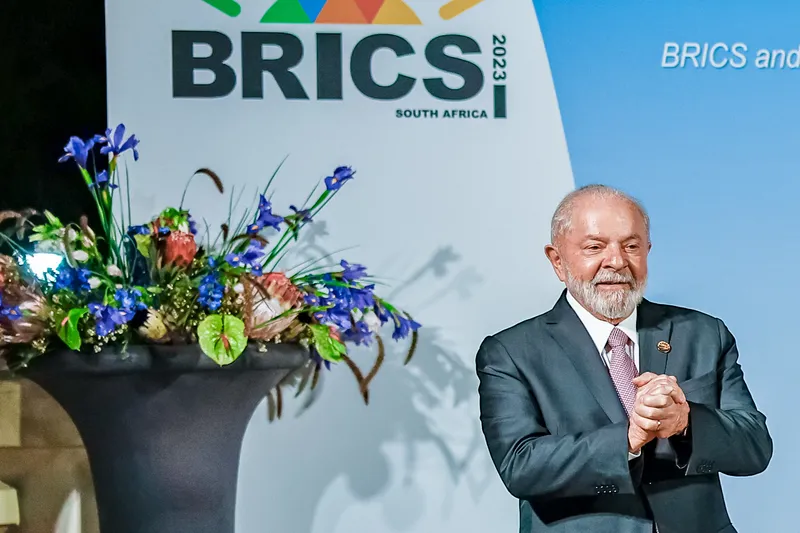
The debate on reducing dependence on the dollar in international trade gained new momentum within the BRICS, a bloc that brings together Brazil, China, Russia, India, South Africa and recently incorporated countries. The discussions involve proposals for alternative payment systems, criticism of the petrodollar model and analyzes of the role of gold, the yuan and technologies such as blockchain, in a context of falling participation of the US currency in global reserves.
The assessments were presented by journalist Pepe Escobar in an article published on the Brasil 247 portal, in which he analyzes the current international financial scenario as a structural movement that challenges the hegemony of the dollar. According to the author, the process is not limited to technical adjustments, but reflects ongoing geopolitical and economic changes, driven by tensions between great powers and the use of financial instruments as a tool of political pressure.
According to Escobar, the petrodollar constitutes one of the central pillars of the economic order led by the United States since the post-Second World War. In this model, international energy trade is mostly priced in dollars, which supports global demand for the currency and US Treasury bonds, allowing the maintenance of high deficits. According to the writer, attempts to break this circuit have historically resulted in sanctions, asset freezing or exclusion from dominant payment systems.
According to the journalist, this arrangement currently faces increasing limitations. The combination of high military spending and the need to maintain control of the international financial system imposes costs that are increasingly difficult to sustain. Escobar cites proposed trillion-dollar defense budgets in the United States as an example of the pressure exerted on the system’s own stability.
A turning point cited in the article is the freezing of Russian reserves abroad after the start of the war in Ukraine. For Escobar, Russia’s exclusion from the SWIFT system demonstrated to several countries that dollar-denominated reserves could become vulnerable in scenarios of geopolitical tension. The reaction, he said, included increased gold purchases by central banks, the expansion of bilateral agreements in local currencies and growing interest in alternative payment systems.
In the text, the journalist states that the objective of these initiatives would not be to abruptly replace the current order, but to create parallel paths capable of reducing risks. In this context, BRICS appears as a space for coordinating these proposals, especially between countries in the so-called Global South. Escobar describes the bloc as a “laboratory” of financial tests, in which different models are evaluated to enable international trade without the intermediation of the dollar.
Among the proposals mentioned is the creation of a non-sovereign, blockchain-based unit of account known as the Unit. According to Escobar, the instrument would not have the character of a traditional currency, but would function as a commercial settlement mechanism, inspired by models such as the Special Drawing Rights of the International Monetary Fund, but restricted to the BRICS ecosystem. The Unit could be backed by a basket of commodities or currencies, with the aim of reducing the influence of a single country.
The article also mentions mBridge, a digital currency project shared between central banks, led by Asian institutions, which would have inspired the so-called BRICS Bridge. According to the analysis, the objective is to allow direct transactions between national currencies, without the need for prior conversion into dollars. Another axis mentioned is BRICS Pay, described as a payments infrastructure initially aimed at lower value transactions, such as tourism and everyday operations, although there are still challenges in its application in large financial volumes.
Escobar argues that the current context favors these initiatives. According to him, the dollar’s share of global foreign exchange reserves would have fallen to less than 40%, the lowest level in at least two decades. Gold, according to the analysis, would have outperformed currencies such as the euro, yen and pound sterling when considered together. For the journalist, these data reinforce the perception that the international financial system has lost neutrality and is now seen as an instrument of political pressure.
The text also uses the analyzes of economist Michael Hudson, who defends the expansion of the use of the yuan and the Chinese international payments system, the CIPS, as paths of least resistance. According to Escobar, CIPS already operates in more than a hundred countries, which gives it practical reach. Hudson, however, assesses that a new international institution, inspired by Bancor proposed by John Maynard Keynes in 1944, could offer greater balance in the long term.
Another proposal cited is that of Brazilian economist Paulo Nogueira Batista Jr., former vice-president of the Novo Banco de Desenvolvimento. According to Escobar, Batista Jr. defends the creation of a new international currency restricted to external transactions, backed by a weighted basket of currencies from participating countries, with weights defined by GDP in purchasing power parity. The author notes that the weight of the Chinese economy would be decisive for the credibility of the arrangement.
Finally, Escobar highlights that the defenders of these alternatives themselves recognize the risk of retaliation from the West, including sanctions and diplomatic pressure. Still, according to the journalist, the cost of not acting tends to increase as the current financial order becomes more unstable. The BRICS, the text concludes, arrives at the next annual summits facing a scenario that could represent an inflection in the international financial system, depending on the capacity for political and economic coordination among its members.
Source: https://www.ocafezinho.com/2026/01/18/brics-testa-moeda-lastreada-em-ouro-fora-do-swift-e-que-ameaca-hegemonia-do-dolar/