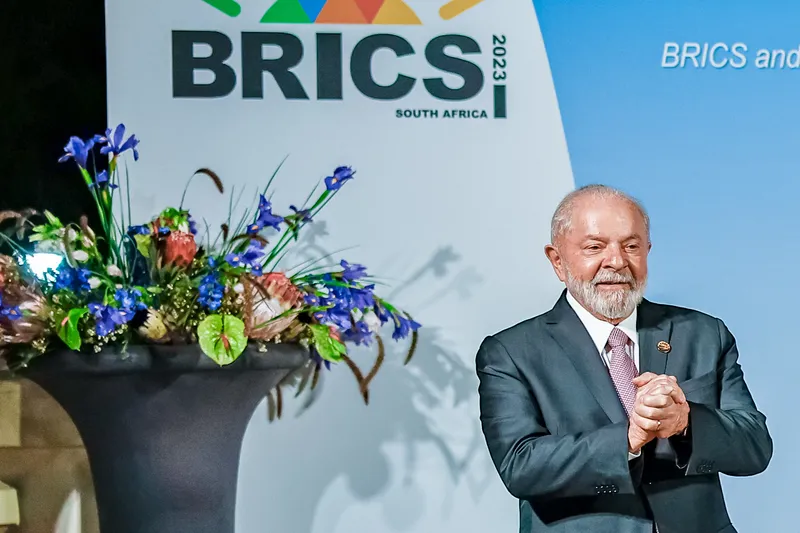
The countries that make up the BRICS economic bloc have advanced in implementing their own international payments system. Named BRICS Pay, the digital platform was developed within the scope of the group’s Business Council and promises to function as a type of “international Pix”, allowing quick transactions between member countries without the need for intermediation through traditional networks dominated by currencies such as the dollar.
The BRICS Pay application is now available for download from the Google Play store and can be used by individuals on tourist or business trips, as well as companies that carry out commercial transactions between the bloc’s countries. The proposal is to simplify cross-border payments, with direct settlement in local currencies.
Decentralized platform and focus on local currencies
According to the BRICS Business Council, the system was designed based on principles of interoperability, financial sovereignty and inclusion. The platform connects national payment systems and financial institutions from the so-called BRICS+ countries, which brings together Brazil, Russia, India, China and South Africa, as well as new members such as Egypt, United Arab Emirates, Ethiopia, Iran and Indonesia.
The technology used is based on blockchain, with a declared capacity to process up to 20 thousand transactions per second. The decentralized architecture seeks to allow direct payments between users and companies, without depending on a single international network.
The main innovation is the possibility of carrying out commercial transactions in local currencies, such as real, yuan and rupee, avoiding the mandatory conversion to the dollar. The objective is to reduce exchange costs, expand the financial autonomy of the bloc’s countries and strengthen internal trade.
Despite this, the creation of a single currency for the group still faces technical and political obstacles, and is not part of the current stage of the project.
Brazilian reference
The BRICS Pay model was inspired by Pix, an instant payments system launched by the Central Bank of Brazil in 2020. The success of the Brazilian experience, which generated R$35.4 trillion in 2025, served as a reference for the development of a mechanism adapted to international trade.
The president of the New Development Bank (NDB), a BRICS financial institution based in Shanghai, Dilma Rousseff, has been coordinating financial integration initiatives between member countries since 2023. Appointed by President Luiz Inácio Lula da Silva, she was reappointed for a second term at the head of the institution.
The NDB also finances projects in areas such as infrastructure, energy transition and combating neglected diseases. In the climate field, the bloc’s countries made commitments aimed at reducing environmental impacts and encouraging renewable energy.
Practical applications
According to the BRICS Council, the system allows users to use existing cards and accounts to make payments in any country in the bloc, whether for everyday travel expenses or for larger business transactions.
The promise is to offer an alternative to traditional international payment networks, with faster settlement, traceability and reduced costs. The institutional discourse highlights the elimination of intermediaries and greater predictability in operations.
Experts assess that the adoption of BRICS Pay will depend on effective integration between central banks, national regulatory systems and private financial institutions. Interoperability between different legislation and technological standards is considered one of the main challenges.
Block expansion and financial integration
With the expansion of BRICS to include new members and associated countries, the group began to represent a significant portion of the world’s population and global Gross Domestic Product. The creation of its own payments infrastructure is seen as part of the strategy to strengthen economic cooperation between members.
Still in the initial implementation phase, BRICS Pay will be gradually tested in different markets. Operational performance, the volume of user adoption and integration with local banking systems will be determining factors in evaluating the impact of the new mechanism on international trade between the bloc’s countries.
Source: https://www.ocafezinho.com/2026/02/26/brics-avanca-com-seu-proprio-pix-e-ja-disponibiliza-aplicativo-para-pagamentos/