“I leave Venezuela convinced that there was no internal coup within Chavismo, there was no political betrayal of President Nicolás Maduro, convinced that Delcy Rodríguez, Diosdado Cabello, Jorge Rodríguez, who are today the main leaders in Venezuela, especially Delcy Rodríguez, did not commit any type of disloyal act towards President Nicolás Maduro.”
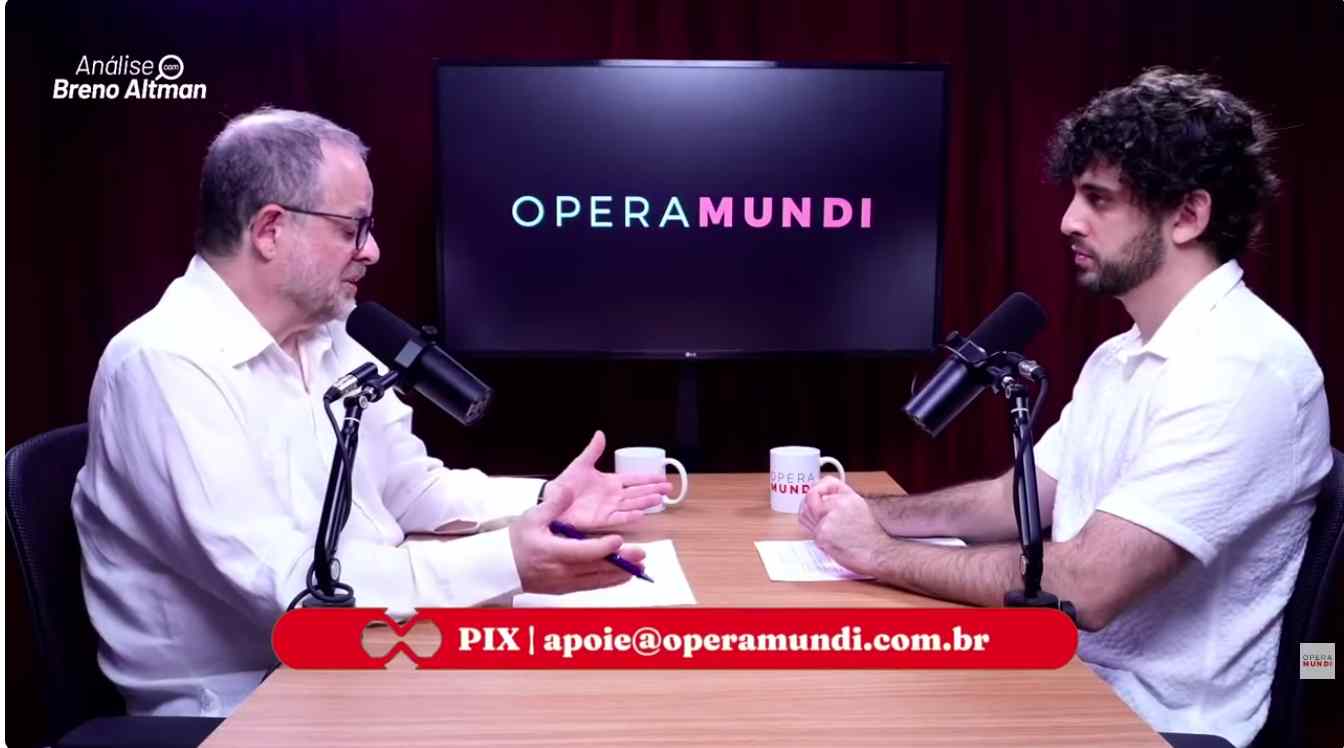
The statement opens Breno Altman’s report on the program aired on Sunday, February 22, 2026, as he seeks to respond to what he describes as a wave of false information and diverse opinions following Maduro’s kidnapping.
🇻🇪”I leave Venezuela convinced that there was no internal coup in Chavismo, there was no political betrayal of President Nicolás Maduro, convinced that Delcy Rodríguez, Diosdado Cabello, Jorge Rodríguez, who are today the main leaders in Venezuela, especially Delcy… pic.twitter.com/Y8abQYxNya
— O Cafezinho 🇧🇷 (@ocafezinho) February 24, 2026
Altman claims to have spent the entire week in Caracas to reconstruct, by investigation, the sequence of the events of January 3rd. He describes fieldwork supported by approximately 20 conversations with government members, opponents, experts and people on the street, including a meeting lasting around two hours with the president in charge.
When justifying the method, the journalist rejects versions based on impressions and rumors. “It’s a method problem”, he says, before maintaining that the analysis is only serious if it is based on the facts. In this key, he recognizes political position, but tries to separate alignment and rigor: “I am not impartial, I have a side. My side is the side of solidarity with the Bolivarian Revolution and Venezuela.”
Delcy Rodríguez’s defense appears, in the interview, as a starting point to reorganize the debate on the events. Altman states that Nicolás Maduro, through his family, maintains permanent contact with what is happening in Venezuela and that his message is always in support of the president in charge. He also says that he received concrete elements from Delcy herself to support his version: “not only did he explain to me what happened on January 3rd, he also proved to me what happened on January 3rd”.
For Altman, Maduro’s kidnapping needs to be understood within a scenario that he defines as extremely delicate even before the attack. Venezuela was under a severe naval blockade and dramatic economic sanctions, and had already suffered previous actions and escalations. In this context, he claims to have heard from Maduro himself, back in November, that a North American attack was inevitable.
The Venezuelan response, according to Altman, would not have been to prepare an open war, but rather to try to avoid it through negotiation. “Venezuela’s line was not one of military confrontation. Venezuela’s line was to avoid military confrontation”, he states, when describing offers to talk about combating drug trafficking, the oil issue and rare earths. He insists that this would not amount to capitulation, but to calculation in the face of the imbalance of forces.
Asked about surrender, Altman is direct: “No, not at all. See, there is an asymmetrical situation of forces.” He describes that the cost of a war of occupation would be devastating and projects numbers and death scenarios when discussing what he calls a war for the entire people. Still, he maintains that Washington would not seek occupation, but a surgical strike, with air, naval and cyber superiority.
It is within this framework that he reconstructs the dawn of January 3rd as an operation aimed at capturing the president. “On January 3, at two in the morning, local time, the United States begins the attack,” he says, before detailing that the first phase would have been cyber. The initial objective would be to blind radars and, in doing so, compromise anti-aircraft batteries and digital communications.
Altman describes the impact as an operational collapse. There would be an electrical blackout, and the offensive would have broken the communication chain, making Venezuela’s defense capacity extremely difficult. He then mentions the presence of 150 aircraft, including helicopters and planes, including F-35s, and says that it was not just Caracas that was attacked.
In the report, the operation would have reached La Carlota, in addition to other points mentioned as targets for anti-aircraft batteries, and culminated in the attack on Fort Tiuna, because the objective was to kidnap the president. Altman disputes versions that would minimize resistance and states that the fight fought at Fort Tiuna was brutal. He attributes the death of 32 Cubans and approximately 27 Venezuelans to the confrontation — 59 casualties at that point in the operation alone, in addition to other deaths recorded throughout the attack.
The negotiation, in the version presented, begins shortly after the first wave of attacks, which he places at around three in the morning. Altman states that Washington would have demanded a response from Delcy Rodríguez within 15 minutes, under threat of new bombing, and narrates the sequence of messages received: first, that the president was dead; then, the correction that he was alive, in North American hands and already out of Venezuela. The leader’s reaction, according to him, was immediate: “We want proof of life.”
Altman argues that, at that moment, the United States would enter a table with three advantages: the kidnapping of the president, the demonstration of military superiority and the absolute naval blockade. From there, he presents the dilemma as a choice between a military option and a political option — the first would be equivalent, in his words, to turning Venezuela into a Gaza strip. The second would be to negotiate to gain time, waiting for a new correlation of forces and using oil as an instrument of survival.
Delcy Rodríguez’s defense extends to the most symbolic and controversial post-attack gesture, which is the presence of US authorities in Caracas. Altman calls the visit of the CIA director a provocation and an attempt to humiliate the Chavista government, but says that refusal would mean the end of the only available path. “What would it mean not to receive the CIA director? It would mean that negotiations would not take place”, he states. He reinforces the personal dimension of the embarrassment: the CIA had killed Delcy and Jorge Rodríguez’s father in 1976.
The economic chapter of the interview focuses on changing hydrocarbon legislation, a topic that Altman says he studied in depth before and during the trip. He attributes part of the disinformation on the subject to a Washington strategy to demoralize the government and create conditions for a conservative bloc capable of replacing Chavismo to emerge in Venezuela.
When explaining the previous milestone, he recalls that Chávez approved the hydrocarbons law in 2001 and rejects the idea of complete nationalization: it was not a law of total nationalization of oil, he states, describing a PDVSA operational and commercial monopoly model combined with relevant tax changes. The sales tax, which was 1%, increased to 30%, and the profit tax could reach 50%.
The turning point, in the narrative, occurs with the accumulated impact of sanctions and blockade on the industry’s investment and maintenance capacity. At the height of the Chávez government, Venezuela extracted 3.2 million barrels per day; under sanctions, it reached 300 thousand. “What sovereignty is this? With 300 thousand barrels a day, sovereignty is over”, he summarizes.
The recovery path he describes involves the Anti-Blocking Law and a new type of contract, the CPP, Petroleum Participation Contract, which allows the entry of external capital to invest and operate, paying taxes and dividends, with freedom of commercialization. Altman relates this mechanism to the recovery in production: before January 3, the country had reached 1.2 million barrels per day, with Chevron accounting for around 160 to 180 thousand barrels.
To maintain that the presence of a North American oil company does not, in itself, mean political capitulation, Altman resorts to a historical parallel. Altman remembers that Lenin named a North American company owned by the Hammer family, which would later be called Occidental Petroleum. In the example he cited, the company received a license to explore and sell Russian oil, paying the government a share that reached more than 40% of non-Soviet extraction. “This is not a revolutionary betrayal. These are needs that revolutionary processes have”, he states.
In the journalist’s assessment, the new law approved by the National Assembly institutionalizes the CPP and changes rules without amounting to privatization. He maintains that the country’s oil assets are not being handed over to private companies, and cites among the changes the loss of PDVSA’s mandatory majority shareholding and tax flexibility, with the floor reduced from 30% to 15%.
Altman also describes the freedom to sell as a centerpiece, because it moves some transactions outside the direct reach of the blockade. PDVSA’s sales were blocked, Chevron’s were not — and this asymmetry would have shaped the sector’s survival strategy. At the same time, he insists that the main obstacle is not the law, but military coercion: the United States militarily prevents Venezuela from selling oil to whoever it wants, making the country hostage to a forced monopsony.
In the interview, Delcy Rodríguez is presented as the political axis of two simultaneous fronts: internal stabilization and external pressure. Altman says that the main task declared by the leaders is to stabilize the country’s political and economic life, rebuilding government capacity and social base, in a context in which salaries lost purchasing power during the period of sanctions.
The construction of a broader coalition appears as part of this design, with the amnesty law as an instrument. Altman argues that, since 2017, the central dispute has migrated: the main struggle is no longer class-based and is now between nation and imperialism. After January 3, the government seeks to expand the coalition of forces in defense of the country, because, in the journalist’s assessment, the United States’ logic is to transform Venezuela into a protectorate.
On the street level, Altman describes a routine of permanent mobilization around the return of the kidnapped president. Since January 3, there have been daily demonstrations for Maduro’s release, distributed across sectors to avoid repetition. During carnival, there was the Marcha de los Claveles, described by him as part of this ongoing mobilization for the release of Nicolás Maduro and Cília Flores.
When projecting the next steps, Altman associates the way out of the impasse with negotiations and international pressure, and already foresees that the electoral issue will come to the table. In constitutional terms, the new election would only take place in 2030, but he is betting that an election will have to be negotiated — with the condition that the sanctions are ended beforehand, to guarantee parity of conditions.
At the end of his diagnosis, the journalist insists that the conflict is not an abstract crisis of democracy, but an imposition of force. “Venezuela’s problem does not have to do with democracy, Venezuela’s problem has to do with imperialism”, he states, remembering that the President of the Republic was kidnapped and that more than 100 people were killed during the operation. The interview, conducted as a report of investigation and taking a position, presents Delcy Rodríguez as a key figure in a strategy described in harsh terms: negotiating under threat, sustaining daily mobilization and trying to rebuild room for maneuver while the country remains under pressure.
Below is the full video with Breno Altman’s testimony.
Source: https://www.ocafezinho.com/2026/02/24/breno-altman-nao-houve-golpe-interno-no-chavismo/