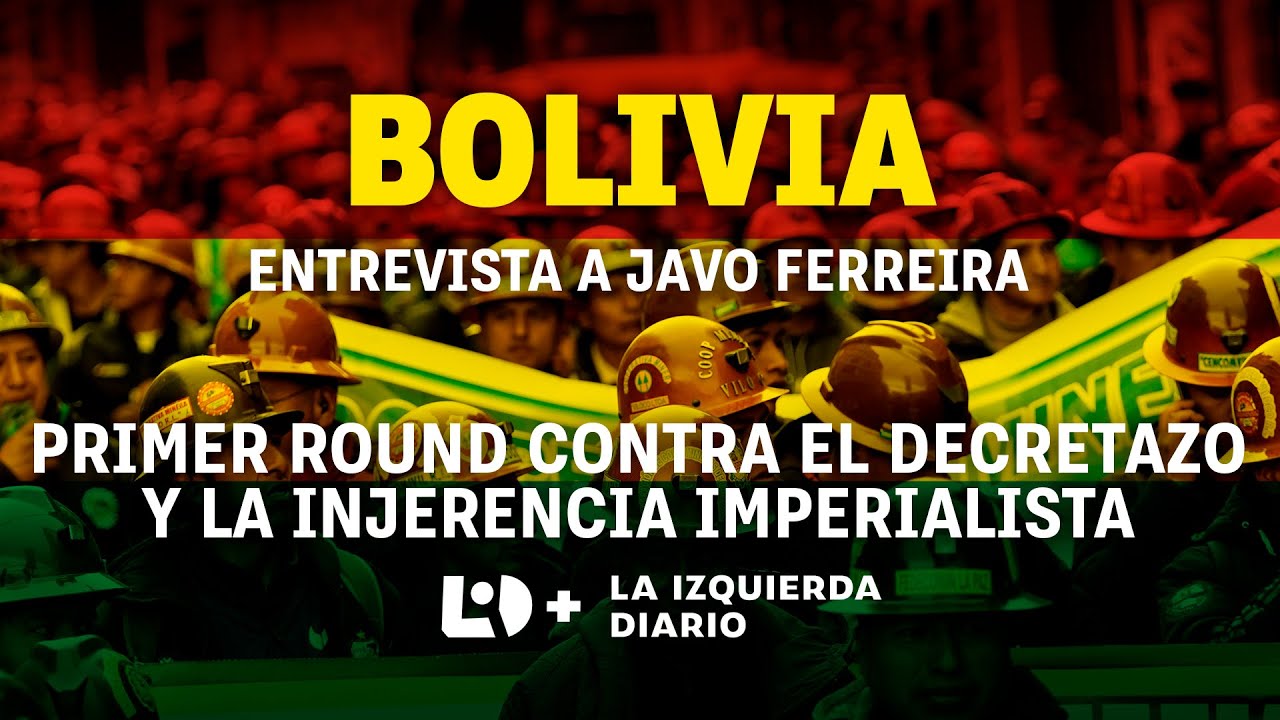
After weeks of strikes, blockades and mass mobilizations, the COB’s pact with the government prevented a possible national uprising. But the situation is unstable. The right advances with an anti-blockade law while unrest grows among the working class and popular base.
– YouTube
Bolivia went through three or four weeks of intense mobilization that was about to transform into a great national uprising. After the mobilization on Monday, January 5, in which it is estimated that between 400 and 500 thousand people participated, the tendency to block roads and stop work began to deepen.
This process led the government of Rodrigo Paz to be pushed to negotiate with the Bolivian Workers’ Central the repeal of decree 5503. The abrogation of this decree, a Milei-style package, was celebrated by the Bolivian Workers’ Central as a triumph. However, the situation that remains in the country is very contradictory, since there is deep unrest in sectors of the worker and student vanguard and in the most advanced sectors of the peasantry. This is because, although Decree 5503 was repealed, the truth is that the Paz government, along with the entire parliamentary right, is politically emboldened.
In fact, yesterday the Bolivian Senate approved an anti-blockade law that seeks to penalize those who, in the context of protest demonstrations, decide to block streets or routes with up to 13 years in prison. This situation is straining the political climate and deepening growing instability.
We could say that, although the agreement between the COB and the government managed to avoid the national uprising, the relationship of forces between the classes is not resolved. Everything was, in simple terms, tied up with wire: the balance of the current political situation is extremely precarious. While the emboldened right affirms that it will advance without hesitation in the application of the anti-blockade law, different sectors of the union world begin to express the possibility of a new cycle of uprisings, a new round of mobilizations against the decrees that Rodrigo Paz has been applying and against the offensive policy of the right in the Legislative Assembly.
In tune with what is happening throughout Latin America, North American imperialism is pressing – as we have seen in Venezuela, Honduras and currently in Cuba – to reorganize what it considers its backyard. In this framework, the process of struggle experienced in Bolivia in recent weeks constitutes the beginning of continental resistance of enormous importance. The plan of Rodrigo Paz and the entire Bolivian right is to become executors of the imperialist project in the country.
We are, then, facing a very dynamic international context, where the most notable thing is the North American offensive to reorganize the region in its dispute with China. This begins to provoke growing demonstrations of protest and popular resistance. The Bolivian general strike of recent days was the first round of a fight that promises to be long, not only in the country but throughout the continent, combined with the resistance that is announced against the offensive of Milei and the Argentine right, particularly with the new labor reform underway.
An uneven process is developing throughout the continent, but with clear tendencies towards mobilization. What it is about is taking these trends to the end: contributing to the organization of grassroots workers, forging the broadest and most democratic unity of those who fight, and imposing not only on the union centers a true plan of struggle and forceful measures capable of defeating the adjustment plans. At the same time, it is necessary to begin to discuss a fundamental solution, which can only be a socialist solution, driven by the struggle and at the service of the working class, the peasantry, the indigenous peoples and the women’s movement.
Yesterday we held a meeting of the Anticapitalist Common Pot, an organization that emerged at the initiative of different groups that organized to contribute and show solidarity with the general strike. With the participation of about 50 people we made a first assessment and defined the need to avoid disorganization and demobilization driven by the betrayal of the leadership of the Bolivian Workers’ Central, and to strengthen these democratic and unitary organizations to prepare the second round of the struggle, which seems to be closer than far.
Participating were university organizations such as Combate Rojo, members of Sendero Whiphala, the Domitila Barrios collective—both from Senkata—and various independent activists who actively contributed during these weeks of struggle to the general strike and the construction of the Anticapitalist Common Pot.
A positive balance left by this process is that the labor movement and the mass movement are not defeated. They have shown that they can unify quickly and take to the streets, showing that there are sufficient forces to defeat the adjustment plan. What it is about now is to build democratic organizations that prevent the union bureaucracy from once again raffling off, at a negotiating table, the efforts of hundreds of thousands of mobilized people.
International / Spanish State Edition / Union Bureaucracy / COB / Bolivia / Uruguay Edition / Venezuela Edition / Bolivia Edition / DS 5503
Source: www.laizquierdadiario.com