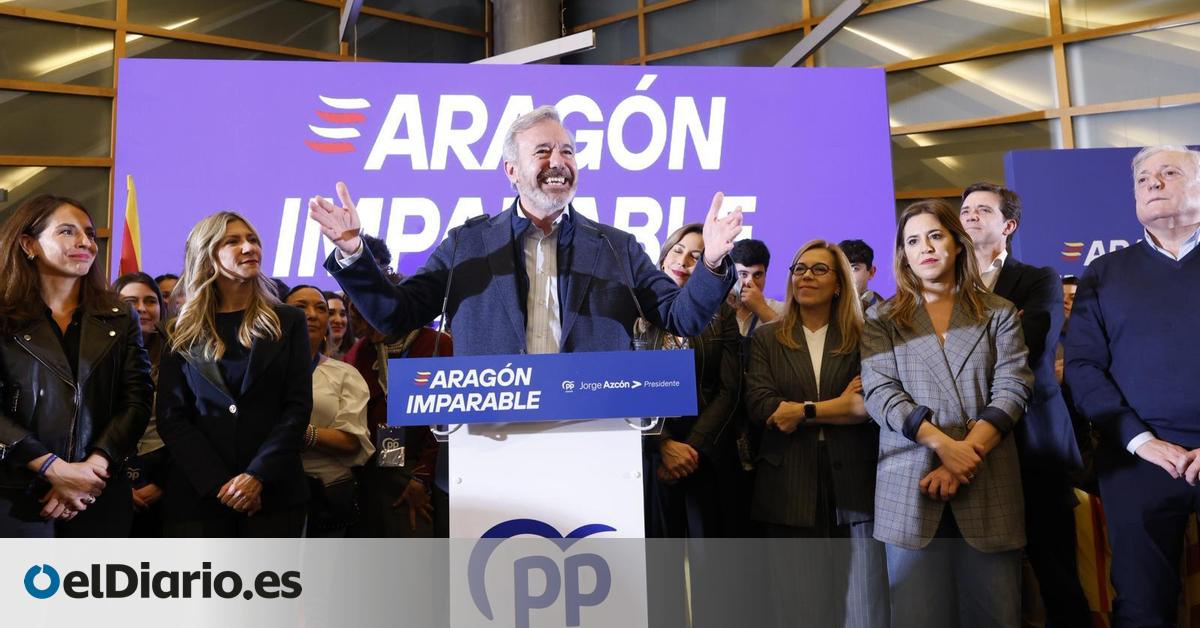
Thirty-three months later, the Aragonese have returned to the polls in regional elections that leave a great winner: the extreme right, which is advancing strongly. If the president and candidate of the PP, Jorge Azcón, anticipated the elections due to the blockade of the budgets, the balance could not be more catastrophic, since the popular ones lose two deputies and, in exchange, become even more hostages of Vox, which rises to 14. What the conservative candidate has achieved – which was perhaps his main objective – is to sink the PSOE of Pilar Alegría, which suffers a setback and equals its worst results since it was founded. They hold regional elections.
As they say, electoral advances are carried out by the devil and they must be thinking something like that about the PP. Azcón called the 8F with the excuse of the extension of the 2026 accounts and without opening his hand to negotiate them: his decision has ended up becoming a shot in the foot.
The striking closing of the PP campaign last Friday, with the group Los Meconios and especially with the agitator Vito Quiles of beers with party leaders, already suggested that the popular ones had detected the danger: the extreme right was rising uncontrollably and it was necessary to try to attract ultra votes. However, Azcón’s strategy has been shipwrecked.
The popular ones fall from 28 to 26 deputies, with about 15,000 fewer votes than in 2023; This, together with the rise of the extreme right, will make governability in Aragon much more complicated. Vox doubles its representation and goes from 7 to 14 deputies: only in Zaragoza capital, for example, it exceeds 50,000 votes and reaches 16% of the votes, compared to 12% three years ago.
The comparison with Extremadura is striking: there, the PP increased its percentage of the vote by 4.5 points, while in the Aragonese elections it lost 1.2.
The ultra formation rises especially in the province of Huesca, and the increase in the number of votes is very significant in nuclei with a high percentage of immigration, such as Fraga (11 points more, even ahead of the PSOE), Caspe (12 points more and very close to the socialists and the PP) or Ricla (20 points more and also ahead of the PSOE).
In Teruel capital, it has been the second most voted party and exceeds 4,000 votes.
Strong fall of the PSOE
As an alibi, Azcón will resort to the collapse of the opposite bench. The socialist result shakes Ferraz’s entire strategy of placing ministers as regional candidates, of which Alegría was the first in the running. In June it will be María Jesús Montero’s turn in Andalusia, where the prospects are not much more promising. But in addition, the disaster may have implications internally, given that the transition from the PSOE of Javier Lambán to that of the current general secretary has not been easy and there is latent discontent.
And that, as the only consolation, could have been worse for the socialists, who remain at the 18 deputies that Javier Lambán obtained in 2015. That will be the official story, although the truth is the scenario is very different from then: eleven years ago Podemos rose to 14 seats, which with those of CHA and IU added up to 17, while now on the left of the PSOE there are only seven.
The sharp drop, from the 23 deputies they had in the last legislature, confirms those who have criticized behind closed doors the campaign approach drawn up by the Federal Executive, which has meant the landing of socialist members from Madrid and which has left aside the party’s representatives in Aragon. The result is striking in a city like Ejea de los Caballeros, with a large socialist establishment but where the party falls 12 points, compared to a rise of 10 points for Vox. Or in Sabiñánigo, where the PP even surpasses the PSOE.
The only good news for the socialists is the province of Teruel: it maintains its four deputies – it even rises slightly in percentage of the vote – by capitalizing on the fall of Teruel Exist.
CHA, the only winner on the left
For his part, Chunta has confirmed the good feelings that his campaign left, with his candidate, Jorge Pueyo, at the helm. Although it is still not a government option and remains far from the results that the Aragonese party obtained in the past, such as with the nine deputies in 2003, the truth is that in these elections CHA breaks the ceiling of four seats that it had since then and obtains six representatives, its second best haul after regional elections.
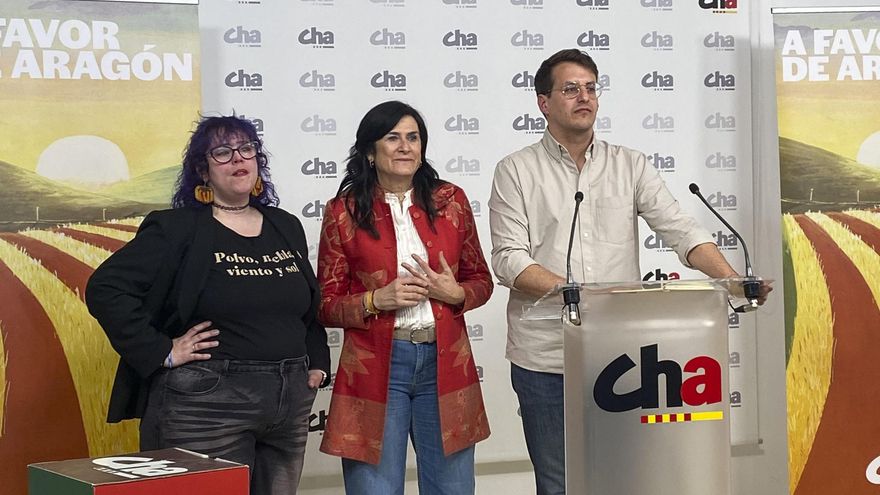
The party has managed to capture a good part of the discontent of the traditional socialist voter, especially in Zaragoza capital, where the drop of six points for one is equal to the rise of the other: there, CHA more than doubles its number of votes, up to nearly 40,000 votes.
Aragón-Teruel There is one deputy down, up to two representatives, especially due to his strong decline in the capital of Teruel, where he lost 2,000 votes and fell ten points.
Izquierda Unida-Sumar fails, unlike CHA, to collect the votes that have eluded the PSOE and, although it maintains its seat, it leaves 2,000 votes behind. Things have fared much worse for Podemos, which in the Zaragoza constituency – the only one where it had any option – has barely surpassed 1% of the votes.
Meanwhile, the PAR confirms what the polls predicted and becomes an extra-parliamentary force for the first time in democracy.
Finally, Alvise Pérez fails in the first regional incursion of Se Acabó la Fiesta, although with more than 14,000 votes he is not far from obtaining a seat in Zaragoza.

Most voted

Population size

2nd party

New winner
Which is the party with the most votes in each municipality in the elections.
Source: www.eldiario.es