Xi and Putin Unite Against US Hegemony in Beijing Summit
Chinese President Xi Jinping and Russian President Vladimir Putin convened in Beijing, reinforcing their strategic alliance and issuing a joint statement that critiqued US foreign policy and militarization efforts.
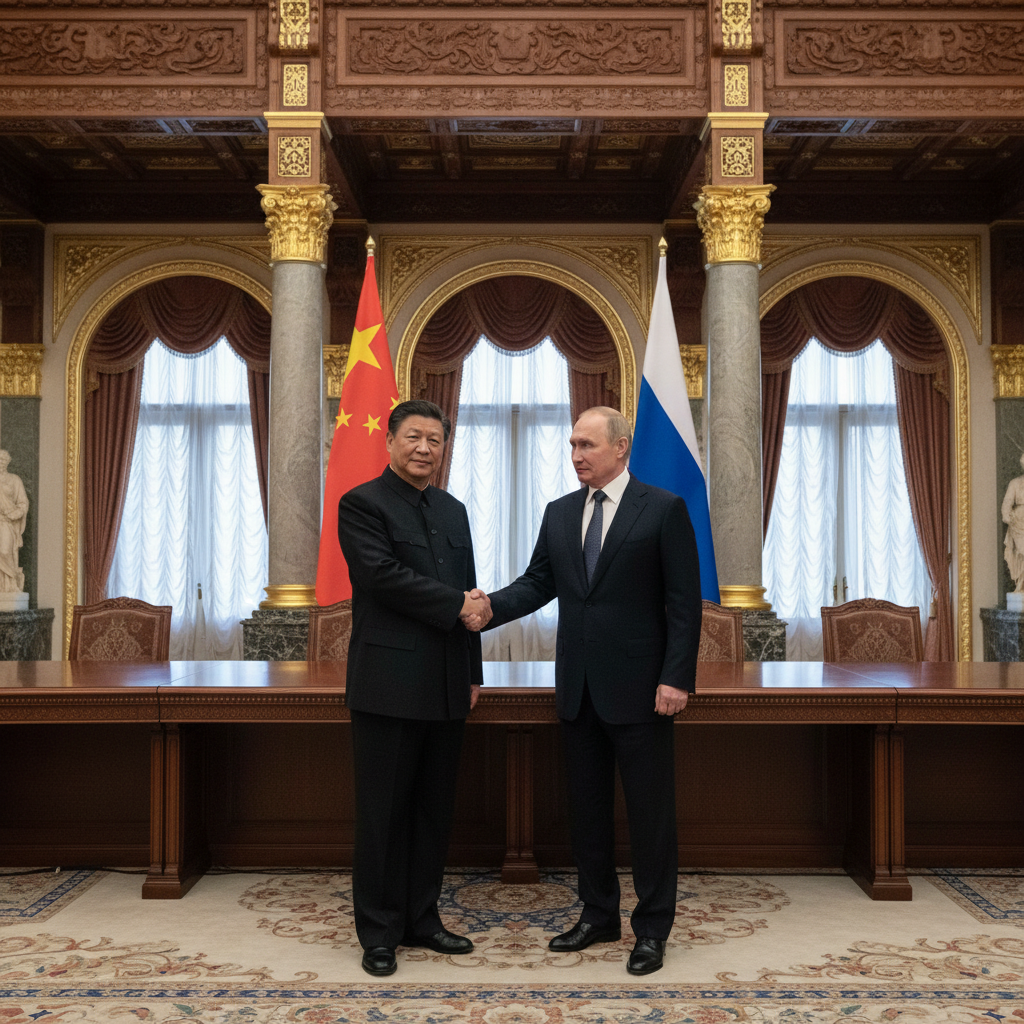
Chinese President Xi Jinping and Russian President Vladimir Putin met in Beijing on May 20, 2026, signaling a strengthened united front against the United States. Their summit culminated in a joint statement warning against a global descent into the 'law of the jungle' and directly criticizing Washington's actions.
Key points of contention highlighted in their joint statement included US President Donald Trump’s proposed $175 billion 'Golden Dome' defense system, which aims to establish a new missile field in the Midwest. The leaders also voiced disapproval over the expiration of the last remaining US-Russia arms control treaty. This treaty lapsed in February 2026 after the Trump administration failed to extend it by a year, despite Moscow's proposal.
The summit, occurring just a week after Xi hosted Trump in Beijing, was marked by a grand welcoming ceremony, featuring a red carpet and military bands playing both national anthems. In their initial remarks, both leaders emphasized the growing importance of their nations' cooperation amidst an increasingly fragmented international landscape.
President Putin remarked to Xi, as reported by Russian media, that their 'interaction and economic cooperation demonstrate strong momentum, even against the backdrop of unfavorable external factors.' Echoing this sentiment, President Xi lauded the 'unyielding relationship' between China and Russia. He stated, 'We have been able to continuously deepen our political mutual trust and strategic coordination with a resilience that remains unyielding despite trials and tribulations.'
During their discussions, Xi also addressed the ongoing conflict involving the United States and Israel against Iran. He conveyed to Putin that further conflict was 'inadvisable,' stressing the 'utmost urgency' of a comprehensive ceasefire and the importance of maintaining negotiations, while condemning the resumption of hostilities.
A separate joint declaration reiterated their concerns, stating, 'there is a danger of fragmentation of the international community and a return to the ‘law of the jungle’.' It further asserted that 'Attempts by a number of states to unilaterally manage global affairs, impose their interests on the entire world, and limit the sovereign development of other countries, in the spirit of the colonial era, have failed.'
Energy cooperation formed a significant part of the agenda, with Putin describing the sector as the 'driving force of economic cooperation' between Russia and China. China has become a vital market for Russian oil and a crucial trading partner following Western sanctions imposed after Russia's full-scale invasion of Ukraine.
Al Jazeera's Katrina Yu, reporting from Beijing, noted that while approximately 40 agreements covering various sectors from economy to education and tourism were expected, energy security remained Putin's primary focus. Yu explained, 'Since the war in Ukraine, any gas sales that were previously heading to Europe, that is all dried up, and Russia is in desperate need of revenue to replace that.'
However, the talks did not yield a new agreement on the long-discussed Power of Siberia 2 gas pipeline. Kremlin spokesperson Dmitry Peskov indicated that while a 'basic understanding,' including the route, had been reached, there was 'no clear timeline' for its construction. Xi, without specifically mentioning the pipeline, highlighted energy and resource connectivity as a 'ballast stone' for the bilateral relationship.
Putin's visit, which marks 25 years of Sino-Russian friendship, contrasted with Trump's earlier visit. The Russian president has met with Xi more than 40 times, indicating a deep-rooted coordination. Putin pledged that Russia and China would jointly pursue an 'independent and sovereign' foreign policy to play a 'stabilizing role on the global stage.' Xi reinforced this, noting that Beijing and Moscow have deepened 'political mutual trust and strategic cooperation' in a world marked by 'hegemony is overwhelming.'
Yu observed that these statements confirm a 'depth of established trust' between Beijing and Moscow absent in China-US relations. She added that Xi is advocating for a 'multipolar world, where the US has less power and influence.' Putin, accompanied by a large delegation of business and government leaders, affirmed in a video address that Russia and China are prepared to cooperate on 'core interests of the two countries, including the protection of sovereignty and national unity,' emphasizing, 'We are not aligning against anyone, but working for the cause of peace and universal prosperity.'