The current conflict is nothing like last year’s 12-Day War. Now, the prospects for a regional war are beginning to take shape, due to the military options adopted by Iran, along with the entry of Hezbollah and Israel’s subsequent ground invasion of Lebanon.
The closure of the Strait of Hormuz adds another factor. Approximately a fifth of the oil traded globally passes through there, with a greater potential impact on regional economies. By restricting or threatening this route, Tehran has added a new front to the conflict, now in the economic sphere, raising the price of oil and gas (fundamental for the European economy) and putting pressure on already fragile production chains.
This move is coordinated with the decision to attack Saudi Arabia’s energy infrastructure and US military and diplomatic targets throughout the region. The goal is to maximize the political costs of war. The calculation of impacts transcends the military sphere, seeking to influence the widest possible variety of objectives that affect the United States and, in particular, its regional allies.
The Iranian military tactic, for now, is geographic dispersion, seeking to overcome defenses and multiply points of tension as much as possible. Not surprisingly, bases in Qatar, Bahrain and Saudi Arabia have been priority targets. In Dubai, considered a symbol of a safe region, the flames in luxury buildings went around the world.
The scene of the downing of American fighter jets by friendly fire in Kuwait shows that dealing with such a diverse theater of operations will not be easy. Furthermore, Iran managed to attack the Al-Udeid air base in Qatar, no less than the largest US military installation in the Middle East, which serves as a forward headquarters in the region.
By expanding its theater of operations, Iran seeks to somehow offset the obvious technological and military advantages of the United States and Israel. These measures constitute what is called a war of attrition. For the United States, it is worth remembering that it has always preferred a war of annihilation, the death of Khamenei and various sectors of the regime’s leadership being an expression of this.
In military terms, a war of attrition is a strategy that seeks to gradually weaken or fatigue the enemy, accumulating human, material and economic losses until it loses the ability or will to continue fighting. A war of annihilation, also called a war of destruction, seeks to defeat the adversary quickly and decisively, concentrating forces to destroy its main forces as quickly as possible.
Meanwhile, there are even more worrying signs. In Pakistan, the attacks against the US embassy demonstrate that anti-Americanism could be escaping the control of local bourgeoisies sympathetic to Washington. After the Palestinian massacre and the expanded offensive against Iran, the legitimacy of the regimes allied with the United States could begin to suffer increasing pressure, with an erosion that could generate new phenomena in the Middle East.
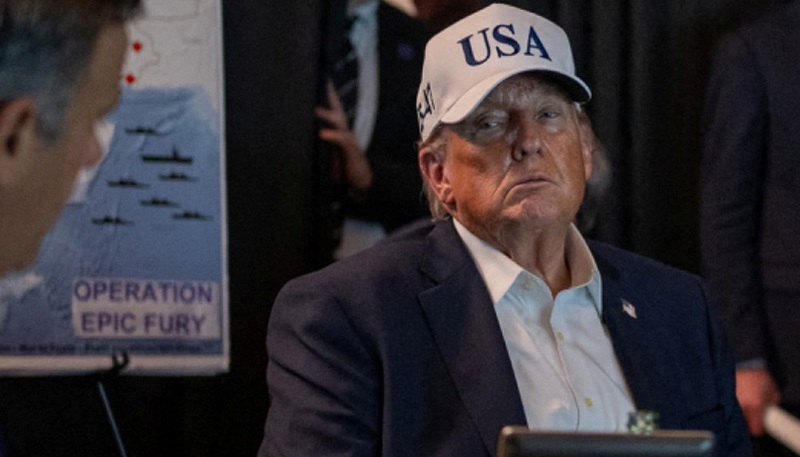
Faced with the military superiority of Washington and Tel Aviv, Tehran is betting on a prolonged war of attrition, for as long as possible. The objectives will not be measured by a purely military victory. If the Iranian regime resists even ruling a country in ruins, this could have a demoralizing effect on Donald Trump and Benjamin Netanyahu, whose speech has explicitly included regime change as an objective since the beginning of the conflict.
Additionally, global inflation caused by rising oil prices could be costly for Trump. In every American election, this is one of the most important factors in evaluating the government. For Netanyahu, who survives thanks to military interventions, the benefits seem greater, at least for now.
Perhaps the fall of Bashar al-Assad in Syria and the devastating offensive in the Gaza Strip fueled the perception in Washington that complete regional alignment would be possible under American tutelage, something that would constitute a historic first. In the context of disputes with China, the consolidation of the Middle East would have significant geopolitical value and could be considered a major achievement of the Trump administration.
On the other hand, there is a factor of internal instability that cannot be ignored. Part of the MAGA movement’s base, as well as influential figures who supported Trump, such as Tucker Carlson, could intensify their criticism of the prolonged involvement in a regional war. In other words, the time factor could become a favorable factor for Iran, and perhaps this will happen soon.
At the same time, the weight of the chauvinist tradition in American politics cannot be underestimated. While initial polls indicate that only about 27% of the American population supports the war, Trump may have been seduced by the propaganda potential of a successful offensive.
The problem and the question could lie in underestimating the capacity for resistance and in the inherent logic of wars of attrition. Intoxicated by the possibility of quick, shocking gains, Trump may have underestimated their contradictory effects. As the saying goes, “he who smokes a lot of pipe deforms his mouth” [que se podría asemejar a Tanto va el cántaro a la fuente que al final se rompe, NdT]and the successive incursions of aggressive Trumpist imperialism on the world stage could open a new moment of questioning the already weakened American hegemony.
Source: www.laizquierdadiario.com