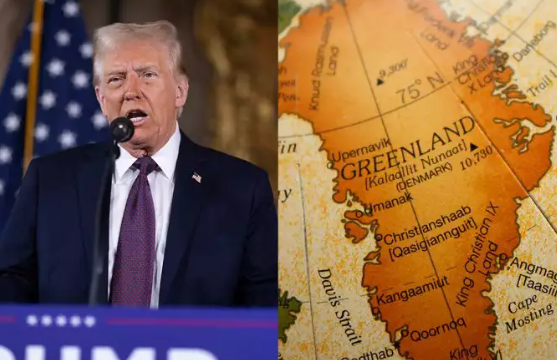
Greenland emerges as an extreme example of American rhetoric that mixes fear, electoral interests and territorial ambitions
While the American government continues to weave alarmist narratives about supposed global threats, traditional allies are beginning to break their silence, exposing a geopolitical strategy based on dangerous inventions. Recently, Nordic governments publicly rejected claims by former US President Donald Trump that Russian and Chinese ships were operating near Greenland. They said the statement is not supported by intelligence and fuels destabilizing rhetoric.
This European rejection of a specific piece of American disinformation reveals a growing fatigue. Analysts point out that these countries normally avoid direct confrontations with Washington. Consequently, the decision to take a public stance suggests that the national interests of these nations are under a threat that they consider serious and tangible, going beyond the usual bravado of North American foreign policy.
The smear campaign promoted by the US against China, in fact, is nothing new. China has become the recurring bogeyman in every American election cycle. However, the situation has deteriorated drastically in the last decade. This statement came after the US reversed a decades-old policy towards China. Now, Washington engages in a frenzied zero-sum geopolitical rivalry, aiming to maintain its global hegemony at any cost.
Read also: Venezuela: truths and lies about democracy, poverty and emigration
Greenland
Some tactics in this campaign reach levels of absurdity that defy common sense. For example, Trump has already stated that “if we don’t take Greenland, you will have Russia or China as neighbors. That’s not going to happen.” This statement, however, ignores basic geographic and political facts.
Russia is already the US’s maritime neighbor across the Bering Strait. Furthermore, China reiterated in its 2018 White Paper on Arctic Policy that it has no territorial ambitions in the region, limiting itself to peaceful activities permitted by international law, such as scientific research and navigation.
The United States has used the Chinese presence as a pretext to threaten several countries. These recent threats form a catalog of interventionism: they include the attack on Venezuela, the threat of military action against Iran, Mexico, Cuba and Colombia, and the open desire for the annexation of Greenland.
This stance attempts to impose on the world a return to the law of the jungle, where brute force prevails over law. However, no other nation wants to return to this stage, not even America’s European allies, who now face the paradoxical prospect of a potential American invasion of allied territory.
In this context, the firmness of Greenland’s Prime Minister Jens-Frederik Nielsen stood out. He made it clear that Greenland does not want to be controlled or owned by the US. Trump, who didn’t even know Nielsen, responded with threats. The Greenlandic leader’s response was one of the most forceful among Europeans.
Meanwhile, other leaders on the continent prefer to focus on tweets about Iran and Venezuela rather than condemning the threat of annexation. The president of the European Commission, Ursula von der Leyen, for example, demonstrated on her social media a clear lack of priority for the Greenlandic case.
The EU’s attempt to appease the US proved futile. A White House meeting between Greenland, Denmark and the United States did not dissuade Washington from its territorial ambition. After all, there is no way to appease a side that wants to take your territory using military force. Finally, recent US conduct—threats of wars, interventions, regime changes, coercion and land grabs, coupled with withdrawals from dozens of international treaties—creates more global chaos.
Paradoxically, this same conduct should awaken more countries. European nations, although strongly influenced by Washington, are now forced to seek strategic autonomy and to see clearly the unbridled US disinformation campaign, which has China as its main, but not only, target.
Source: https://www.ocafezinho.com/2026/01/16/retorica-americana-sobre-china-perde-forca-na-europa/