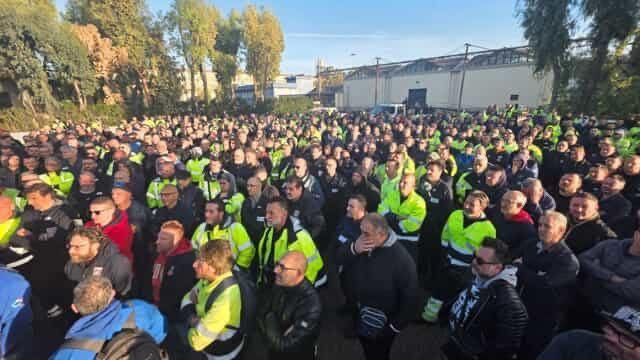
The day before yesterday in Genoa, a general strike brought together the city’s main metallurgical factories, from Ansaldo to Aero Avio, including Fincantieri, in solidarity with the workers of the former ILVA steelworks in the Cornigliano district. Steelworkers had been on strike for four days, protesting the possibility of 6,000 workers being laid off in the Ligurian capital and other plants in Piedmont and Taranto, and the threat of a complete divestment of the company by next February. The steel group, under state administration after the departure of ArcelorMittal in 2019, is looking for a buyer.
However, none have been found since negotiations with Baku Steel collapsed last September, and the government has no serious plans to step up public intervention. In this sense, it is being pressured by Federacciai, the Confindustria steelworkers’ association, which is promoting the closure of the former ILVA plants, presumably as a lever for some owners to benefit more from the sale.
In this situation, the workers’ mobilization seems to have changed the government’s mind. Minister d’Urso yesterday promised the presidents of the regions of Liguria and Apulia that there would be no severance payments and that, after the end of a short maintenance period, the semi-finished steel would be sent from Taranto to Genoa. The blockade of coil production at the southern plant triggered protests by northern workers, which later spread to their colleagues in Apulia.
This is another demonstration that the struggle bears fruit, especially when it is participatory, coordinated across multiple plants, and carried out with radical methods.. In addition to occupying the factory in mid-November and striking in recent days, workers from Genoa stormed the Brignole station two days ago, while on Tuesday, workers from Taranto blocked the highway. It is also interesting how the Genoa metalworkers’ strike the day before yesterday served as a rallying point for other sectors of workers: the dockers sent a delegation, as did the IKEA employees involved in a contract battle. Exorcising the specter of the “Lock Everything” strike of recent months, which began in the city that was the epicenter of the protests, may have been one of the factors that drove Meloni & co. to reconsider its plans for the former ILVA plant.
The news of the suspension of the closure prompted the Genoese workers to evacuate their camp; However, they must remain alert. The government’s statements are just that, mere statements. D’Urso promised the continuous supply of steel from Taranto to Genoa, at least until February 28, and the possibility of the State retaining ownership of the former ILVA plant in the absence of private purchase offers. However, he offered no guarantees about abandoning the so-called “short cycle.” This plan foresees significant reductions in production volumes, and therefore, in employment, at the Taranto plants. This would be accompanied by a disconnection of the southern plant from those in the north, which would benefit exports, but would also clearly harm employment in the area, since the production of special steels from Genoa depends on semi-finished products from Taranto.
An investment plan still needs to be implemented that offers real environmental guarantees and prevents thousands of families from facing difficulties. The government’s attempts to divide workers by opening separate negotiations between north and south, a strategy actively supported by local governments, led by the Democratic Party, in both Liguria and Apulia, must also be rejected. As a former ILVA worker from Cornigliano told us: “We don’t want to separate from Taranto. If that happened, we would be weaker, because now we are 10,000. What can we achieve alone, 1,000 in Genoa?” Until now, the pressure of joint fighting at the two main plants has prevented the government from implementing a divide and rule strategy. However, in recent weeks, the leadership of the FIOM – the dominant force in Genoa – has agreed, together with the UILM and the FIM (unions=), to participate in separate negotiations for each plant. The USB, historically well represented in Taranto, but also present in Genoa, explicitly raises the question of joint negotiations involving all plants. This position must be supported and strengthened through the coordination of rank-and-file workers and challenging all unions to adopt it.
Furthermore, the demand for public intervention by labor organizations is sacrosanct. That said, justifying it primarily based on Italy’s strategic needs, as some Democratic Party politicians and some union leaders do—perhaps hoping that increased spending on rearmament will benefit the local steel industry—risks being counterproductive to the struggle. As is well known, especially in the case of Taranto, production is highly polluting and harmful.
It must be clearly stated that closing factories, as requested by some citizen committees, would not definitively solve the problem, with the risk of leaving behind not only real eco-monsters, but also a weakened working class, thus worsening the balance of power to achieve a satisfactory cleanup plan (as demonstrated, for example, by the experience of the Bagnoli neighborhood in Naples). However, the ex-ILVA conflict risks becoming isolated if workers and union leaders do not reject the health (environment)-work dichotomy and limit themselves to emphasizing the protection of production volumes.
Curiously, one of the most popular chants in the workers’ demonstrations in Genoa is “Occupiamola” (Let’s occupy it), perhaps the former ILVA workers also adopt the slogans launched by the Florentine Factory Collective. The dichotomy between health (environment) and work, as well as the siren song of rearmament, must be answered with the demand for nationalization under democratic workers’ control, at the service of an authentic program of environmental sanitation and ecological reconversion of production.
This article was originally published in Italian in La Voce delle Lotte, part of the International Network of La Izquierda Diario.
Source: www.laizquierdadiario.com