50 years after the civil-military coup of 1976, CELID (La Izquierda Diario Economic Data Center) was born, an initiative that aims to produce and systematize economic information, and contribute to public debate from the point of view of the working majorities. Far from being neutral, data is a field of dispute: who produces it, how it is interpreted and for what purposes.
Why a data center from the left? In a context where already known recipes are once again being applied—trade openness, fiscal adjustment, external debt and salary deterioration—it becomes essential to build our own tools. Because the production of economic information has historically been concentrated in official organizations, private consultancies and study centers linked to economic power. This not only determines what is measured, but also how the data itself is interpreted.
A data center from the left seeks to break with that logic, providing analyzes that put the living conditions of the working class, their interests, and the power relations that structure the economy at the center. It is not just about describing reality, but about understanding its determinants and contributing to the construction of alternatives of the kind that moves the world.
First report: external debt, economic groups and salary
The first report of CELIS It is divided into three sections, and proposes to analyze the relationship between external debt, economic structure and living conditions, taking as a starting point the economic program implemented during the last dictatorship.
The first addresses key aspects of the origin of the jump in external debt. In the second, the actions of the dominant sectors that promoted the coup and benefited from the economic scheme are exposed. Finally, the situation of workers is analyzed based on the evolution of real wages and other socioeconomic variables.
Economic Report Military coup. CELID by La Izquierda Diario
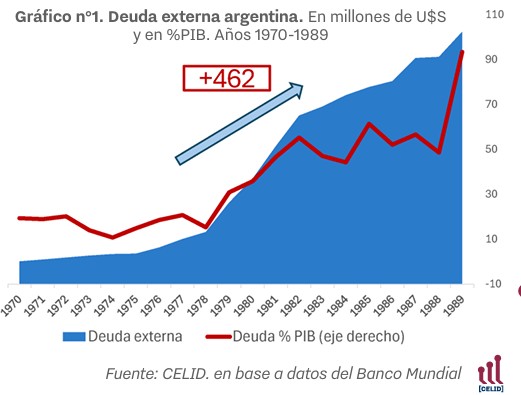
External debt as a looting mechanism: The turning point of the external debt is located in the last dictatorship, with a growth of 462% between 1976 and 1983, going from about US$ 8,000 million to more than US$ 45,000 million.
The role of the Economic Groups: The nationalization of private debt consolidated the socialization of losses and the privatization of profits in favor of large economic groups. These benefited from the scheme of external debt and flight, while they imposed internal discipline in the factories.
A breaking point in real wages: fell 41% between 1974 and 1977marking a historic break, along with a sharp drop in workers’ participation in income, the advance of job insecurity and the growth of poverty.
In the last fifty years, external debt was consolidated as a structural pillar of the functioning of the Argentine economy. Far from acting as a development tool, and even more so, from being the result of the “fiscal deficit”, it operated as a systematic mechanism for the transfer of resources from labor to capital, associated with the flight of foreign currency, financial speculation and the strengthening of concentrated economic groups. Its evolution was not neutral: it accompanied and deepened processes of adjustment, inequality and deterioration of the living conditions of the majority.
Graphic design and visual identity – Manuel Badenes
Editorial design and layout – Jorge Inchaurrandieta

Source: www.laizquierdadiario.com