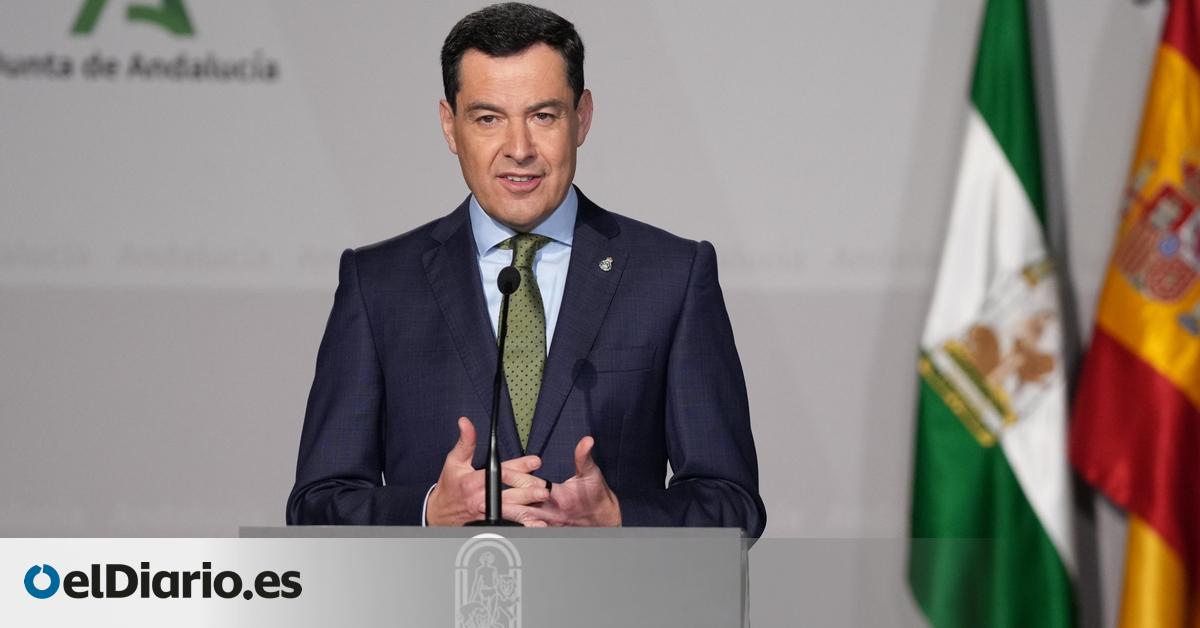
The call for the Andalusian elections for May 17 announced by Juan Manuel Moreno, ahead of schedule, will mean the closing of the mini-electoral cycle that opened last December and with the governments of Extremadura, Aragon and Castilla y León in the air due to the lack of understanding between PP and Vox, who keep their negotiations open, the PSOE with María Jesús Montero even more attentive to Madrid than Seville and the left divided into three candidates with little sign of understanding each other.
Moreno seeks to maximize participation in elections that appear complicated when his stated objective is to revalidate the absolute majority he achieved in 2022 thanks to taking the last deputies in some provinces only by a handful of votes. His leader, Alberto Núñez Feijóo, also demands that he match a success that is difficult to repeat.
“Everything seems to indicate that the PP is going to win the elections and the discussion is whether or not it is going to win them with an absolute majority,” Feijóo acknowledged this Tuesday in an interview on Antena 3. The leader of the PP admitted that it is “difficult” for Moreno to achieve it. The experience of the last elections forces them to be cautious: María Guardiola, Jorge Azcón and Alfonso Fernández Mañueco were far away, and the first two even lost votes in the previous election.
Vox achieved an increase in its support in the three communities, and in Castilla y León it reached close to 19% of the vote. In Andalusia, even without a candidate, polls anticipate a similar result. For this reason, Moreno said this Tuesday on Onda Cero that they should not “be obsessed” with Santiago Abascal’s party, which constantly marks the discursive path to the PP.
“The less we talk about Vox, the better,” said Moreno, who has anticipated that he will ask for the vote to prevent Andalusia from falling into the “blockade” suffered by his colleagues.
Last week, Feijóo proposed this month of March as the deadline for Vox to reach an agreement with the PP in the three pending communities, but nothing indicates that his request will be fulfilled.
The leader of the PP revealed this Tuesday that both parties will meet “formally” this week in Extremadura to try to advance an agreement. In Aragón, Azcón has assumed that the Andalusian elections can influence his negotiations. In an informative event this Tuesday, he recalled that the deadline for an agreement is “May 3, and it would be desirable that they serve to advance the Aragon and Extremadura agreements.” Which is tantamount to admitting that it can have the opposite effect. As for Castilla y León, the deadlines are different because the elections have just been held and, for the moment, the Cortes have not even been established.
The PSOE, facing the worst omens
In the PSOE, meanwhile, they are working on the final landing in Andalusia of María Jesús Montero, who this Tuesday attended her last Council of Ministers as first vice president of the Government and Minister of Finance. Although Montero has combined her ministerial agenda with that of a candidate in recent months, she made the decision to speed up the deadlines to abandon her job in the Executive, something that is expected to be official before the end of the week.
They do not give much relevance in the socialist ranks to the impact of the date chosen by Juan Manuel Moreno, May 17, for elections that could also have been held in June. But the socialist candidate herself assured in an appearance in Seville this Tuesday that she does glimpse the intention of not inflaming the electoral atmosphere among citizens.
“Moreno Bonilla does not want an electoral or campaign environment, because he knows that this harms him. That is why he has set that date, in the middle of the spring festivals,” said Montero, who went so far as to insist that his party is experiencing a “rebound” that makes the PP fearful. “Moreno Bonilla has brought forward the elections because he knows of the rise of the PSOE and the wear and tear of his management,” he noted.
The great challenge in the ranks of the PSOE of Andalusia, once a guarantor of electoral successes for Ferraz Street, is to activate the party and the progressive electorate in record time to turn around polls that predict the worst possible results. The latest internal polls indicate the possibility, even, that María Jesús Montero’s candidacy obtains worse numbers than Juan Espadas’s four years ago. And the certain risk, therefore, of harvesting the electoral soil of the socialists in a land that was a bastion until just two terms ago.
The script drawn involves putting the entire electoral machinery at the service of the great cause of public health, the authentic management black hole of the Juanma Moreno era, with the breast cancer screening scandal as the main argument. “In these elections, our lives are at stake, the health of Andalusians is at stake. They are not just another election, they are a referendum on public health,” Montero cried.
Meanwhile, in Moncloa and Ferraz they look at the May 17 appointment with suspicion. A person of the utmost confidence of Pedro Sánchez and one of the few ministers who has remained at his side since he was sworn in as president, a failure by María Jesús Montero would greatly imply a severe setback for the president himself and for the PSOE as a whole. Entrusted to the resuscitation capacity of the strong Andalusian socialist machinery, in the Executive they defend in any case as “an asset” Montero’s background as a minister with “unbeatable management” and as “the best possible candidate.”
The alternative left, divided
On the left of the PSOE, on the contrary, the problem is not so much that the electoral call has taken the space in a moment of political weakness as that it seems impossible for it to present itself united. Right now, the alternative left plans to run on three separate lists: that of Por Andalucía (the coalition between IU and Movimiento Sumar, the strongest of the three, although it has not yet started in the polls), that of Adelante Andalucía (the formation of Teresa Rodríguez) and that of Podemos. And, although neither IU nor the purples want to rule out a last-minute agreement to jointly participate in the elections, the sources consulted see it as very difficult for this pact to end up happening.
Once the countdown to the elections has started, Podemos and IU have ten calendar days to try to redirect the situation, since that will be when the deadline for registering the coalitions ends. But neither in public nor in private are the messages conveyed by its leaders very flattering. This Tuesday, the coordinator of IU and candidate of Por Andalucía, Antonio Maíllo, left in the hands of Podemos – which has chosen Juan Antonio Delgado as its candidate – the decision to join its project, which in his opinion is the “only unitary” one in the alternative left. But he also let it slip that his organization had waited unsuccessfully for “nine months” for Podemos to “respond” to his invitation.
For her part, the purple general secretary, Ione Belarra, also avoided expressly closing the door to a coalition, but stated that her model is “that of Extremadura”, which is currently unaffordable for IU. In those elections – held last December – Maíllo’s people accepted that Movimiento Sumar would be left out of the alliance and that the list would be led by Podemos candidate, Irene de Miguel. In Andalusia, on the other hand, IU has already closed a political agreement with Yolanda Díaz’s small party and has no intention of breaking it. Several heavyweights in the Andalusian leadership of Podemos have publicly defended reconciliation with IU, but the state leadership led by Belarra has always been evasive about that possibility.
However, sources from the Podemos state leadership maintain that, far from seeking an agreement, it is Maíllo’s people who are doing everything possible to torpedo any possibility of understanding, and affirm that the agreement will only occur if IU “changes its attitude.” For the purples, however, the Andalusian elections come at a very complicated time, after two consecutive electoral failures in Aragón and Castilla y León – in neither of the two communities did they reach 1% of the votes – and with poor prospects for the May event as well. The polls, in fact, agree in predicting that Podemos would be left out if he ran alone.
Far from this struggle is Adelante Andalucía, which aspires to collect a part of the vote disenchanted with the rest of the alternative left. The Andalusian party, which will present José Ignacio García as a candidate, maintains a very critical discourse with the PSOE and also serious strategic differences with the other parties in its space, since it rejects sharing governments with the socialists. And its objective is to try to expand its space after having obtained representation last term in the Parliament of Andalusia for the first time, after its traumatic break with Podemos and IU.
Source: www.eldiario.es