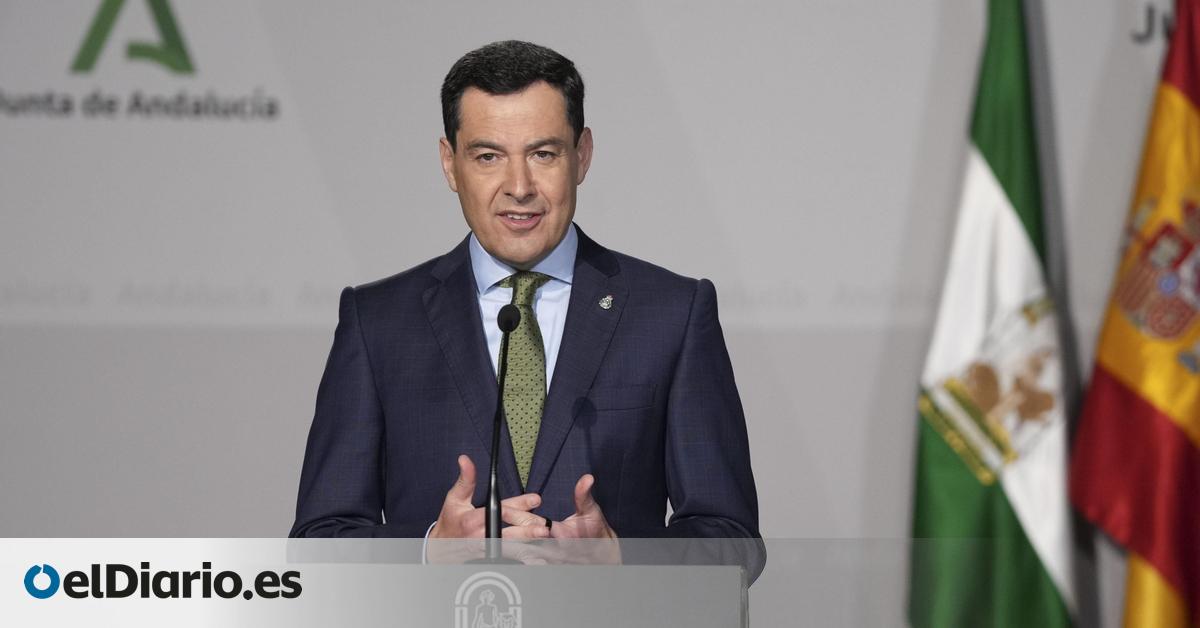
The president of the Junta de Andalucía, Juan Manuel Moreno, has called this Monday an extraordinary Government Council to report on the dissolution of Parliament and the calling of regional elections on May 17. The electoral campaign will start on the night of Thursday, April 30, the week after the Seville Fair, and in the middle of the May holiday in Córdoba.
The PP candidate for re-election has decided to end the legislature a month earlier than planned, but pushing a full four-year term almost to the end, something that has not happened in Andalusia since 2012. On Sunday, May 17, 6.5 million Andalusians are called to the polls.
Moreno starts as a clear favorite in all the polls, which place him close to revalidating the absolute majority in Parliament (55 deputies), unless the rise of Vox conditions governability in Andalusia, as is already happening in Extremadura, Aragon and Castilla y León.
The first reason given by the president for anticipating the date has been to “arrive next summer with a new Government at full capacity”, something that will happen as long as the result of the polls does not become entangled in the complex negotiations of the right and the extreme right. [Extremadura celebró elecciones hace casi cuatro meses y la vencedora, la popular María Guardiola, aún no ha sido investida presidenta].
There are other reasons that Moreno has not cited today, but on which he has been reflecting (publicly and privately) for days: the two tragedies that Andalusia has suffered in recent weeks, the Adamuz train accident, in which 46 people died, and the storm that devastated much of the territory and forced the evacuation of entire towns, have strengthened Moreno’s institutional profile. The PP is in a solid political moment, capable of revalidating its absolute majority.
Other reasons are more strange, but also influential: the Pope’s visit to Spain, between June 6 and 12, made it difficult to call the Andalusian elections on those dates, because the PP expects many of its voters to travel to Madrid and Barcelona to see Leo XIV (“ours go more than Vox’s,” they say). He has also had to overcome the complex calendar of spring festivals, between fairs, pilgrimages, the Rocío, to seek “greater participation,” he assured.
The chosen date, in fact, coincides with the Córdoba Fair, something that terrifies the PP of this province, due to the risk that many of its voters will be away that weekend (the capital concentrates more than 50% of the province’s scrutiny, and the last deputy in contention in the 2022 regional elections was won by the popular ones by very little).
Moreno has dissolved the Andalusian Parliament 48 hours before a plenary session in which two decree laws and four bills were going to be approved, including the Sustainable Tourism Law and the Law for the Advancement of Science, which are now decaying.
Andalusia, the most populated community with 8.5 million inhabitants, represents almost 20% of the national vote (61 seats in Congress), its political weight and its projection in the next general elections is much higher than that of Extremadura, Aragón and Castilla y León.
“Democratic stability and normality”
The Andalusian Government has released a video at 8:30 p.m. where Moreno has announced the election date and has announced the first driving idea of his mandate with an absolute majority: “stability and democratic normality.” The president of the Board has admitted that many have asked him to “anticipate” the elections, because his political opponents were not even prepared, but he has preferred to complete the mandate.
Moreno has spent weeks – since the electoral failure of the PP in Extremadura, last December – confronting two antagonistic ideas as a campaign slogan: “stability or trouble”, in reference to the blockade to which Vox subjects the PP in the three communities where they have won, but without a sufficient majority to govern alone.
“Stability has become a hallmark of my government,” he stressed. In these four years, the Andalusian Parliament has approved 64 laws and decree laws, a much more prolific legislative activity than in the last legislature, when the first Moreno Government [una coalición de PP y Ciudadanos] It depended on external support from the extreme right.
Since the Andalusian elections of 2022, the Board has comfortably approved four regional budgets, and has enforced that stability always in confrontation with the complex political arithmetic of Congress, which has prevented Pedro Sánchez’s Government from even presenting General State Budgets.
Moreno has also highlighted that, in this period, the Andalusian Parliament has approved a couple of opposition bills with the support of the absolute majority of the PP – “something unusual in politics” -, although the most significant – the free glasses for minors – was an initiative of the mixed group Adelante Andalucía, sent to Congress to mutate into state law. The popular president has already demanded from his adversaries a “clean, respectful, without lies and noble” campaign.
Montero leaves the Council of Ministers
Moreno’s main rival is the first vice president of the Government, Minister of Finance and general secretary of the Andalusian PSOE, María Jesús Montero, who in the coming days will leave the central Executive to focus on the Andalusian campaign. Asked if this Tuesday will be her last Council of Ministers, on Cadena Ser: “It always depends on the president, but he will be around there,” after clarifying that he has to “close pending things.”
If Moreno goes to the polls with the motto “stability or trouble,” the socialist candidate has planned these elections as “a referendum for health.” The PSOE, which scores very low in voting intention, has the challenge of mobilizing a dormant social base, which in the Andalusian elections of 2022 was around 883,000 votes, and a year later, in the general elections, it added almost 600,000 more ballots. The strategy of the socialists is not to play the trick of their acronym – today in low hours – or that of their candidate, who has not been the stimulus for the progressive electorate that they expected.
The objective is to convey to citizens that what is at stake are public services, starting with health, education and dependency. Montero accuses Moreno’s PP of planning a gradual privatization of all policies that depend on the community, based on “little by little impoverishing the public service.”
The long waiting lists of patients for the family doctor, for the specialist or for surgery have made healthcare rise to the second problem for Andalusians, behind unemployment, according to the latest Centra barometer, financed by the Board itself.
The PSOE wants to impact the most dissatisfied society there, placing special emphasis on the breast cancer screening scandal, the biggest crisis suffered by Moreno in this legislature, which resulted in the resignation of the Minister of Health and the entire leadership of her team.
Montero has already announced “an urgent plan for public health” as a first measure if she is elected president, and “housing, housing is the great challenge, giving an affordable option to young people.” He also explained that Moreno has called for two reasons, “because the public health crisis is taking him by storm” and “because he fears the rise of the PSOE.”
Three ballots to the left of the PSOE
The announcement of the electoral call has caught Vox without an official candidate and Podemos still guessing whether it will run alone or remain in the Por Andalucía coalition, together with Izquierda Unida and Sumar. Santiago Abascal’s party is the only one in Parliament that had not nominated its candidate to succeed Moreno, although in the last three electoral appointments Vox has opted for the more institutional and on-the-ground profile it had.
In this case, it would be the parliamentary spokesperson, Manuel Gavira, although he himself has ruled himself out until the national leadership of the party opens the debate on the candidates. Vox today has 14 deputies in Parliament and polls predict moderate growth that could put the PP’s absolute majority at risk. Abascal has already announced that his party will govern alongside the Popular Party if the arithmetic leaves Moreno in the minority, contrary to what they did in 2019, when they supported the investiture of the president of the PP, but chose to negotiate with him from outside the Andalusian Executive.
To the left of the PSOE there are, for now, three formations: the Por Andalucía coalition, which integrates IU, Sumar Movement and the Andalusian People Initiative, launched in October of last year, and has chosen a well-known face as its candidate for the Presidency, the former Andalusian deputy and federal coordinator of IU, Antonio Maíllo.
The confluence of the left seeks to consolidate its political project, which in this legislature has had a parliamentary group with five deputies. Maíllo did not want to arrive at the electoral meeting without clarifying the project, the names and the objectives of his coalition, as happened in 2022, which is why he has left the door open to Podemos, but in the meantime they have been choosing their electoral lists in the eight provinces and last week they presented the main lines of their electoral program.
The general secretary of Podemos, Ione Belarra, started the pre-campaign in Andalusia this Saturday, at an event in Seville, but she avoided clarifying on up to four occasions (in response to questions from the press) whether they will appear alone or in coalition with their current partners. Today, its candidate is the Andalusian parliamentarian, Juan Antonio Delgado.
The last party in the running is Adelante Andalucía, founded by the former general secretary of Podemos Andalucía Teresa Rodríguez, and whose candidate is the current spokesperson for the parliamentary group, José Ignacio García. Adelante Andalucía has two deputies, one for Seville and the other for Cádiz, but aspires to consolidate its “sovereignty, left-wing, Andalusian and anti-capitalist” project in these elections. From minute one they have distanced themselves from the debate on the unity of the left, although the ERC spokesperson, Gabriel Rufián, included them in the list of parties invoked to make their votes profitable in the next electoral events.
Source: www.eldiario.es