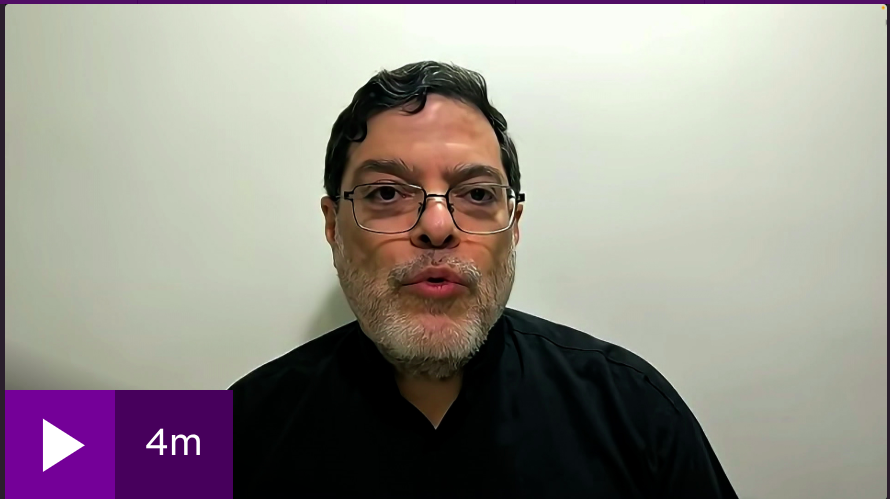
For Tehran University professor Mohammad Marandi, the Iranian resistance provides a historic service to the global majority by demonstrating, in practice, that it is possible to confront the United States and its coalition.
The assessment was made in an interview with journalist Marco Fernandes, international correspondent for Brasil de Fato in Moscow. Marandi, a literature professor and geopolitics expert, was one of the Iranian government’s consultants in the JCPOA negotiations, between 2015 and 2018.
In the conversation, he outlines a harsh diagnosis of the ongoing war, Tehran’s ability to resist, the exposed weaknesses of its adversaries and what he considers an irreversible change in the global correlation of forces.
Resistance, martyrdom and war economy
Marandi claims that the death of Ali Khamenei, on the second day of the war, had a galvanizing effect on Iranian society. According to him, the supreme leader refused to leave the place where he lived and worked because he did not accept seeking special protection while the population remained exposed to the consequences of decades of sanctions.
“He refused to leave because he told people that many Iranians, because of the sanctions, are struggling and have nowhere to go. As long as they have nowhere to go, I’m not leaving.”
The professor describes Khamenei as a deeply cultured man, knowledgeable about literature and defender of social justice. In his opinion, the leader’s sacrifice further strengthened the country’s internal cohesion.
The succession occurred quickly. The Assembly of Experts elected Mojtaba Khamenei as the new supreme leader, and his first public statement indicated continuity in the line of resistance.
For Marandi, Iran’s ability to sustain confrontation with the US and its allies did not arise by chance. It is the result of a long-term strategy, based on what he calls “resistance economy”, a concept promoted precisely by Khamenei.
“Ayatollah Khamenei was the key figure who promoted the resistance economy. In fact, that expression was something he started using publicly.”
“If they had listened to him, we would be in an even better position today.”
He cites as an example the expansion of Iranian higher education, which jumped from 175,000 students in 1979 to 4.8 million in 2015. According to his analysis, this educational base helped form the human infrastructure that allowed the country to advance in areas such as nuclear energy, nanotechnology, artificial intelligence, medicine, aerospace technology and missile systems.
Marandi also maintains that most of Iran’s military capabilities were developed domestically. For him, missiles, drones, underground bases and underground factories are the result of indigenous technology and a long process of investment in strategic autonomy.
“Iran’s capabilities are mostly indigenous. The missiles, the drones, the underground bases, the underground factories that produce more missiles and drones.”
“Indigenous technology is behind all this.”
According to him, Iran has been adopting a strategy of attrition, first using older stocks of weapons. Still, these weapons would have already caused significant damage and pushed their adversaries’ defensive systems to the limit.
Conflict and the new global correlation
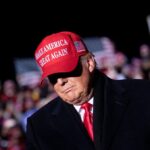
Commenting on the reasons for the American escalation, Marandi says that Washington’s decisions do not correspond to the interests of the people of the United States. In his view, the White House’s foreign policy is captured by a Zionist-aligned elite.
“Trump came into office on a platform declaring no more wars. But he is deeply under the influence of Zionists.”
“They put Israel first, not the United States.”
The professor mocks the official American rhetoric that the mission was nearing its end. For him, the US is looking for a way out of a war whose political and military cost has already become greater than imagined.
Marandi also states that the Iranian government sees no point in negotiating after having been, according to him, betrayed twice in recent negotiation processes. In this context, Tehran’s position would be to maintain pressure until its adversaries recognize their error and bear the price of the conflict.
He also denounces what he considers unprecedented censorship of images of destruction in the affected areas. In his reading, this reveals both the severity of the damage and Western hypocrisy regarding freedom of information.
“The very fact that there is unprecedented censorship and that the West goes along with it shows that things are very bad.”
“They only want freedom of information when it serves their interests.”
For Marandi, the war accelerated Iran’s rapprochement with Russia and China. Although he emphasizes that the Iranian technological base is indigenous, he assesses that convergence with Moscow and Beijing has become even more strategic given the West’s complete alignment with Israel and Trump’s policies.
In the final part of the interview, the teacher expands the meaning of the conflict. According to him, Iranian resistance is not just a national issue, but a fact with a broader historical impact, because it strengthens the self-confidence of countries that live under permanent pressure from the empire.
“Iran’s stunning success is a great victory for humanity and great news for the global majority, because it will give them power in the face of empire.”
“This will create greater self-confidence among nations.”
In Marandi’s interpretation, the ongoing confrontation has already altered the international political imagination. By imposing high costs on the United States and its allies, Iran would be demonstrating that the superpower can indeed be confronted.
Source: https://www.ocafezinho.com/2026/03/16/mohammad-marandi-o-ira-esta-humilhando-os-estados-unidos-no-campo-de-batalha/