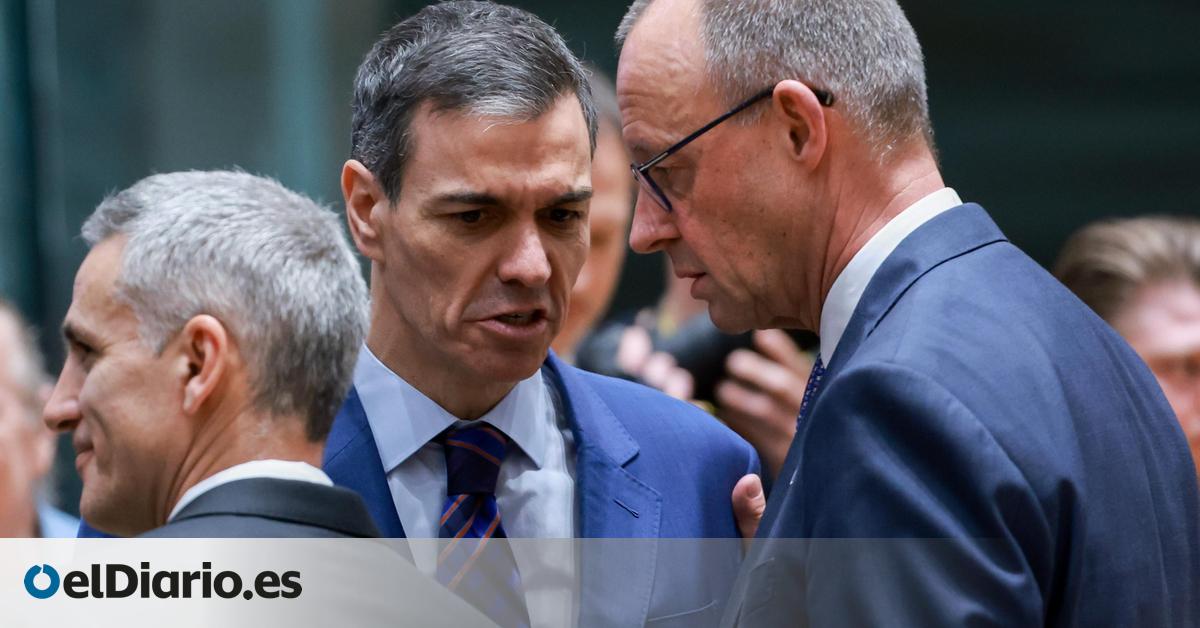
In the European response to the economic effects of the crisis in the Middle East, unleashed by the unilateral attacks by the United States and Israel against Iran, there is more of “all for one” than “one for all.” The Twenty-seven member states were unable to close, this Thursday, an urgent solution to the skyrocketing prices that are already biting the pockets of citizens from Lisbon to Warsaw. But practically everyone, on their own, has given the green light to measures that focus on the price of fuel and gas stations.
And Spain has not been the exception. The Council of Ministers approved this Friday, in an extraordinary meeting, what La Moncloa has called the Comprehensive Response Plan to the Crisis in the Middle East, a compendium of 80 measures worth 5,000 million euros, which is balanced between cyclical measures to respond to the rise in prices and other structural measures (which recover the bulk of those that declined in response to the blackout) to reinforce the strategic autonomy of the Spanish energy network.
“When the plan that we have approved today comes into force tomorrow, Spain will become the country with the greatest social and economic shield in the entire European Union in response to this illegal war that we do not endorse,” President Pedro Sánchez said solemnly in his appearance after the extraordinary meeting. A package that ended up divided into two regulations, after a cabinet meeting that started very late due to the refusal of Sumar’s ministers to sit at the table unless measures were adopted on housing.
The Spanish response, in which the bulk of aid (2.5 billion, according to government sources) corresponds to tax reductions, is not too far from what the rest of Europe is giving. In our case, with tax cuts focused on fuel (VAT at 10% for gasoline, for example) and with specific aid for the most affected sectors, such as the countryside, transportation or electro-intensive industries.
But it follows in the footsteps of Germany, which has decreed that gas stations will only be able to raise prices once a day and has established reinforced surveillance of abusive practices. There is even a tax on the extraordinary profits of energy companies, like the one that was in force in our country until 2024. Or France, which has imposed greater administrative controls regarding the prices of service stations. Italy has introduced a sanctioning mechanism against speculation.
These are just some examples of these independent measures that each of the Member States are adopting to confront a crisis that, according to the executive director of the International Energy Agency, Fatih Birol, has become “the greatest threat to energy security in history.” According to the International Monetary Fund (IMF), there are already significant changes on a global scale that anticipate a slowdown in the economy. In the case of Spain, the institution has cut its growth forecasts by two tenths for 2026 (up to 2.1%) and to 1.8% in 2027 (one tenth less) only due to the effects of three weeks of war in the Middle East. And the European Central Bank already anticipates that inflation will skyrocket and has raised its tone in relation to interest rates, although without a scenario of changes in monetary policy in sight.
Community measures will have to wait
A unified response from the European Union is another story. There were many expectations about the European Council this Thursday, since the approval of measures to fight against the rise in energy prices caused by the war in Iran was expected. The President of the European Council, António Costa, arrived at the meeting with the speech that “high energy prices are one of the biggest challenges for the competitiveness of the European Union. We must be more autonomous using our own clean energy sources. We need to take immediate measures to protect our citizens.”
The president of the European Commission, Ursula Von der Leyen, had already sent a previous letter to the leaders of the 27 EU countries marking the lines along which the possible measures were going to run. Von der Leyen pointed out that “the lessons of the past must be learned. A key lesson of the 2022-2023 crisis was that many of these measures were broad and not very selective, which caused inefficiencies and very high fiscal costs”, so she proposes that “any short-term measure: does not delay the decarbonization of the energy system, does not increase the demand for oil and gas, is temporary, targeted and minimizes fiscal costs.”
After 12 hours of meeting, once again, the EU managed to make another nice statement without saying anything because there were no measures to announce. The summit conclusions specify that “given that the conflict in the Middle East has an immediate impact on energy prices for European citizens and companies,” the Commission is urged “to present without delay a set of specific temporary measures to address the recent increases in the prices of imported fossil fuels arising from the crisis in the Middle East.”
That is, a meeting is proposed to approve measures to urgently solve a problem, but at said summit only a request is approved to design measures for which another meeting will be necessary for approval. In theory, the EU is following a process of simplifying rules and processes to speed up procedures as a boost to competitiveness. At the moment, it seems to be failing.
Yes, the lines were redrawn (which were already in Von der Leyen’s letter) with grandiloquent words about the objectives to reduce energy prices ranging from “the intention to increase the market stability reserve” to “addressing excessive short-term volatility, even for energy-intensive sectors, taking into account the different situations between Member States” to “working closely with Member States to design temporary and specific national measures aimed at mitigating the significant impacts of fuels” and always preserving “signals long-term investment, supporting the acceleration of renewable and low-carbon energy production, and ensuring a level playing field in the internal market.”
Boost to renewables, the Spanish recipe
On a positive note, the same strategy that Spain has maintained in recent years to promote renewable energies to eliminate dependence on fossil fuels is proposed. The 27 EU countries agreed that “recent spikes in imported fossil fuel prices demonstrate that the energy transition remains the most effective strategy to achieve Europe’s strategic autonomy” and “structurally reduce energy prices”, so that “accelerating the deployment and integration of renewable and low-carbon energy sources, as well as energy storage, is essential to reduce dependence on volatile fossil fuel markets and improve security of supply.” In fact, the President of the Government, Pedro Sánchez, put Spain at the top as a model at the energy forefront in Europe thanks to the Government’s commitment to the deployment of renewable energies that “is making our fellow citizens, our industries, our companies, our workers, and our homes suffer less impact on the price of gas.”
One of the reasons for this paralysis within the EU was due to the fact that a good part of the discussion on energy measures was dominated by the group of countries, led by Italy and Austria, that seek the temporary suspension of the taxation mechanism on carbon emission rights, known as ETS. This tool, which Spain along with another group of Member States defends because it reduces polluting emissions and increases income, is being questioned because countries consider that CO2 prices harm the competitiveness of their industries.
In this discussion between what is urgent and what is important, neither one thing nor the other was done. Von der Leyen proposed increasing investments in the ETS with 30 billion euros, financed with 400 million permits through a first-come, first-served allocation scheme where European countries with less income will prevail. There will also be an update of the parameters that determine how many free permits each industrial sector receives and a proposal for the offer of permits. The system will be reviewed, but in no case will it be suspended. In the summit conclusions, the leaders called on the Commission to carry out the review of the ETS “by July 2026 at the latest, to reduce carbon price volatility and mitigate its impact on electricity prices… while preserving its essential role.”
The European Summit began with a clear statement: “Specific short-term solutions are needed to ensure affordable energy, taking into account technological neutrality and the particular situations of Member States, the special exposure of certain industrial sectors to the risk of relocation and the need to improve conditions for innovative energy-intensive sectors, without undermining predictability or a level playing field.” Without measures yet to be finalized at the European level, it was agreed that “the European Council will discuss these matters again in June 2026 to review progress.” Meanwhile, the United States and Israel bomb Iranian gas fields and Iran responds with attacks on oil infrastructure in the Gulf, increasing the price spiral. The short term of the EU.
Source: www.eldiario.es