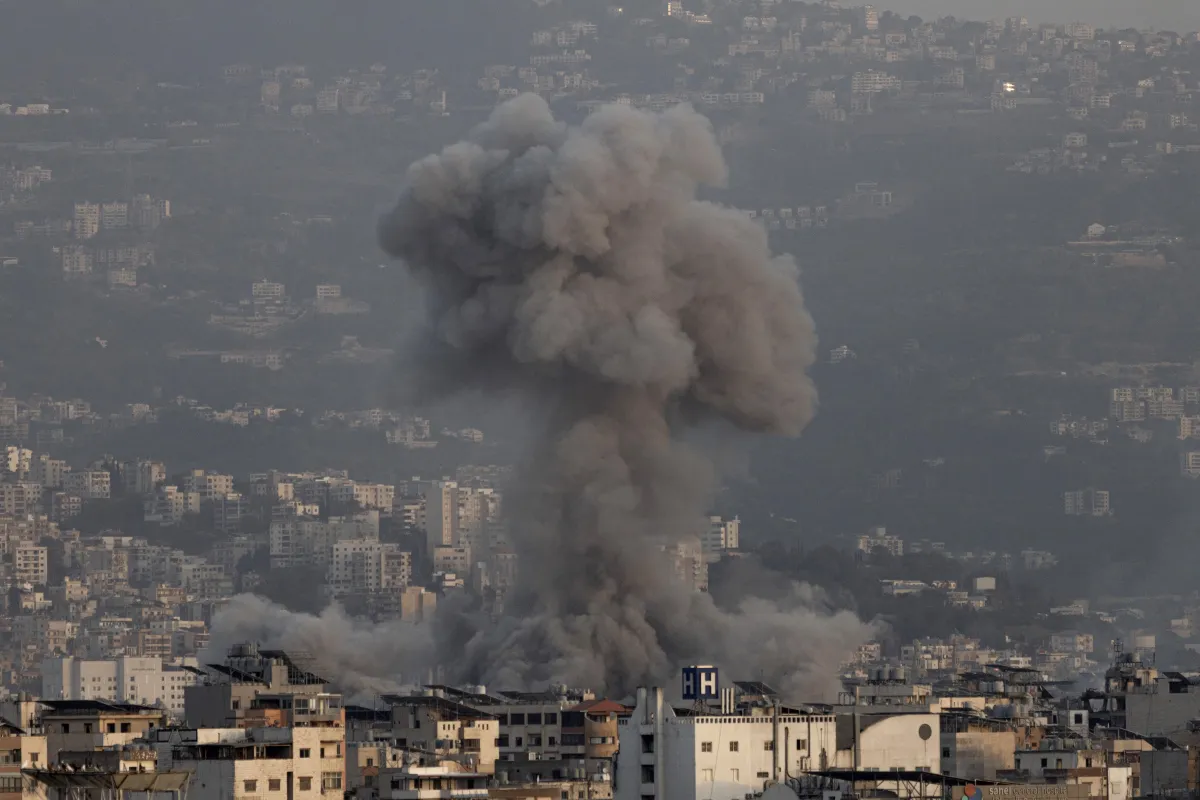
Israeli airstrikes hit the southern suburbs of Beirut and several areas of southern Lebanon in the early hours of Monday (16), amid the escalation of the conflict between Israel and the Shiite group Hezbollah. The offensive is part of a new phase of the war that has intensified in recent weeks and increased the risk of a broader crisis in the Middle East.
According to the Lebanese state agency National News Agency (NNA), multiple bombings were recorded both in the capital and in cities in the south of the country. Images released by international agencies show large columns of smoke forming over neighborhoods on the southern outskirts of Beirut, an area known as Dahieh and considered one of Hezbollah’s main political and military strongholds.
The Israeli Army said the attacks were part of operations against the Iranian-backed armed group’s military infrastructure. In recent days, the Israel Defense Forces (IDF) also announced the start of limited ground operations in southern Lebanon, with the stated aim of targeting Hezbollah positions and reinforcing defensive lines near Israel’s northern border.
According to Israeli authorities, these operations target bases, weapons depots and rocket launch positions used by the group. The offensive comes after a series of rocket attacks fired from Lebanese territory against Israeli cities and military positions.
Hezbollah said it carried out at least five attacks against Israeli targets this Monday. On Sunday (15), the group said it had launched around 25 attacks against IDF positions and areas in the Golan Heights, Syrian territory occupied by Israel since 1967.
The current military escalation is part of a broader conflict that intensified after the start of the war involving the United States, Israel and Iran at the end of February. Since then, clashes between Israel and Hezbollah have escalated sharply on Israel’s northern border and in Lebanese territory.
According to data from the Lebanese Ministry of Health, at least 850 people have died and more than 2,100 have been injured in the country since the beginning of the current phase of the conflict.
The bombings also caused a serious humanitarian crisis. Estimates indicate that more than 800,000 people have been displaced within Lebanon since the start of the offensive, representing around 15% of the country’s population.
Many families who fled the hardest-hit regions moved to cities such as Sidon and Beirut. However, improvised shelters and collective centers are already overcrowded, forcing part of the displaced population to live in cars, unfinished buildings or improvised structures.
International organizations warn that the humanitarian situation could quickly worsen if the fighting intensifies. The UN recently stated that civilians are the main victims of the military escalation and called for urgent efforts to prevent a further deterioration of the conflict.
Bombings have also hit densely populated areas of the Lebanese capital in recent days. In an attack on March 12 in the coastal region of Ramlet al-Baida, in Beirut, at least eight people were killed and more than 30 were injured after an airstrike hit an area where displaced families were sheltering.
The current conflict comes just months after a partial truce reduced fighting between Israel and Hezbollah in 2024. Even after the ceasefire, however, sporadic attacks and shelling continued to occur along the border.
Source: https://www.ocafezinho.com/2026/03/16/israel-bombardeia-beirute-e-sul-do-libano-enquanto-hezbollah-anuncia-ofensiva-contra-o-pais/