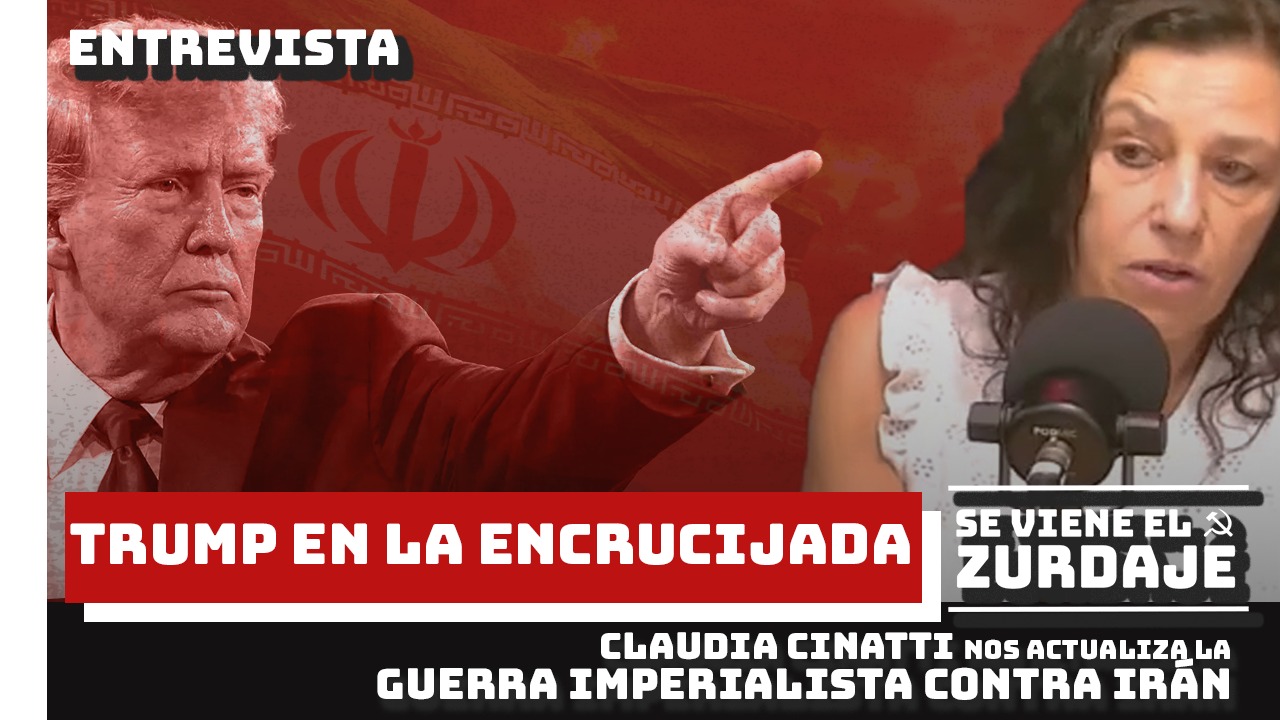
The last segment of Se is coming left-handed addressed the international scenario regarding an eventual escalation of war between the United States, Israel and Iran. The guest, Claudia Cinatti, analyzed the causes, the global context and the possible consequences of the conflict.
Cinatti stated that “the order that governed interstate relations, which allowed North American hegemony during the second postwar period, no longer exists.” In that sense, he maintained that the world is going through a transition in which “the old is no more, but there is no defined new order nor who dominates it.”
As he explained, Donald Trump’s foreign policy should be read as an attempt to recompose American leadership: “in the face of the crisis of North American hegemony there is an attempt to recompose that dominance through force.” For Cinatti, Trump is not the cause of the crisis, but rather “a response to that decline,” in a scenario where “a competing power like China emerged” and also “other intermediate powers that pursue their own interests, like Russia.”
The analyst also highlighted that Trump’s speech against wars was misinterpreted: “his proposal of not getting involved in wars should not be confused with a pacifist position.” On the contrary, he explained that his strategy is based on “the two strong points that the United States still has: the Pentagon and the dollar,” combining military and economic pressure.
In relation to the alliance with Israel, Cinatti pointed out that there is a strong discussion within the United States. “There is a wing that says Trump was dragged by Israel into a war that was not in its national interest,” he said. At the same time, he mentioned criticism from sectors of the right that suggest that “instead of ‘America First’, the government is acting like ‘Israel First’.”
Regarding the role of the Israeli government, he maintained that its objectives are clearer: “Netanyahu seeks to reaffirm Israeli hegemony in a hostile region.” In this framework, he linked the current offensive with a broader strategy that includes “the genocide in Gaza, the advance on the West Bank and the extension of the conflict to other fronts such as Lebanon and Syria.”
In contrast, he described Trump’s policy as changing: “he went from talking about regime change, to curbing the nuclear program, to regime adjustment.” Currently, he noted, the main problem would be another: “opening the Strait of Hormuz,” something that “until now has not been able to achieve.”
Cinatti explained that the United States’ initial hypothesis—a quick victory—“was shown to be totally false.” Instead, he highlighted that Iran deployed an expected strategy: “in a symmetrical war it cannot defeat the United States and Israel, but it can complicate the situation, prolong the conflict and generate economic disruptions.”
In that sense, he stressed the importance of the Strait of Hormuz: “around 20% of the world’s oil passes through there,” and its blockade is already having consequences. “The price of oil increased between 30 and 40%,” which directly impacts the global economy and the internal situation of the United States.
On the domestic level, Cinatti maintained that Trump faces an adverse scenario: “the war is absolutely unpopular” and his approval level is around “38%.” Unlike other conflicts, he explained, “it did not generate an effect of national unity.” In addition, he mentioned “divisions within the Republican Party” and social conflicts that weaken his position.
Finally, from a political perspective, Cinatti explained the position of leftist sectors regarding the conflict. “Despite the reactionary nature of the Iranian regime, it is an oppressed nation,” he said. In this framework, he maintained that “a defeat of the United States and Israel would weaken imperialism” and could “generate more favorable conditions for the struggles of the people.”
Source: www.laizquierdadiario.com