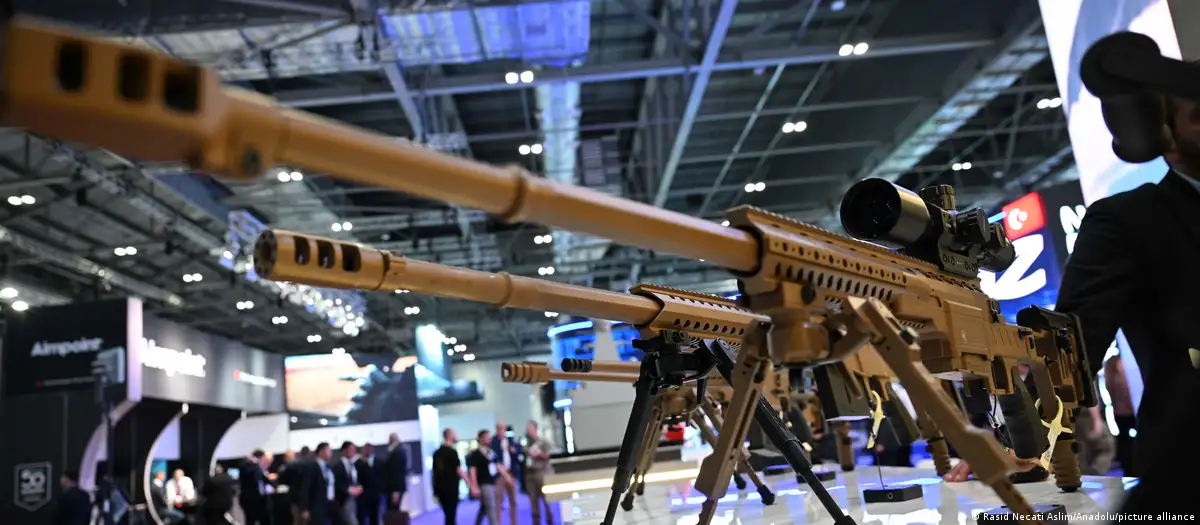
Continente became the largest global buyer for the first time since the 1960s, according to a study. The USA is now consolidating itself as a major supplier in a multipolarized world.
Global arms flows have grown by almost 10% in the past five years, with Europe more than tripling its imports, the latest data from the Stockholm International Peace Research Institute (Sipri) shows.
Although European imports are not yet at the levels seen during the Cold War, the continent is now the largest arms destination in the world, for the first time since the 1960s, according to a report released this Monday (09/03).
In the period analyzed, between 2021 and 2025, European countries accounted for 33% of global arms imports, compared to 12% in 2016 and 2020. The institute analyzes trends in blocks of five years because some deliveries of large contracts can distort annual numbers.
“Deliveries to Ukraine since 2022 are the most obvious factor, but most other European countries have also started importing many more weapons to bolster their military capabilities against a perceived growing threat from Russia,” said Mathew George, director of Sipri’s Arms Transfers Program.
The other regions that received the most weapons are, respectively, Asia and Oceania (31%), the Middle East (26%), the Americas (5.6%) and Africa (4.3%). In the Americas, growth was 12%.
Brazil received 21% of the total imported between 2021 and 2025 in the region, behind only the United States (52%), and 60% in South America. The country is the twenty-fourth supplier of weapons in the world (0.3% of the global total), with Portugal as the main buyer, and the twenty-fifth importer (1.2% of the global total), being supplied, above all, by France and Sweden.
More sales from the US, less from Russia
Almost half of the weapons destined for Europe (48%) came from the United States, followed by Germany (7.1%). Americans are the world’s leading exporters, accounting for 42% of all international arms transfers in the period analyzed — notable growth compared to the 36% recorded in the previous five years.
Under Trump, the White House views arms exports as an instrument of foreign policy and a means of strengthening its defense industry. “The US further consolidates its dominance as an arms supplier, even in an increasingly multipolar world”, points out Pieter Wezeman, senior researcher at Sipri.
Germany is the 4th largest exporter
In turn, Germany overtook China and became the fourth largest arms exporter between 2021 and 2025, with 5.7% of global exports. In second and third place come respectively France (9.8%) and Russia (6.8%).
In the Russian case, there was an abrupt drop of 64% during the period, in which the last four years were marked by the war in Ukraine. The country uses more of its own equipment against its neighbor, while the United States and Europe pressure third countries not to buy Russian weapons.
In the context of high regional tension, the largest arms importer among the member states of the North Atlantic Treaty Organization (NATO) in Europe is today Poland, which borders Ukraine and Belarus. As the country seeks to strengthen national defense, the volume of imports increased by 852%.
European weapons around the world
Despite its leaders speaking about the need for Europe to become more self-sufficient, transfers between countries on the continent represented only a fifth of its flows.
“European suppliers still mostly export outside of Europe, not within the continent,” said George.
In the case of Germany, almost a quarter of exports (24%) went to Ukraine, and only 17% went to other European countries. That is, more than half left the continent, mainly to Egypt (14%) and Israel (10%).
Last year, Germany imposed a partial embargo on arms sales to Israel, suspending the supply of military equipment that could be used in Gaza. Exports reached zero, before the measure was reversed three months later. The German government conditioned the resumption of arms sales on maintaining the ceasefire concluded between Israel and the Palestinian group Hamas.
Total Israeli imports increased by 12%, making the country the fourteenth global recipient. The United States supplies 68% of the weapons and Germany, 31%. The country’s exports also grew by 56%, “helping to strengthen the domestic arms industry to support Israel in its multi-front war,” Sipri said.
Perspectives in the Middle East
Arms imports to the Middle East fell 13%. Still, three of the world’s largest importers continue to come from the region, which received more than half of its weapons (54%) from the United States.
Saudi Arabia accounted for 6.8% of global imports, while Qatar and Kuwait represented 6.4% and 4.8%, respectively.
“Going forward, there is a long list of pending delivery systems to the Middle East. When those deliveries occur, we could see those numbers go up,” George told the AFP news agency.
The region has been at war since February 28, when the United States and Israel began bombing Iran, and the consequences of the conflict cannot yet be predicted for the arms trade. Geopolitical tensions, however, often affect the closing of new contracts, with security crises boosting sales.
China invests in its own production
Meanwhile, China and India “are seeking to develop and produce defense technology domestically,” said George, in yet another explanation for the drop in Russian exports.
In the Indian case, the country has also sought to diversify suppliers. Pakistan has also significantly increased its imports. Both countries have been among the world’s top ten arms importers over the past five years.
China’s shift toward domestic production and away from Russian imports caused its total imports to fall by 72%. The country dropped out of the list of the top ten importers for the first time since the early 1990s, according to Sipri.
“Fears about China’s intentions influence weapons efforts in other parts of Asia and Oceania, which often still rely on imported weapons,” according to Wezeman. Japan increased its arms imports by 76%, while Taiwan increased itss by 54%.
Originally published by DW on 03/09/2026
Source: https://www.ocafezinho.com/2026/03/09/europa-triplica-importacoes-de-armas-em-tensao-com-a-russia/