The internal commission of the Teaching Union Association of the Faculty of Economic Sciences of the UBA has just published its “Report on Salary Evolution of the Salary of University Teaching in Argentina N°4”. “The song without end”, they gave it the title, and unfortunately the title is accurate: the drop in teaching salaries does not seem to find its bottom, despite the historic marches that won the University Financing Law that, if fulfilled, would restore some of what was lost in the last decade. But Milei’s government is not complying.
“In the long-term analysis – the report states – it is observed that The level of the real salary of university teaching is at its historical minimum: 35.6% below November 2023, even 2.7% below the worst levels reached in 2004. In recent months, while our basic salary increased 4.3% since September, accumulated inflation was approximately 14%.
1) ‼️The level of the real salary of university teaching is at its historical minimum:
35.6% below November 2023 and even 2.7% below the worst levels reached in 2004!!I share a report prepared by AGD Económicas 👇 pic.twitter.com/eZfiWftkbx
— Lucía Ortega (@OrtegaLu_) March 13, 2026
The University Financing Law won in August 2025 based on the 2024 mobilizations, which included takeovers in more than 100 faculties throughout the country and two historic mobilizations, establishes that the current basic salary “should increase by 55.4%.”
On the other hand, the report indicates that if the salary loss is added month by month since November 2023, university professors lost “the equivalent of 11.5 current salaries (almost a year).” In other words, “for every 3 months worked, they paid us 2,” he concludes.
But even this recomposition would be partial, since it would only lead to the similar salary levels of 2006 or 1999. To recover the purchasing power levels of November 2015, an increase of 105% would be necessary.
Instead, the government is negotiating with the rectors a new law so that the increase is only 12.3% and in three installments, the last to be collected in September, which would render the current Law ineffective and would also have a negative effect on student scholarships, which would have to be recomposed by 63.7% so that the stipend of 35,000 pesos recovers the purchasing power of 2023 (not including the indexation by inflation, which the Law does not contemplate). As a negotiation pledge, the government includes in its new law a fixed amount of 80 billion dollars for operating expenses, mainly university hospitals in the case of the UBA.
The situation is unsustainable and Every day we see how our fellow teachers are forced to abandon teaching due to the impossibility of being able to pay even the minimum mobility expenses to teach classes.. More than 10,000 were calculated by the CIN, only until 2025. To give some examples, in the Faculty of Agronomy of the UBA there is already a poster with the number of teachers who have resigned to date (83) and in the Superior Council of the University of Comahue, this week alone 16 teacher resignations were dealt with.
From the rectorate of the UBA Yacobitti attacks the teaching strike and winks at the Milei government
But Milei is not alone in the attack on teaching: the rectors are, as we said, negotiating with Milei, while they balance the crisis and the anger from below.
What happened in the session of the Superior Council of the UBA on Wednesday the 11th illustrates this well. While the rectorate presented a motion that is limited to demanding that the government apply the University Financing Law, while the student minority presented a motion that adds a repudiation of the government’s attempt to pass the reform. Well, the rector’s office avoided denouncing this maneuver and Emiliano Yacobitti, vice-rector of the UBA and Head of the Buenos Aires UCR, took the floor to state that the government is strong, fighting against the teaching strike and opening the door to a negotiation.
“The situation is more complicated than the previous year,” he noted, given that “society supported this government in the elections” and the government “has greater power to veto any of the laws that we want to pass” (sic). So “we must achieve the greatest possible social consensus for each of the things and measures that we are going to carry out.” “We must be firm regarding compliance with the law,” but, be careful, “we have a particular situation at the UBA,” since the adjustment to operating expenses “by mistake” (sic) did not cover that of the university hospitals, which were not updated. But he then stated that “we always have to work for the positive”, “do it with full classrooms and giving classes” so as not to play into the hands of the government. And they are taking action against “extreme measures” for an indefinite period of time, which – he points out – complicate life for society, not for the government, which uses the strikes to discredit the university. “We need to dialogue with the national government to discuss the university of the future, not just recompose a situation to be able to remain open.”
The maneuver is clear: while outwardly it calls for the application of the Law, it opens the door to a negotiation if there are funds for the hospitals (which the government has already included in its proposed Law) and goes against the fight plan that we teachers are promoting.
But the Law was achieved with strikes, power takeovers and historic marches that imposed that those who voted for the main laws for the government – with similar arguments about their strength – and who had previously raised the measures of struggle with their rectors in the CIN and the union leaderships, had to vote for it. Today, along with the crisis entailed in the direct desertion of teachers, the anger is expressed daily in groups in the hallways, WhatsApp groups and meetings. The government, for its part, far from the strength that Yacobitti boasts, does not stop falling in the polls, with rising inflation, increased layoffs, industrial destruction, extractivist attack (Glacier Law) and scenes of treacherous nepotism and corruption on the part of the “heartless” chief of staff.
Deepen the fight from below
In this framework, the base assemblies of Conadu (Córdoba, Rosario and La Plata, among others) and Conadu Historica (UBA, Tucumán, among others), within the CTA (in total 15 base associations), voted for the mandate of unemployment for an indefinite period. But the Extraordinary congresses of these federations, for their part, resolved a one-week ring in the week of March 16 to 21 and in the March 30 and 31 strike (in ConaduH, the vote was close, 41 to 57; Conadu added a full-week strike in the week of Monday, April 27). Faduna university teaching union enrolled in the CGT, directly calls, together with FATUN (non-teachers) to stop only one day, March 16. But, in turn, the leadership of Conadu as Conadu Historica, joined the “University Union Front”, together with FATUN, FAGDUT, Ctera and UDA, with an action plan that calls only for… “a week of protest from 3/16 to 3/21”.
As in 2024 together with the rectors, and as before, in the great struggle of 2017, the union leaderships limit the struggle, several of them aligned with political sectors of Peronism that only think about the 2027 elections. The force to impose the Law will come from the organization from below, together with students and non-teachers, and other sectors in struggle, independently of governments and rectors.
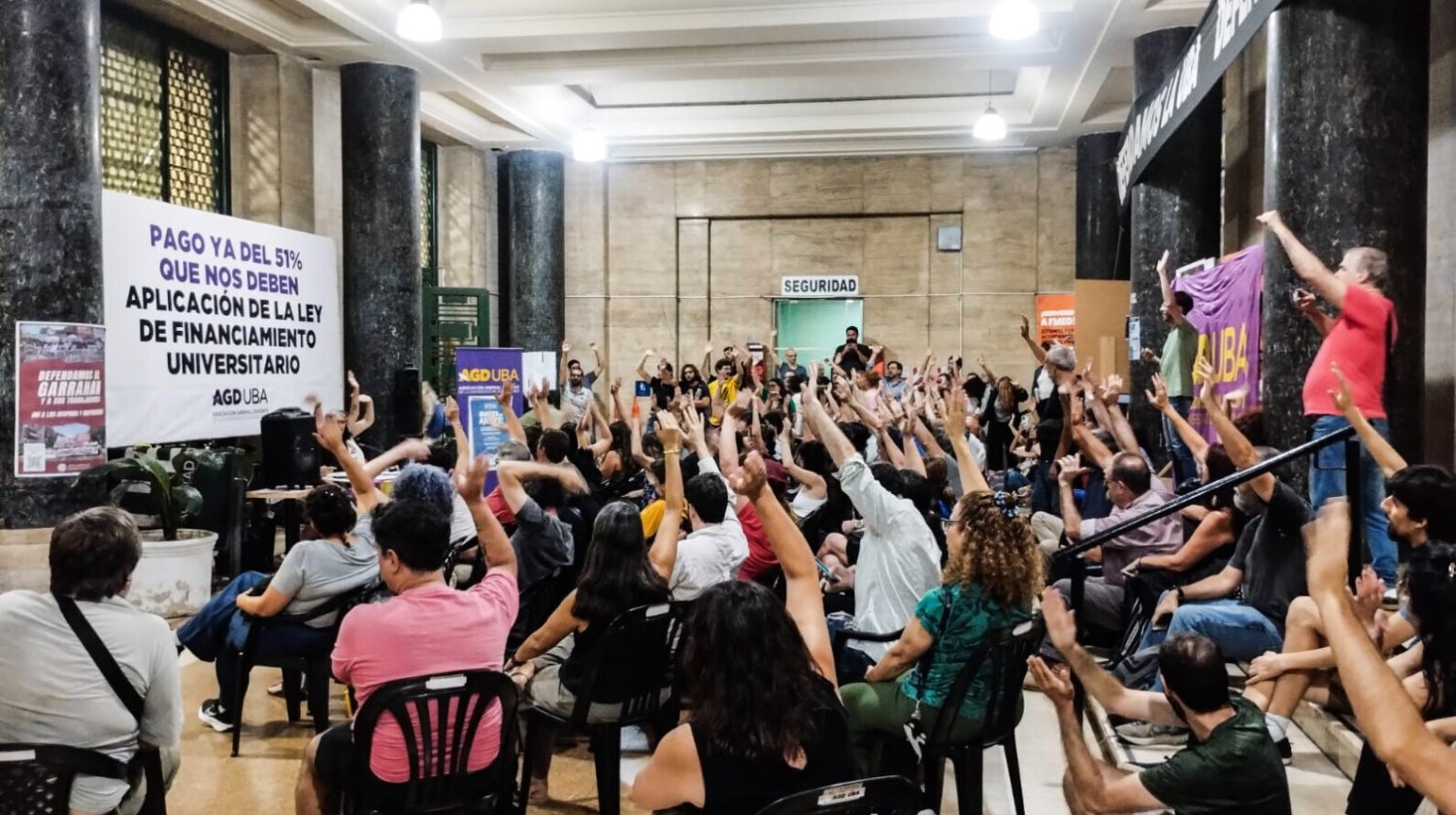
And precisely from below, from the UBA Teachers’ Union Association, assemblies are being held in the different Faculties preparing the strike week for the week of the 16thwith visibility activities and instances to come together with students and non-teachers:
- The assembly of Philosophy and Letters students of the UBA, with the participation of teachers, has already taken the first step and resolved make the conflict visible and join the fight with a cut on Monday, March 16 in Puán and Rivadavia at 8 am and a vigil at the faculty that will take place during the week voted.
- The assembly of teachers Medicinefor its part, decided to carry out a hug to the Faculty on Wednesday 3/18 at 3 p.m. along with non-teachers and students.
Due to the application of the University Financing Law, teachers, many of whom are students, are going to a hug at the Faculty of Medicine this Wednesday 3/18 at 3 p.m., together with non-teachers. Each one has a role in training us to serve public health, join in! pic.twitter.com/hqsXDxKFMW
— Paula (@fracastastica) March 13, 2026
Source: www.laizquierdadiario.com