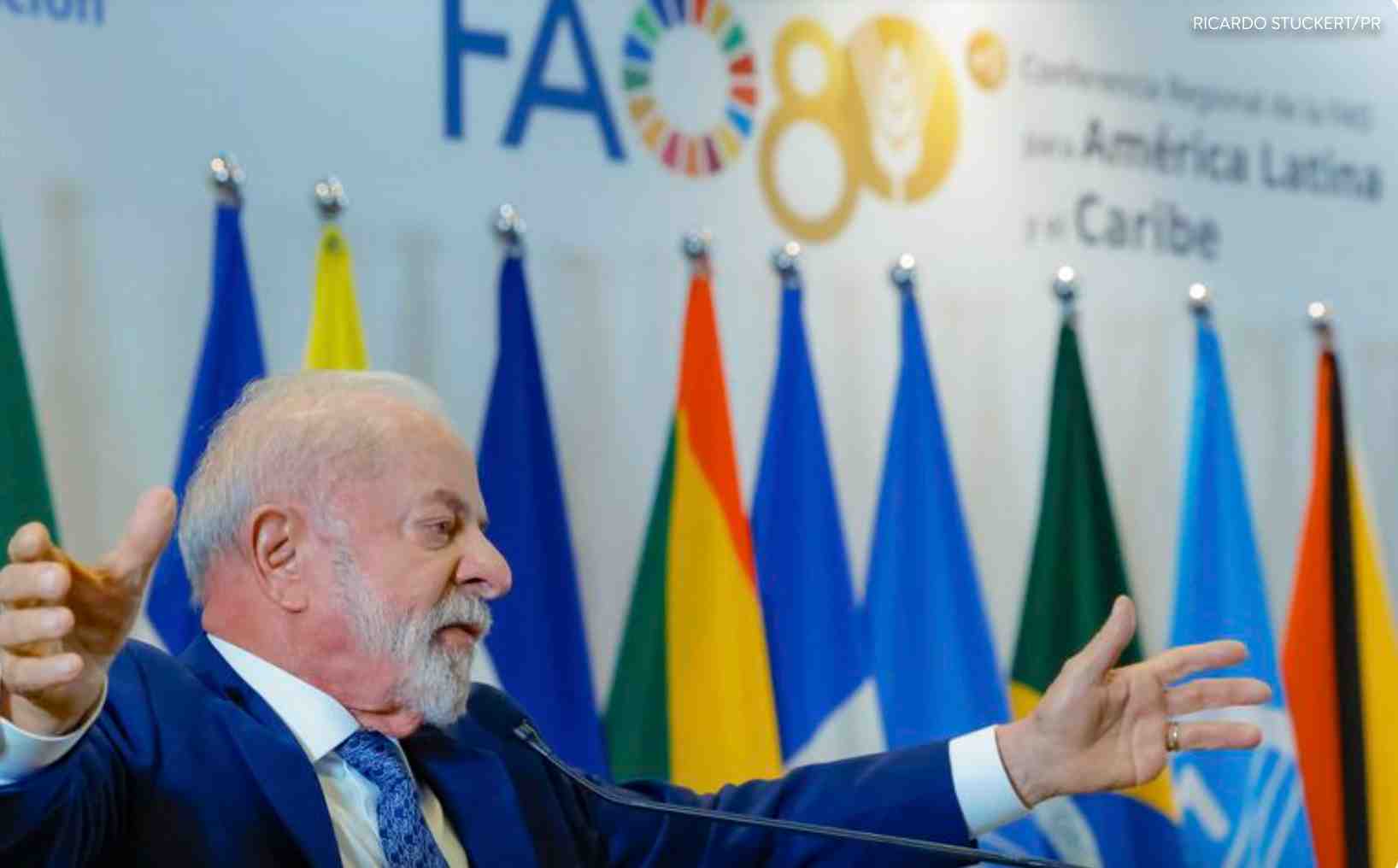
President highlighted, during the United Nations Food and Agriculture Organization Conference, the country’s exit from the Hunger Map
During a speech at the 39th Regional Conference of the Food and Agriculture Organization of the United Nations (FAO) for Latin America and the Caribbean (LARC39), President Luiz Inácio Lula da Silva highlighted that Brazil has demonstrated that it is possible to reduce hunger through public policies aimed at food production, strengthening agriculture and increasing the population’s income, citing Brazil’s exit from the Hunger Map.
“Brazil has set an example twice, it is possible to end hunger. It is possible to guarantee that everyone has the right to have breakfast, lunch and dinner every day. It is completely possible”, he stated.
The opening ceremony, held in Brasília (DF), took place this Wednesday, the 4th. The meeting is the organization’s main regional forum for defining priorities and strategic alignment of the organization’s actions in the 2026-2027 biennium.
Work Priorities
The FAO Regional Conference for Latin America and the Caribbean takes place every two years as a space for technical and political dialogue on the region’s advances and challenges in the areas of agriculture, rural development and food and nutritional security. The meeting contributes to defining the Organization’s work priorities for the following years.
“This is what the message has to come out of, from a conference that involves Latin America, which is a rich part of the world, which has practically everything that nature has offered to all human beings and which are often exploited by people who are not from here to produce part of the weapons that destroy what has already been built”, declared the president.
Lula also stated that global resources could be directed more effectively to combat poverty and food insecurity. “It is due to excessive irresponsibility, it is due to an excessive lack of commitment that we are unable to exterminate hunger on planet Earth, which already has genetic knowledge, already has technological knowledge, already produces more food than we should consume and this food does not reach people’s homes. Meanwhile, the important people on the planet who should be worried about hunger are worried about war”, stated Lula during his speech.
80 years of FAO
The Conference takes place alongside the celebrations of FAO’s 80th anniversary. During the event, Palácio Itamaraty hosts stands from the Brazilian government and an exhibition commemorating the anniversary of FAO and Brazilian South-South cooperation, highlighting the main initiatives and programs developed in Latin America and the Caribbean. In addition to foreign authorities, representatives from international organizations, the academic sector, civil society and the private sector participate.
“We cannot treat the issue of hunger as if it were an NGO issue, as if it were like this: ‘if there is more, there is. If there is no surplus, there is no’. It has to be treated as a matter of priority, zero priority. It is a sacred right, everyone has to have breakfast, lunch and dinner every day”, added President Lula.
As host country, the Government of Brazil participates in discussions and parallel activities at the conference, including debates on trilateral South-South cooperation developed by the Ministry of Development and Social Assistance, Family and Fight Against Hunger (MDS), in partnership with the Brazilian Cooperation Agency (ABC) and FAO.
Food Safety
Mauro Vieira, Minister of Foreign Affairs (MRE), highlighted that Brazil has placed the fight against hunger back at the center of public policies. Furthermore, he highlighted the role of Latin America and the Caribbean as strategic for food security. “We are major food producers and an innovative agri-food powerhouse, deeply connected to the land, waters and forests. We are the first region to make a collective commitment to eradicate hunger,” said Vieira.
“By hosting this Conference, Brazil reaffirms its conviction that multilateralism must produce concrete benefits for our populations. Few objectives are as urgent as ensuring that no one goes hungry anymore. I hope that this meeting produces clear guidelines and robust commitments that live up to the expectations of our people”, added Mauro Vieira.
Family Farming
Paulo Teixeira, Minister of Agrarian Development and Family Farming (MDA), co-president of the FAO Latin American Conference, highlighted that the Conference takes place after a period of Brazilian presidencies in international forums, such as the G20, the BRICS and the UN Climate Convention, in which agriculture and food systems played a central role.
“Today, we know, based on data from FAO itself, that family farming is an essential part of the solution to the major crises of our time, hunger, poverty and the environment. Therefore, it is essential to support family farming with policies on access to land, credit, technical assistance and rural extension, public purchases, encouraging cooperativism and strengthening the economic autonomy of women, young people, traditional peoples and communities”, declared Teixeira.
The minister also defended the strengthening of international cooperation and more sustainable production systems as ways to guarantee food security. “To accelerate the ecological and agroforestry transition, it is necessary to invest in the productive systems of family farmers, peasants, including young people, indigenous peoples, Afro-descendant rural communities, people from traditional communities, small fishermen and animal breeders settled from agrarian reform and rural workers”, he stated.
Dialogue and Commitment
Minister Carlos Fávaro, of Agriculture and Livestock, highlighted that facing challenges such as food inflation, hunger and the impacts of climate change requires international cooperation and investment in science and innovation. “In a scenario of growing challenges, strengthening the resilience of food systems is a task that requires cooperation, dialogue and commitment to science. Each country present here brings valuable experiences and we have a duty to share them”, he highlighted.
Fávaro also mentioned Brazilian actions to combat hunger. “It is an honor to share the advances in Brazil in the bioinputs, science and innovation agenda. In 2025 alone we were able to register 139 new biological inputs with the Ministry of Agriculture, a record that demonstrates the dynamism of this sector. Today, in Brazil, more than 80% of our soybean producers use biological nitrogen fixation, reducing costs, reducing dependence on nitrogen fertilizers and contributing to the mitigation of carbon emissions”, he said.
Cooperation
For the director general of FAO, Qu Dongyu, Latin America and the Caribbean have been making progress in the fight against hunger, with a consistent reduction in recent years thanks to effective public policies and cooperation between countries. “Agri-food systems provide livelihoods for more than 100 million people in this region. Women in rural areas, young people, indigenous peoples and small-scale farmers are extremely important for local economies, as well as the food supply chain. FAO has supported countries to improve their expertise in relation to soil management, the expansion of digital agriculture, also strengthening animal and crop health,” he said.
Fome Zero
The director stated that some countries in the region already have low rates of malnutrition and others are on track to achieve the goal of Zero Hunger by 2030. “We are here to leverage the transformation of our agri-food systems so that they are more efficient, more inclusive and more sustainable, so that we can truly achieve better production, better nutrition, a better environment and better life for everyone. This region is a leader in innovation and precision agriculture”, he highlighted.
Ambassador
During the ceremony, the First Lady of Brazil, Janja Lula da Silva, received the title of FAO Goodwill Ambassador Against Hunger. “It doesn’t matter if you are a refugee, migrant or living in a country of conflict, hunger should never be used as a weapon of war. The right to food is universal and we, as humanity, must work to guarantee it,” said the First Lady.
Hunger Map
Brazil once again left the Hunger Map after recording a historic drop in severe food insecurity and the lowest level of extreme poverty in three decades. The results were attributed to the expansion of public policies that integrate social protection and incentives for food production, with income transfer programs, access to rural credit and strengthening family farming.
At the Conference, the Government of Brazil also highlighted actions aimed at sustainable production, the recovery of degraded areas and the expansion of social assistance, in addition to international recognition for initiatives in the health sector by FAO, reinforcing the country’s commitment to food security, reducing inequalities and sustainable development. Among the initiatives are Bolsa Família, Plano Safra, Pronaf, Programa Cisternas and Crédito no Primeiro Passo, which are part of the strategy to reduce poverty, increase income and strengthen food production.
Woman Farmer
During LARC39, the regional launch of the International Year of Women Farmers will also take place, an initiative approved by the United Nations General Assembly with the aim of highlighting the contribution of women to agri-food systems.
In Latin America and the Caribbean, women play a central role in agri-food systems, working in the production, transformation, distribution and marketing of food. They represent 36% of the workforce in these systems, with a particularly relevant participation in non-agricultural activities, such as processing, marketing and sales.
Despite this contribution, rural women still face structural inequalities, such as limited access to land, credit, technologies and markets, in addition to the overload of domestic work and unpaid care. In this context, the designation of 2026 as the International Year of the Female Farmer seeks to give visibility to the contribution of these women and promote actions and policies aimed at their empowerment and reducing inequalities in the region’s agri-food systems.
Four Priorities
The Regional Conference will summarize FAO’s lines of work under four Regional Priorities, reflecting the “Best Four” of the Organization’s Strategic Framework — four interconnected dimensions that contribute to the transformation of agri-food systems:
- Regional Priority 1: efficient, inclusive and sustainable production. (Best Production)
- Regional Priority 2: end hunger and achieve food security and nutrition. (Best Nutrition)
- Regional Priority 3: sustainable management of natural resources and adaptation to climate change. (Best Environment)
- Regional Priority 4: reducing inequalities and poverty and promoting resilience. (A Better Life)
The ministerial segment takes place between March 4th and 6th following the meeting of senior officials on the previous two days. By hosting LARC39, Brazil reaffirms its commitment to food and nutritional security and to strengthening multilateralism and regional integration.
Originally published by Agência Gov on 03/04/2026
Source: https://www.ocafezinho.com/2026/03/05/lulao-brasil-deu-exemplo-duas-vezes-e-possivel-acabar-com-a-fome/