
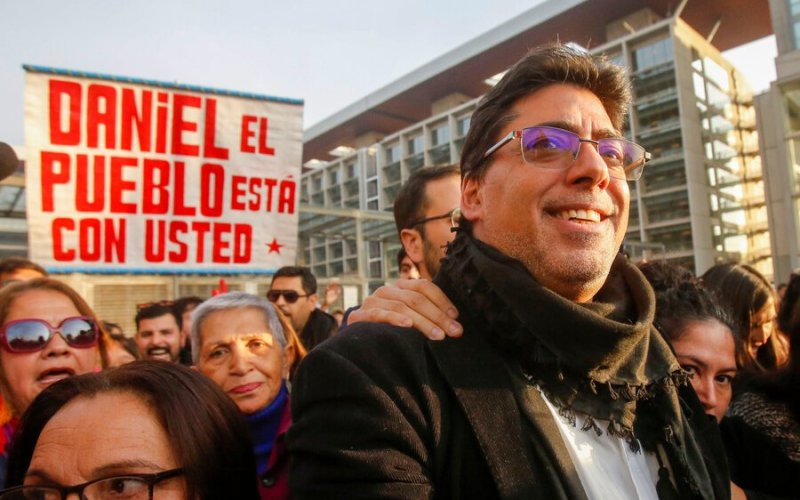
The Daniel Jadue case exposes how a prolonged precautionary measure produced political effects that today challenge — head-on — the Chilean Rule of Law
*By Anjuli Tostes
Daniel Jadue, an architect and sociologist of Palestinian origin, was mayor of the commune of Recoleta, in the Metropolitan Region of Santiago, between 2012 and 2024, becoming one of the best-known figures on the contemporary Chilean left. A historic activist of the Communist Party of Chile, he gained national recognition by implementing innovative municipal policies aimed at the decommodification of life — such as “popular pharmacies”, which deliver medicines at cost — and even contested the presidential primaries of the Chilean left in 2021. His trajectory and electoral projection have consolidated him as a central actor on the Chilean political scene, frequently highlighted as a potential candidate for larger positions.
When, on February 27, 2026, the Third Guarantee Court of Santiago replaced Daniel Jadue’s full house arrest with nighttime house arrest and a ban on leaving the country, judge María Alejandra Cruz Vial recorded something that goes beyond a simple precautionary review. His decision indirectly reveals a deeper problem: the most serious measure had been maintained for almost two years without a sufficient contemporary basis. And, precisely for this reason, the order reopens — with probative force — the discussion about the character and real purpose of the precautionary measure applied, allowing the political design of the case to be reconstructed.
The judge stated that the “need for caution” that could have been invoked at some point no longer met the intensity required by the legal system. Jadue was no longer mayor; had not engaged in conduct intended to interfere with the investigation; did not maintain the status of authority or public servant; there was no danger of flight — even when he could have left the country and chose to stay —; police surveillance and media scrutiny made any evasion practically impossible; there were no other formalized processes that reinforced a risk hypothesis; the accused had actively collaborated with the investigation; and there were no antecedents that would allow us to assume that he represented a danger to society.
If these grounds today are sufficient to rule out full house arrest, they also constitute the parameter to evaluate its previous extension. And here the question arises that any citizen understands without the need for technicalities: why keep it out of circulation for so long, if the risks invoked had disappeared early?
Daniel Jadue was deprived of his liberty on June 3, 2024. Forty-five days later he left office as mayor. However, his mobility and capacity for public action remained severely restricted for 634 days, almost twenty-one months. Based on the logic set out by the judge on February 27, 2026, the conclusion is legally consistent: at least since August 2024 — when it was no longer a municipal authority — the maintenance of full house arrest lacked sufficient current basis. Precautionary law requires the current nature of the risk; does not allow its prolongation due to inertia nor its transformation into an anticipated sentence.
But the analysis cannot stop at procedural technique. It must move to the formal plane and, above all, to the material plane of democracy.
The inter-American human rights system establishes clear parameters for this type of situation. On a formal level, article 23 of the American Convention on Human Rights protects the right to participate in public affairs, to vote and to be elected, strictly delimiting when these rights can be restricted. The Inter-American Court has already ruled in different cases that restrictions on political rights must be exceptional and, as a rule, can only occur after a definitive criminal conviction. When provisional measures end up producing, in practice, the same effect as an electoral disqualification, a serious problem arises for representative democracy.
If the inter-American system prevents formal disqualifications without definitive conviction, it must even prevent material disqualifications with greater reason. Because a precautionary measure that lasts for almost twenty-one months, even after the cessation of the public function that was alleged to be a source of risk, produces an equivalent practical effect: it removes from the public space a political actor with real capacity to dispute power without there being a definitive sentence. It is not necessary for a decision to formally declare disqualification. It is enough to prevent, in practice, anyone from campaigning, articulating support and exercising a constant territorial presence.
The subsequent sequence confirms this dimension. In September 2025, the Election Califier Court (TRICEL) declared Jadue ineligible to run as a candidate for deputy for District 9, a decision confirmed in October of the same year, despite there being no criminal conviction. In addition to the material neutralization resulting from the prolonged precautionary measure, there was a formal neutralization in the electoral sphere.
The legally decisive point is this: when a precautionary measure keeps someone out of circulation for almost twenty-one months and, in parallel, the electoral court excludes them from the process, two arms of the State operate in the same direction — one criminal and the other electoral.
The accumulated result is predictable and verifiable: first preventing a presidential candidacy and then eroding — even blocking — parliamentary viability. The real purpose does not need to appear in any recital: it reveals itself in the concrete political effect. Election time passed while he remained under precautionary confinement. Daniel Jadue was kept out of circulation during the decisive period for a possible presidential candidacy and, subsequently, his parliamentary viability was formally annulled.
Jadue responds to accusations linked to alleged irregularities in the management and financing of Achifarp, an entity associated with the “popular pharmacies” policy. The charge, as it has been publicly presented, does not support that he appropriated resources, but that he participated in operations to purchase medical supplies during the pandemic — such as masks and glucometers — at prices and quantities considered “unfavorable to the Tax Authorities”, which, in the Public Prosecutor’s thesis, is classified as a type of fraud.
It is precisely here that the debate stops being just technical and accounting and starts to have a broader political and institutional dimension. Part of the legal and political literature describes cases of this nature as lawfare: the strategic use of the judicial system to neutralize opponents. The central mark of this phenomenon is not necessarily the final conviction, but the political effect produced throughout the process — especially when precautionary measures and provisional decisions operate as anticipated punishment, removing leaders from the public space at decisive moments.
A particularly relevant reading is that of Observatorio Lawfare (OBLAWFARE), which treats the case as an example of “Chilean lawfare” and inserts it into a regional matrix of judicial persecution: judicialization does not appear isolated, but articulated with a public dispute over legitimacy and anticipated political effects (Chilean Lawfare: Daniel Jadue Case and the regional recipe for judicial persecution). The focus there is not to recount the process, but to identify the pattern: imputations and narratives that operate as a “recipe” to wear down leaders with national projection, especially when they embody policies that confront economic interests and reorder social priorities.
The debate is not exclusive to Chile. At different times in the last decade, legal processes were used to remove progressive leaders from political disputes in Latin America. The best-known case was that of Brazilian President Luiz Inácio Lula da Silva, whose arrest in 2018 prevented him from running in that year’s presidential elections — later annulled by the Federal Supreme Court. Similar situations also marked cases against Rafael Correa in Ecuador and Cristina Fernández de Kirchner in Argentina.
The implications go beyond the person directly involved. If Chilean jurisprudence allows a precautionary measure to extend beyond the existence of current risks and, in addition, tolerates electoral restrictions without definitive conviction, a precedent is consolidated that is incompatible with contemporary constitutional democracy and in direct tension with the inter-American human rights system.
This case could become a turning point. Either Chile reinforces strict standards of proportionality, temporality and exceptionality in precautionary matters and harmonizes its electoral practice with inter-American jurisprudence, consolidating a robust doctrine of protection of political rights; or it will be established that it is possible to change the democratic game not through a conviction, but through the accumulation of precautionary and electoral decisions that, together, produce the same effect as disqualification.
Democratic erosion rarely announces itself as rupture. It advances through formally legal, but materially disproportionate, acts that produce political effects before the final sentence — that is, when the precautionary measure works, in practice, as a penalty. This was the historical meaning of what was seen in Brazil with Lula: not just a process, but a chain of decisions and narratives capable of interfering in the electoral game before the judicial outcome and, later, demanding a late correction of the damage from the institutional system itself.
The Jadue case must be read in the same light. It’s not just a criminal proceeding: it’s an institutional warning for Chile — and a Latin American reminder that, when provisional decisions start to determine who can or cannot compete politically, the democratic dispute runs the risk of no longer taking place at the polls and starting to be defined by the convergence between media, courts and procedural time management.
Anjuli Tostes is a lawyer, PhD student in Law and Economics (University of Lisbon), founding member of the Brazilian Association of Jurists for Democracy (ABJD) and the Association of Jurists for Democracy of Chile (AJD-Chile), and author of works on lawfare and contemporary legal theory.
Source: https://www.ocafezinho.com/2026/03/05/fora-de-circulacao-como-uma-cautelar-de-634-dias-alterou-o-cenario-eleitoral-chileno/

