This Monday, the world’s stock markets began the week with high volatility, with the panic generated by the fear of a prolonged war in the Middle East against Iran. On Wall Street, the stock market opened in the red and then rebounded and closed positively. Meanwhile, the stock markets in Asia and Europe closed with generalized falls, with the importing countries being more dependent on gas and oil from the conflict zone, and with greater risk.
In Japan, the fourth largest economy in the world, it is the fifth largest importer of crude oil, with nearly 95% of its supply coming from the Middle East, the stock market (the Nikkei 225 index) plummeted 5.24%. Similarly, in South Korea, the fourth largest oil importer, the stock market plummeted up to 6%. In China, the main international buyer of crude oil, the Shanghai Stock Exchange and the Hang Seng in Hong Kong fell 0.7% and 1.4% respectively.
In Europe, the Euro Stoxx closed 1.82% in the red. In Germany, the DAX fell 1.32% and the French CAC also fell 1.92%. In the United Kingdom (outside the European Union), the stock market fell 1.18%.
In this context, the governments of the G7 countries scheduled a meeting to analyze the international energy situation and evaluate the implementation of emergency measures.
Historic rise in oil and impact in Argentina: “Charge champion”
The price of crude oil reached close to 120 USD, a historic increase of 25%, to end the day with a drop to 90 USD per barrel. A “relief” that some media explain after the new statements by Donald Trump, who stated that “the war with Iran is practically over.”
On the other hand, Iran had warned the US and Israel that their aggression could send oil prices above $200.
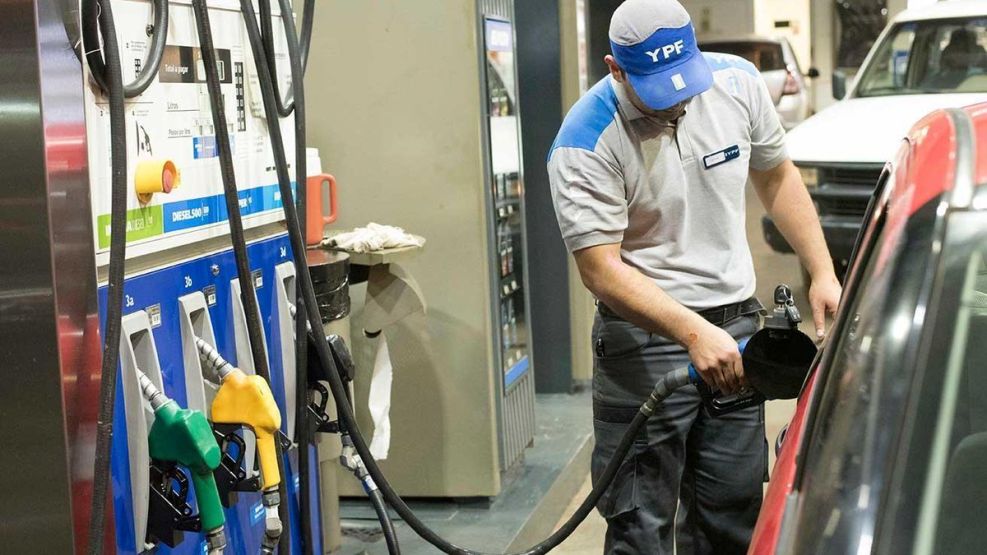
In this context, oil companies in Argentina transferred part of the increase in international crude oil to the suppliers, with a 5% increase adding pressure to prices.
The head of YPF, Horacio Marín, after having declared that “there will be no shocks in the price of gasoline,” responded mockingly to the increase in fuel prices: “Let’s be honest: if you have to load gasoline tomorrow, load it today. If you think things are going to increase, load it sooner,” he stated. A similarity to Caputo’s “buy champion”.
With the Bases Law (No. 27,742) and its regulations (Decree 1057/2024), the Government modified Argentine oil policy, moving from the “self-supply” paradigm to one of free market and export. In a producing country, the State no longer sets prices or intervenes in marketing.
Again the problem of reserves and inflationary pressure
Faced with financial stress and global volatility, the IMF insisted that countries strengthen reserves to face exchange crises. Although the IMF did not make a direct mention of Argentina but rather a general call to all central banks to accumulate foreign currency, the Argentine case has the particularity that the Government failed to meet the reserve accumulation goal last year set by the Fund within the framework of the agreement for the loan disbursed in April 2025.
Faced with the second review of the agreement in progress, Luis Caputo, asked to remove periodicity from the reviews and annualize them: “For me to say we are going to buy more or less dollars on such a date would be arrogant, we even talk about this with the Fund. Normally, we have to set quarterly goals, and we tell them: ‘We can set quarterly goals, but the logical thing would be an annual goal, because I, realistically, cannot tell you with certainty that I can buy more on this date than on this one.’ Because exporters retain or They advanced exports and then they cancel, you can’t know. If you can have an estimate on how much you are going to buy,” he stated, showing the vulnerability to the markets as a result of his own policy.
Contrary to the Government’s statements, inflation is once again putting pressure. This Monday, the City of Buenos Aires published the inflation for February. The data showed a general increase of 2.6% in prices, a slight decrease compared to the 3.1% in January. In this way, it accumulates a year-on-year increase of 32.4%.
Above the general level, the strong increase of 5.9% in “Housing and services” and 2.9% in Food stood out, driven by the increase in Meat and derivatives (7.3%), hitting the most vulnerable.
Source: www.laizquierdadiario.com