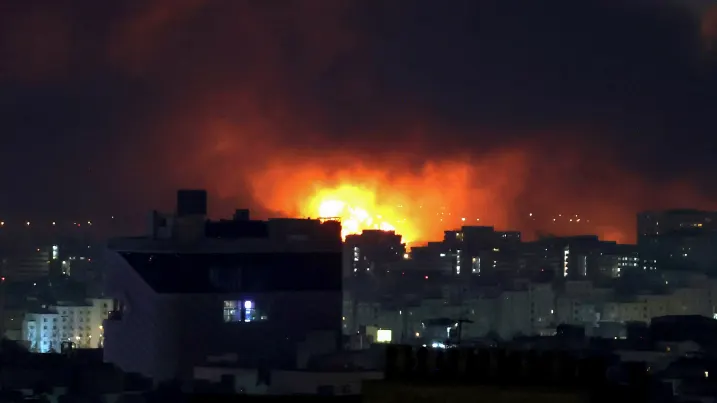
President Masoud Pezeshkian’s statement that Iran would avoid attacking neighbors contrasts with new military actions and criticism from hard-line sectors of the regime
The war in the Middle East took on a new shape this Saturday after Iran said it attacked a United States air base located in the United Arab Emirates. The action came just hours after Iranian President Masoud Pezeshkian declared that his country did not intend to attack neighboring nations and apologized to Persian Gulf governments.
The contradiction between the diplomatic discourse and the military operation exposed, once again, the complexity of the current regional escalation. As leaders try to control political damage, attacks and counterattacks continue to multiply.
Read: Persian Gulf blocks routes and oil reacts strongly
At the same time, the United States and Israel maintain an intense offensive against Iranian territory. According to American military officials, the campaign has hit thousands of targets since the start of the war. The new escalation increases fears that the conflict will go beyond borders and cause an even greater global impact — including on the energy market.
Furthermore, Gulf countries reinforce their air defense systems and experience days of permanent tension. Security alerts and drone interceptions have become routine in the region.
Attack hits air base south of Abu Dhabi
According to information released by the Iranian news agency Tasnim, the operation was conducted by the drone unit of the Islamic Revolutionary Guard Corps Navy. The target was the Al Dhafra air base, located south of Abu Dhabi, capital of the United Arab Emirates.
The military installation houses American forces and serves as a strategic point for operations in the Gulf region. Therefore, any attack against the base has strong political and military weight.
To date, the UAE government has not confirmed significant damage. The country’s Defense Ministry said it detected 121 unmanned aerial vehicles on Saturday. Air defense forces managed to intercept most.
According to the ministry, 119 drones were destroyed before reaching their targets. Even so, two devices crashed in Emirati territory.
Despite the episode, the UAE Ministry of Foreign Affairs did not immediately comment on the attack. The lack of a detailed official reaction indicates diplomatic caution at a time of great regional instability.
Hours before the attack, the Iranian president had adopted a conciliatory tone when talking about relations with neighboring Gulf countries. In a message released by the Iranian state agency, Pezeshkian stated that Iran does not intend to expand the war to other nations in the region.
During the statement, he apologized to neighboring countries after a week marked by retaliatory attacks.
“I apologize to neighboring countries,” Pezeshkian said. “We have no intention of invading other countries. Let us set aside all the disagreements, concerns and resentments we have for each other. Today, let us defend our own territory to lead Iran out of this crisis with dignity.”
At the same time, the Iranian president made it clear that Tehran does not intend to give in to external pressure. In another statement, he said the United States can “take its dreams to the grave; we will not surrender unconditionally.”
This balance between diplomatic discourse and military resistance reflects internal disputes within the Iranian regime itself.
Conservative sectors criticize apology
The public apology quickly provoked negative reactions among more conservative sectors of Iranian power.
Members linked to the Revolutionary Guard and part of the clerical elite demonstrated irritation with the president’s stance.
One of the most direct criticisms came from hardline cleric and parliamentarian Hamid Rasai. In a social media post, he directly addressed Pezeshkian.
According to Rasai, “His stance was unprofessional, weak and unacceptable.”
The reaction reveals political fissures within the regime. While some advocate diplomatic restraint to avoid international isolation, others demand an even tougher military response against external adversaries.
This internal conflict occurs precisely at a time of intense military pressure on the country.
Trump attributes apology to military offensive
United States President Donald Trump reacted quickly to the Iranian leader’s statements. According to him, the apology occurred due to strong military pressure exerted by Washington and Israel.
In a post on the social network Truth Social, Trump wrote that Iran retreated after suffering a series of attacks.
“Iran, which is being massacred, has apologized and surrendered to its Middle Eastern neighbors, promising that it will no longer shoot at them,” he said.
Soon after, he added another message that raised the tone of the dispute even further.
“Today Iran will be hit hard!” Trump wrote.
The aggressive rhetoric increases international concern. Analysts fear that statements of this type will further expand the cycle of military escalation.
US claims to have hit more than 3,000 targets in Iran
The military campaign led by the United States and Israel has entered its second week. According to US Central Command, the attacks continue at an intense pace.
According to the American military, more than 3,000 targets have already been hit during the first week of the operation called Epic Fury.
“American forces hit more than 3,000 targets in the first week of Operation Epic Fury, and we will not slow down,” the military command said in a Facebook post.
Israel has also expanded its operations. The Israeli Defense Forces announced this Saturday a new wave of attacks in Tehran.
According to the statement, more than 80 fighters participated in the offensive.
The aircraft dropped around 230 munitions on Iranian military installations. Among the targets were a missile storage site, an underground facility linked to the production of ballistic weapons and the Central Military University of the Revolutionary Guard.
According to the Israeli army, the operations seek to reduce Iran’s military capacity.
“These attacks reduce the Iranian regime’s ability to fire on Israeli civilians,” the military said.
Internal political dispute raises debate about new supreme leader
As the bombings continue, Iran’s internal political landscape is also facing instability.
Two influential clerics have publicly advocated the swift selection of a new supreme leader. The proposal emerged after the assassination of Ayatollah Ali Khamenei.
Among the measure’s supporters is Grand Ayatollah Naser Makarem Shirazi. He argues that the country needs clear leadership to face the crisis.
According to Shirazi, the appointment should take place quickly to “help better organize the country’s affairs”.
Currently, a three-member council exercises temporary command of the country, as provided for in the Iranian Constitution.
Even so, some sectors of the clergy express discomfort with this provisional solution.
The situation became even more delicate after Donald Trump stated that the United States should participate in choosing the new leader. The Iranian government immediately rejected this idea.
War causes regional tension and impacts on the energy market
As the war intensifies, neighboring countries reinforce their defenses.
Saudi Arabia reported having intercepted a drone in the eastern region of Riyadh. In Dubai, authorities issued security alerts and advised residents to seek shelter in safe buildings.
Military escalation also has direct effects on the global economy.
The conflict practically paralyzed traffic in the Strait of Hormuz, one of the most important maritime routes for transporting oil.
As a result, energy prices have soared.
On Friday, US oil posted the biggest weekly gain in futures market history. The accumulated increase reached 35.63%, the highest since the creation of the contract in 1983.
A barrel of West Texas Intermediate closed the session at US$90.90 after rising 12.21% on the day.
Brent, an international reference, advanced 8.52% and ended the session quoted at US$ 92.69.
This scenario reinforces the fear that the war in the Middle East is not just a regional conflict. In practice, it is already beginning to have profound effects on the world economy.
With information from CNBC*
Source: https://www.ocafezinho.com/2026/03/07/ira-diz-ter-atacado-base-nos-emirados-apos-pedido-de-desculpas/