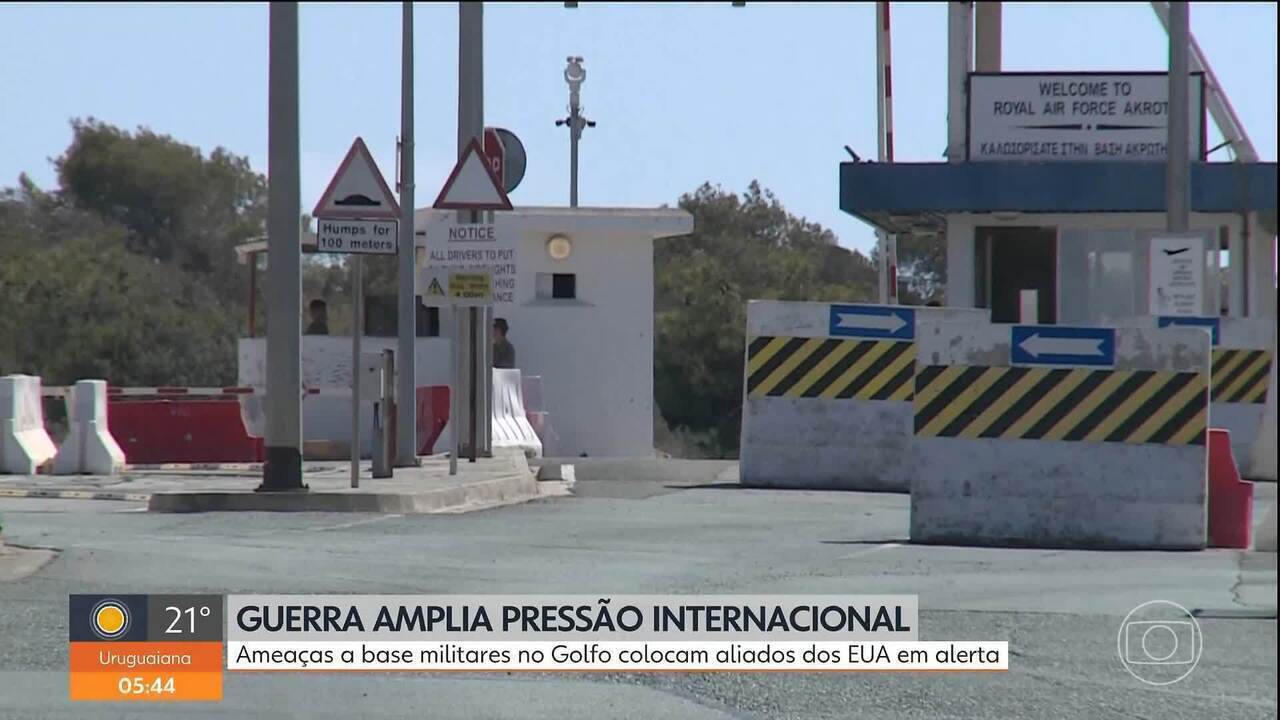
A drone attack hit the British Akrotiri air base, located in Cyprus, in the early hours of Monday (2), causing damage considered limited and no casualties recorded, according to Cypriot and British authorities. The episode occurs amid escalating tensions involving Iran and represents the first incident of its kind against the facility since a rocket attack in 1986.
According to official information, the impact occurred at 00:03 on the runway at the Royal Air Force (RAF) base. The President of Cyprus, Nikos Christodoulides, stated that the device was a Shahed-type unmanned aerial vehicle, a model associated with the Iranian military industry. According to him, all security and defense services in the country were placed on high alert after the incident.
Authorities are still investigating the origin of the drone. Sources interviewed on condition of anonymity initially reported that a second unmanned aircraft had been intercepted by British forces, but later clarified that only one piece of equipment was confirmed. The British government did not release additional technical details or information about possible direct perpetrators of the attack.
Strategic base and sensitive territory
The Akrotiri base is southwest of the coastal city of Limassol and is part of one of the two areas maintained under the sovereignty of the United Kingdom after the independence of Cyprus in 1960. Although located on European territory, these areas are administered directly by the British and have strategic importance for international military operations.
In addition to operational facilities, the site houses military and family residences. The United Kingdom maintains around 7,000 people linked to the armed forces in these areas, which occupy approximately 99 square miles — just under 3% of Cypriot territory.
Akrotiri has already been used as a logistical and operational point in military actions in the Middle East, including missions in Iraq, Syria and Yemen. The region also houses a signals and communications monitoring station considered strategic for intelligence operations.
Official reaction and diplomatic positions
In a public statement, Christodoulides emphasized that Cyprus does not participate in military actions. “I want to be clear: our country does not participate in any way and does not intend to be part of any military operation,” he declared. The speech sought to avoid interpretations of the country’s direct involvement in regional conflicts.
British Foreign Minister Yvette Cooper said additional security measures had been put in place around the base, but said she could not provide further details about the incident. According to her, authorities are evaluating all technical and operational aspects related to the impact.
The Sunday before the attack, British Prime Minister Keir Starmer had reported that the United Kingdom had accepted a request from the United States to allow the use of British bases in defensive operations against Iranian missiles. Defense Secretary John Healey said that British forces intercepted two missiles fired towards Cyprus, adding that he did not believe that Cypriot territory had been deliberately targeted.
Repercussion in the European Union
The president of the European Commission, Ursula von der Leyen, expressed support for Cyprus and highlighted the bloc’s solidarity. In a public message, he stated that the European Union is “collectively, firmly and unequivocally” alongside its Member States in the face of any threat.
A European official interviewed on condition of anonymity assessed that the episode could indicate an attempt to expand the regional conflict, with possible indirect involvement of European countries. Community authorities are monitoring the situation and are in contact with the Cypriot government to assess possible additional risks.
Local impact and population reaction
Residents of the civilian village of Akrotiri reported moments of tension during the early hours of the morning. Part of the population left their homes and sought shelter in Cypriot Army barracks in the city of Limassol, as reported by the local mayor, Pantelis Georgiou.
A resident identified as Theodoros told state broadcaster that he heard a loud explosion while watching television. According to him, when he contacted the police at the British bases, he received the response that they could not provide information at that time. The resident claimed to have taken family members to another city as a precaution.
After the impact, military authorities advised the population to remain sheltered until further official communication. They later said non-essential staff would be moved from the area, while other British facilities would continue to operate as normal.
Geopolitical context and escalation risks
Analysts assess that the incident occurs at a time of heightened tension on the international scene, especially after recent clashes involving Western forces and Iranian interests. The use of drones in military operations has been increasingly common in regional conflicts, due to their relatively low cost and ability to reach targets at long distances.
International security experts highlight that attacks on military installations in European countries can increase the risk of coordinated responses and expand the scope of the conflict. Still, to date there has been no announcement of formal retaliation from the United Kingdom or its allies.
The episode reinforces the strategic sensitivity of the eastern Mediterranean, a region that brings together commercial routes, military bases and areas of geopolitical interest for different powers. While investigations continue to clarify the origin and responsibility for the attack, European and British authorities maintain a heightened state of surveillance to prevent new incidents.
Source: https://www.ocafezinho.com/2026/03/02/drone-atinge-base-militar-britanica-no-chipre-e-amplia-tensao-internacional-envolvendo-ira/