This Wednesday, the Federal Court of Criminal Cassation upheld the prosecution of gendarme Héctor Jesús Guerrero for the shot that seriously injured photographer Pablo Grillo on March 12, 2025. In response, his family, through a public letter, highlighted that the actions of the Gendarmerie “cannot be read as an isolated event or the simple ‘excess’ of a distracted force. When aggression against the press becomes a constant in each operation, we are faced with a method.” A method that responds to the government’s repressive policy to defeat the resistance: with clubs and bullets, intimidation and silencing the voices of those who confront it in the streets and the press.
That is why we said that the repeal of the Journalist Statuteincluded in the Slave labor reformit is not simply a change in the rules of journalism but is an attempt to limit freedom of expression. This siege to journalism brutal and repressive government poses to us continue debating its effects, give greater visibility when the major media outlets have decided to remove the topic from their covers and without Statute the conditions of precariousness worsen.
We share a new round of consultations with the journalists what they assume the registration and information from the street about the new scenario of journalism.
Journalism uncovered
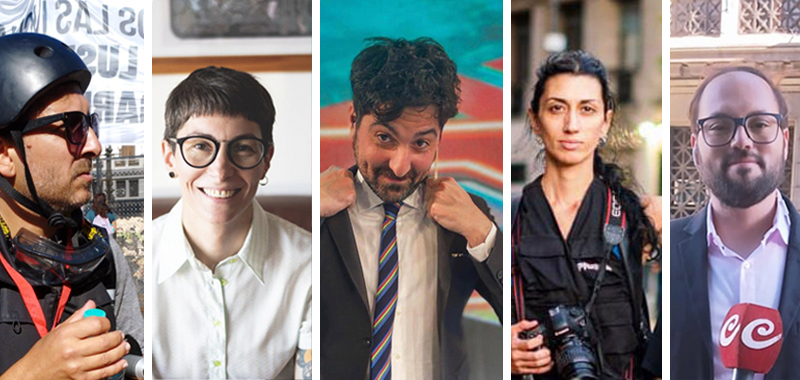
Let us remember that the Journalist Statute (Law 12,908) not only regulates salary but includes a series of regulations such as “the conscience clause” and protection against arbitrariness, aggravated compensation, special working hours, among other points, aspects that organizations such as the SiPreBA have been identified as pillars of the right to information. “When they move the semantic axis and say ‘labor modernization’, you have to translate it: modernization means removing regulations that protected the worker, under the promise of efficiency. We already saw it in the ’90s, when the word ‘reform’ ended up associated with flexibility and precariousness, although now, flexibility is used shamelessly,” explains the journalist and mobile driver Lautaro Maislin. “It is clear that the Statute was not a corporate privilege,” he affirms, “it was a specific framework that recognized that journalistic work has particularities: extended hours, coverage in risk contexts, political and business pressure, public exposure, ethical responsibilities. By repealing it, the journalist becomes governed only by the general law of employment contracts, losing the tools of the activity.”
Nor is it about denying the necessary modernization of the Statute, what needs to be debated is in what sense and its objectives. In this regard he told us this the journalist Estefanía Santoro“We must modernize the Journalist Statute in order to fulfill the rights and obligations that the different media companies have towards the workers. We are in a situation of absolute precariousness, of absolute exposure to violence on the part of the repressive forces of the national government and in particular I believe that the repeal of the Statute not only hits the press workers, but is also a very big wound that it causes to the right of citizens to receive truthful information, verified information.”
For him mobile driver in Crónica TV, Emanuel Herrerathe repeal of the Statute is part of a broader pattern of disciplining the press: “The Government says it out loud: ‘We do not hate journalists enough’. In addition to beating us, delegitimizing us and attacking us through state media and parastatal trolls, they now intend to take away historically won rights.”
Lucho Lucero mobile driver and correspondent of The Daily Left He told us, “I think it is part of a more comprehensive attack to be able to carry out adjustment policies against workers, against the population in general, and journalists are not exempt from this Reform. It is a way of installing greater doses of impunity on the part of the government.”

When Milei and Bullrich try to dismantle the Journalist Statute They not only seek to make a profession precarious. “A journalist, a journalist with less economic stability makes us vulnerable workers to indirect censorship by the big media or the governments in power,” he adds. Estefania Santoro“which ends up affecting in some way also the right that society has to receive information independent of the economic and political powers and those in power.”
Information as a battlefield
The ability of the direct journalistic record to “twist the arm of power” has a long history and crucial examples. In Vietnam, the images that reached televisions ended up breaking support for the war and hastening the withdrawal of troops. More recently, in 2020, cell phone video of the murder of George Floyd disproved the Minneapolis police, sparking mobilizations against police racism across the country. The images and transmission of the repression in Plaza de Mayo during the days of December 2001 were triggers for thousands to understand what was at stake. It was thanks to the lenses of photojournalists that the official version of the ‘Avellaneda Massacre’ collapsed: their images of June 26, 2002 proved that Darío Santillán and Maximiliano Kosteki They were executed by the police, denying the accusation of a confrontation between picketers.
Today, in a scenario of concentrated media and government journalistic operations, real-time transmission remains the most difficult witness to refute. The workers who “cover” the streets know it and so does the government. “Journalists who work on the street are not exempt from the pressures to carry out our work,” he points out. Emanuel Herrera“As the guarantees necessary to function and defend freedom of expression are distorted, we run the risk of losing our jobs for the mere fact of giving voice to those who bother or contradict official and business narratives. It is not something that does not happen now, but at least the Statute protects us. What this anti-journalist Government intends is very dangerous. We live in a low-intensity democracy and journalistic work is no stranger to it.”
When power tries to hide what is happening, it inevitably collides with the body of the chroniclers, cameramen and photographers. In that sense, Meislin adds: “Journalism is not an office from 9 to 18. It is the street, the live coverage, the social conflict, the endless guards. The Statute recognized this. And for those of us who are on the street – chroniclers, mobile drivers, cameramen, photojournalists – the impact is even more concrete. The photojournalist who covers a repression or a demonstration works in a context of almost extreme physical risk today. The Statute reinforced his professional character, his social role and certain guarantees. Without this, the possibility of demanding conditions appropriate to the risk is weakened.”
The thing is an image or filma live voice, the trace of a projectile, a rubber bullet or the gesture of a cash can become a test. “There is clearly an intention on the part of the government through repression both with federal forces and with police forces in the case of the city government, says the photoperiodista Silvana Luciole “of trying to turn off what our cameras record.” The case of photojournalist Pablo Grillo undoubtedly marks a before and after in the experience of press workers under the Milei government. “I think that there is precisely a super important role that photojournalism has been fulfilling, which is to persist, to continue in the streets, right? I think it has been done, there is a group of young people, above all, who have taken it in some sense as militancy. For the right to information, being with a camera on the street recording and trying through the available media, mainly the networks, to massify that message of resistance.”

In this context, teamwork is crucial. Firefly He put it in these terms, “I think the collective takes a lot of strength and the case of the reconstruction of what the attack on Pablo Grillo was is quite concrete because it could be done through many photos, many videos, from different angles, which is also something super valuable, we are all at different angles, so that gives the possibility of reconstructing an event in factual terms. From different points of view and I think that is part of the role that we play today in the street. The work we did together with colleagues of the police map “It is a paradigmatic case.” So, it is about strengthening the ties of solidarity with those who demonstrate but also as part of the common work. Not only to protect themselves from repressive action but to ensure coverage, registration and filming, which can be crucial material. “They are brutal operations, very costly from an economic point of view, that saturate the streets with police, who seek to intimidate the protesters,” he says. Lucero of The Daily Left“The government tries to prevent us from showing its repressive actions and giving a voice to those who mobilize or confront it; it tries to hide these actions because it is functional for the government to sell an image that the entire adjustment is accepted by the population, without any type of resistance. And that resistance exists, we feel it closely, in multiple conflicts on a daily basis, denying the speech of the government and its press spokespersons or the resignation of the opposition. There are conditions to fight and stop this reactionary project.”
Once again, in the country where a large part of the press functions as a gear for journalistic companies, fueling war journalism against the workers and popular sectors and information is the fuel to get it going, we must continue the fight for a journalism willing to fight in defense of freedom of expression, against censorship and precariousness, in the media, on the networks and in the streets and in everyday resistance.
Source: www.laizquierdadiario.com