A strategic ally has slipped into Donald Trump’s mental scheme that establishes a world divided into enemies and vassals who does not seem willing to go along with him. The position adopted by Spain of frontal rejection of the war waged in Iran clouds the aspiration of the tenant of the White House for a global order without contestation to his designs, subject to his order and command. And his explicit threats of a trade blockade as a reprimand, far from silencing Pedro Sánchez, have served the head of the Spanish Executive to raise his voice against the military offensive and keep up with his North American counterpart.
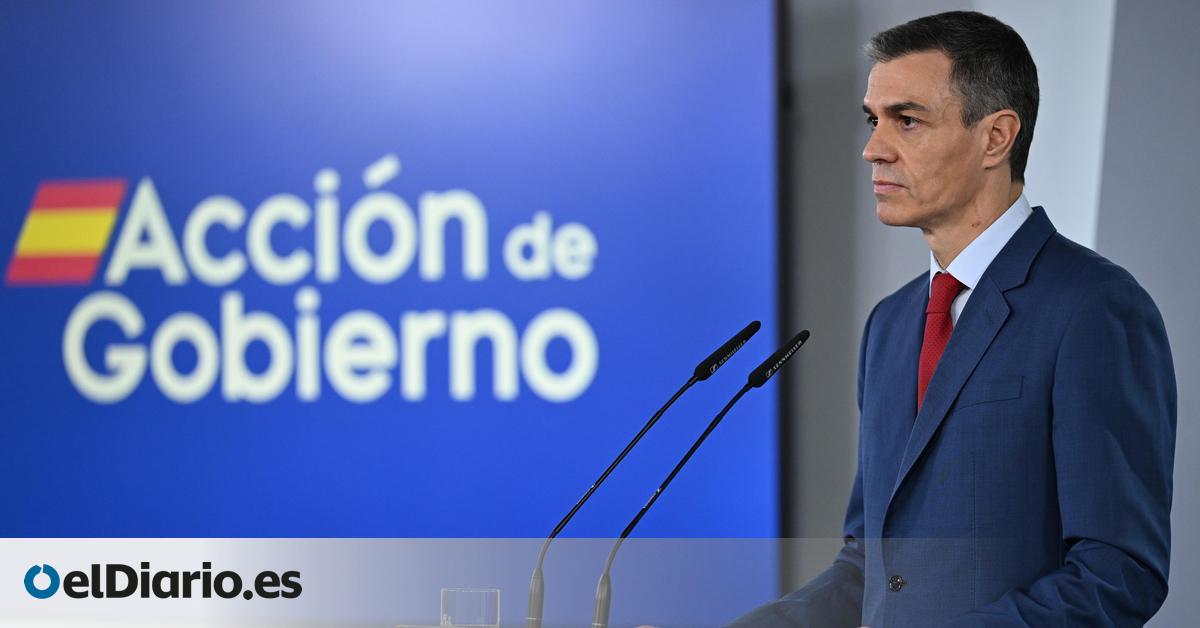
“We are not going to be complicit in something that is bad for the world simply because of the fear of retaliation by some,” Sánchez responded this Wednesday morning from Moncloa to Trump’s threats to launch a trade war against Spain. A clear message to stand up to the president of the United States and break ranks with the long list of international leaders who have decided to accompany his steps without question. And that is why the announcement from the White House was so surprising just 24 hours after the broadside directed from the Oval Office.
“With respect to Spain, I believe you heard the president’s message yesterday, loud and clear, and as I understand it, in the last few hours they have agreed to cooperate with the US military. I know that the US military is coordinating with its counterparts in Spain,” said White House spokeswoman Karoline Leavitt this Wednesday afternoon. Just a few minutes later, Moncloa denied it and Foreign Affairs denied the American government. “I categorically deny it. Our position has not changed one bit and I have no idea what it could be referring to,” said José Manuel Albares during an interview on Cadena SER.
During his morning institutional statement, in fact, Pedro Sánchez raised the tone against the foreign policy of the United States. “Spain’s position is summarized in four words: no to war,” he said, before slipping that this operation on Iran only has the objective of covering up Trump’s own “failure” and “filling the pockets of a few.” It was not the first time that the Spanish president distanced himself from the White House’s plans. He did it with Greenland, Gaza, Venezuela or with military spending, but this time the message sounded especially forceful.
Although the response came only 15 hours after Trump’s threat as punishment for the restriction of the use of the Rota and Morón bases for the war in Iran, Moncloa assures that this appearance was decided and dated before and outside of Donald Trump’s latest attack. “Foreign policy and diplomacy require prudence,” they say from the Government, where they emphasize that the day chosen for the institutional declaration had been studied in advance to respect the deadlines.
“The attack occurred on Saturday and the president made a first assessment before the press at the Goya gala, but we did not want to skip any steps. The appearance in such a serious situation was decided, but we wanted the Foreign Minister to first inform the Council of Ministers and for the office to take place with the king before heading to the country.” Trump’s threat caught the president, in fact, on his return from the Zarzuela Palace.
Sánchez met with King Felipe VI early in the afternoon on Tuesday. Although it was due to the periodic dispatch maintained by the Head of State and the Executive, sources familiar with that meeting assure that it was a somewhat longer appointment than usual. These same sources point out that the conversation revolved almost monographically around the escalation of international war unleashed since last Saturday by the US attack on Tehran. And that Pedro Sánchez shared with the king the direction of foreign policy that he was preparing to confirm publicly the next day.
“The question is not whether we are on the side of the ayatollahs, no one is. The question is whether we are in favor of peace and international legality,” said the president, who also left a message to international and especially European leaders who have decided not to complain to the head of the White House no matter what he does. “Blind and servile following is not a way to lead,” he said.
The phrase sounded like an obvious reaction to the attitude of the German Chancellor, Friedrich Merz, who was in the Oval Office with the president of the United States while an explicit threat was made to his European partner and, far from distancing himself, he followed up on those criticisms. “When you share a currency, a common trade policy or a common market with a country, you expect solidarity,” said José Manuel Albares in an interview on TVE. The Foreign Minister revealed that he personally telephoned his German counterpart to convey his “surprise” and his discomfort. “I cannot imagine Chancellor Merkel or Chancellor Scholz making statements of that type. “It was another European spirit,” Albares added in that same interview.
Beyond the German Government, whose attitude towards Spain has been criticized in recent hours even by the German press itself, Pedro Sánchez did receive a good handful of explicit international support after Trump’s threat and his demand for an end to hostilities. This was done by the French president, Emmanuel Macron, who in a direct conversation with Sánchez conveyed “France’s European solidarity in response to the recent threats of economic coercion launched yesterday against Spain.”
The European Commission also did so, recalling its ability to “act if necessary to safeguard the interests of the EU.” And even China did so in the mouth of its Foreign Minister, Mao Ning, who demanded that “trade” not be used “as a weapon or as an instrument.” Furthermore, late in the afternoon, the Spanish president assured that he had spoken with his counterpart in Brazil, Lula da Silva, with whom he shares the “desire for the war to end and a negotiation to begin as soon as possible within the framework of international legality.”
In the Moncloa, where they affirm that they tried to “avoid the frontal clash” with the American administration and maintain “a low profile” regarding the restriction of use of the Rota and Morón bases, they express their conviction that the foreign policy championed by Pedro Sánchez is not only consistent with the defense of international legality also claimed in Gaza or Ukraine, but with the majority sentiment of Spanish public opinion. And they call not to set off alarm bells with each of Trump’s bravado, hoping that this latest threat may have as little impact as the previous ones.
Source: www.eldiario.es