Possible purchase of Chinese missiles by Iran worries powers and could change the military balance in the Persian Gulf amid the US naval presence
Iran is close to reaching a deal with China to acquire supersonic anti-ship cruise missiles, according to six sources with direct knowledge of the negotiations. The move comes at a time of strong regional tension, as the United States mobilizes a large naval force near the Iranian coast, in preparation for possible clashes.
The possible agreement involves the CM-302 missiles, designed to fly at low altitude and high speed, making it difficult for naval defense systems to intercept. With a range of approximately 290 kilometers, these weapons could alter the military balance in the Persian Gulf and significantly expand Iran’s attack capabilities.
Experts warn that the incorporation of this weaponry would represent a relevant technological leap. At the same time, it would increase the risks of direct confrontation with US forces positioned in the region.
Negotiations accelerate after regional conflict
Talks between Tehran and Beijing on missile systems began at least two years ago. However, they gained speed after the 12-day war between Israel and Iran, which took place in June last year. According to sources linked to the Iranian government and the security sector, high-ranking military authorities intensified contacts with Chinese representatives during the final phase of negotiations.
Among the names mentioned is Massoud Oraei, Iran’s deputy defense minister, who reportedly traveled to China last summer. The visit had not previously been publicized. This movement reinforces the perception that the country is seeking to rebuild and modernize its arsenal after significant losses in the recent conflict.
Danny Citrinowicz, a former Israeli intelligence officer and current senior researcher at the Israel Institute for National Security Studies, highlighted the potential impact of the acquisition. “It would be a radical change if Iran had supersonic capabilities to attack ships in the region,” he said. “These missiles are very difficult to intercept.”
Despite the proximity of an agreement, there is still no definition regarding the number of units, values involved or delivery schedule. It is also unclear whether China will move forward with the sale given the escalation of tensions in the Middle East.
Cautious reactions and diplomatic silence
Official responses to the possible deal were marked by caution. Iran’s Foreign Ministry stated that the country has military agreements with allies and that this would be “the appropriate time to make use of these agreements.”
On the other hand, the Chinese government stated that it was unaware of the reported negotiations. In a later statement, China’s Ministry of Foreign Affairs said it had no information about the sale. The Chinese Ministry of Defense did not respond to requests for comment.
In the United States, the White House avoided commenting directly on the negotiations. Still, an administration official said President Donald Trump has made it clear that “either we will reach a deal or we will have to take very tough measures, like last time,” in reference to the nuclear standoff with Tehran.
This strategic silence reveals the delicacy of the moment. None of the actors involved shows any interest in publicly inflaming the crisis, although all are preparing for harsher scenarios.
US naval presence increases risk of confrontation
The possible agreement comes as the United States reinforces its military presence in the region. A naval fleet was positioned within striking distance of Iran, including the aircraft carrier USS Abraham Lincoln and its battle group. The USS Gerald R. Ford, accompanied by escort ships, is also heading to the area.
Together, the two aircraft carriers can carry more than 5,000 troops and around 150 aircraft. This concentration of forces indicates that Washington is preparing for prolonged operations if tensions evolve into direct confrontation.
Trump recently said he would give Iran ten days to reach an agreement on its nuclear program. Otherwise, the country could face military action. Reports indicate that the US is already considering the possibility of weeks-long campaigns.
In this context, the eventual acquisition of supersonic missiles by Iran would increase the risks of escalation. The simultaneous presence of advanced weapons and large military contingents increases the likelihood of incidents with unpredictable consequences.
Growing military alliance between China, Iran and Russia
The possible sale reinforces the military rapprochement between China and Iran at a time of reorganization of global power. In recent years, the two countries have expanded strategic cooperation, including joint naval exercises with Russia.
US authorities have already sanctioned Chinese entities accused of supplying chemical precursors to the Iranian missile program. Beijing has rejected the accusations and said it strictly complies with export controls.
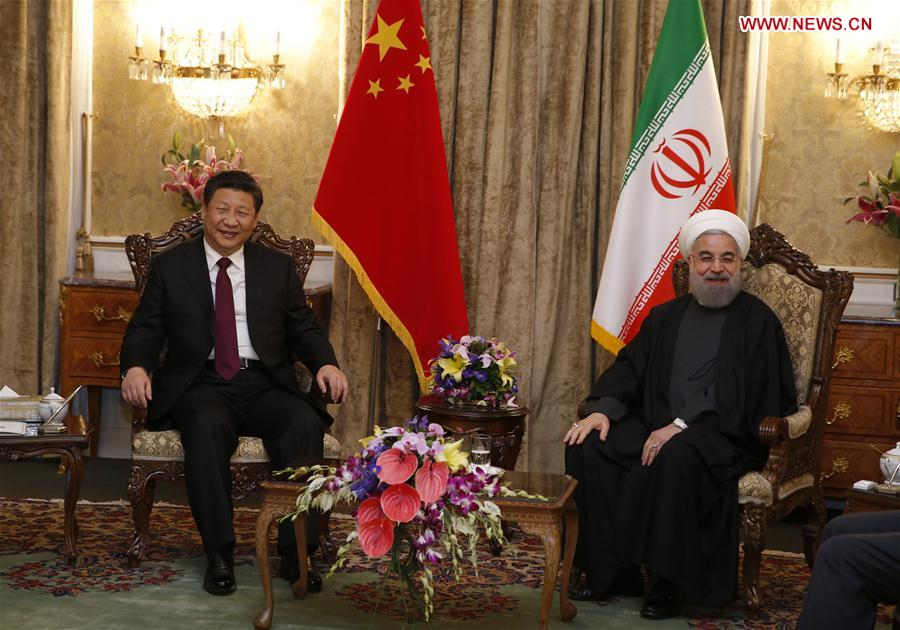
During a meeting with Iranian President Masoud Pezeshkian in Beijing, Chinese leader Xi Jinping declared that “China supports Iran in safeguarding sovereignty, territorial integrity and national dignity”. Subsequently, China, Russia and Iran signed a joint letter classifying the decision to reimpose sanctions as a failure.
An official briefed on the negotiations summed up the scenario bluntly: “Iran has become a battleground between the US” on one side and Russia and China on the other.
Impact on sanctions and military balance
The transfer of the CM-302 missiles would be among China’s most advanced military supplies to Iran. Furthermore, it would defy the United Nations arms embargo first imposed in 2006. Sanctions were lifted in 2015 as part of a nuclear deal but came back into force last September.
Researcher Pieter Wezeman of the Stockholm International Peace Research Institute said the acquisition would represent a significant improvement for an arsenal weakened by the recent war. Chinese state-owned CASIC promotes the CM-302 as one of the most advanced anti-ship missiles in the world, capable of hitting aircraft carriers and destroyers.
The system can be installed on ships, aircraft or mobile land vehicles. Furthermore, it has the ability to hit targets on land, expanding its tactical versatility.
Sources indicate that Iran also negotiates surface-to-air systems, anti-ballistic weapons and anti-satellite technologies with China. If confirmed, these acquisitions could redefine the regional military balance.
Geopolitical dispute and regional sovereignty
The possible agreement highlights a broader struggle for influence in the Middle East. For analysts, China seeks to expand its presence in a region historically dominated by the military power of the United States. At the same time, Tehran seeks to diversify alliances and reduce the impact of Western sanctions.
Danny Citrinowicz noted that China does not want a Western-aligned Iran as this would threaten its strategic interests. According to him, Beijing hopes that the current regime will remain in power.
From a broader perspective, the episode reveals how countries in the Global South become the scene of disputes between powers. Instead of promoting stability, military and technological competition intensifies conflicts and increases risks for local populations.
The possible purchase of the missiles, therefore, is not limited to a military transaction. It symbolizes the reorganization of global alliances and the advancement of a multipolar world, in which different centers of power compete for influence over strategic routes, resources and national sovereignty.
With information from Reuters
Source: https://www.ocafezinho.com/2026/02/24/ira-negocia-misseis-supersonicos-com-a-china/