Republican says he generated an economic boom in the country and imposed a new order abroad. See the highlights of a speech that aims to contain the drop in the government’s approval ratings just a few months before the election
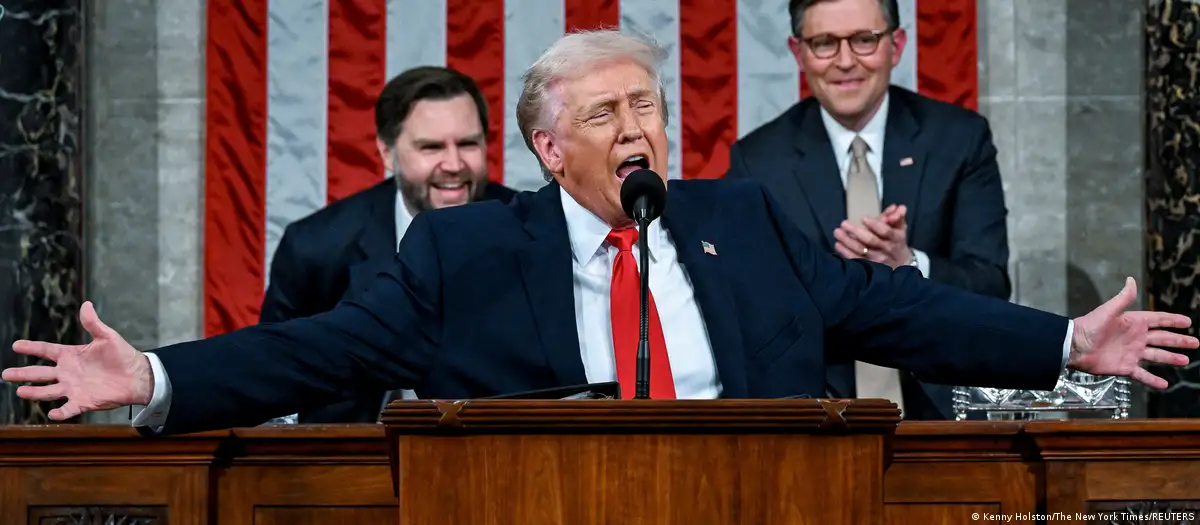
The President of the United States, Donald Trump, delivered his annual State of the Union address this Tuesday (25/02), in a joint session of Congress, highlighting the increase in economic production, the reduction in immigration numbers and the US men’s ice hockey team.
In total, Trump spoke for a record 108 minutes – surpassing the previous mark recorded in his speech to the joint session of Congress last year by eight minutes – in a speech largely focused on domestic issues, Trump stated that “our nation is back”, with an economy “roaring like never before”. He insisted he would have driven an economic boom at home and imposed a new world order abroad, hoping to stem a slide in his approval ratings.
The statement came at a potentially decisive moment, as the White House seeks to consolidate support among Republican voters ahead of November’s midterm elections, amid rising tensions with Iran and voters’ frustration with the high cost of living.
Trump claimed that “American oil production has increased by more than 600,000 barrels per day” and that “natural gas production is at the highest level in history because I kept my promise to drill, baby, drill,” a statement that was repeatedly applauded by Republican lawmakers.
Regarding immigration, the president declared that the United States now has “the strongest and most secure border in American history”, claiming that, in the recent past, “millions and millions of illegal immigrants” entered the country without any control.
Below are the main highlights of the speech:
Economy
Trump devoted a large part of his speech to the economy, touching on a range of everyday economic issues – housing, healthcare, utility bills, crime, retirement – but again avoided explicitly acknowledging that many Americans still suffer from the high cost of living, including food and housing.
The president promised that his health proposals to reduce drug prices and make direct federal payments to the population will generate benefits for citizens’ pockets. He also stated that the tariffs struck down by the Supreme Court were producing revenue and that they would be reestablished under another legal basis.
Republican strategists warn that without a more emphatic message about inflation, the party risks losing control of Congress in the November elections.
According to Trump, inflation, mortgage interest rates and fuel prices are falling, while the stock market, oil production, foreign investment and industrial jobs are on the rise.
But official data shows that inflation rose last year, while the country lost industrial jobs and job creation slowed. And while some items — like eggs — have become cheaper since Trump’s return to the White House, food and other prices continue to rise.
Surveys show that voters remain anxious about the economy and dissatisfied with the presidential performance on the issue. A Reuters/Ipsos survey shows that 56% disapprove of the conduct of the economy, while 36% approve.
Political show for the cameras
The president has largely avoided his usual braggadocious style, going off script only occasionally. Trump peppered the speech with television moments designed to reinforce his message with the public. He handed out medals, introduced surprise guests and traded barbs with Democrats.
Honored were Korean War naval pilot E. Royce Williams and U.S. national hockey goaltender Connor Hellebuyck. Guests such as Erika Kirk, widow of conservative activist Charlie Kirk, were also mentioned.
Trump awarded the Medal of Honor to Army non-commissioned officer Eric Slover, a pilot injured during the operation to capture then-Venezuelan President Nicolás Maduro.
Each gesture reinforced how the annual address has transformed into a political spectacle over the years, both visually and programmatically.
A habitual showman, Trump has used patriotic displays to push his agenda. He organized a military parade on his 79th birthday and has made strongly partisan statements in front of military personnel.
To reinforce his narrative that the country is “winning” under his leadership, Trump welcomed the US men’s ice hockey team, recent Olympic champions at the Milan-Cortina Winter Games, in Italy, to the plenary.
“Our country is winning again. In fact, we’re winning so much that we really don’t know what to do with it. People come to me and say, ‘Please, please, please, Mr. President, we’re winning too much. We can’t take it anymore,'” Trump said before introducing the team. The president awarded goalkeeper Connor Hellebuyck the Presidential Medal of Freedom.
Other guests were used as a warning: Dalilah Coleman, seven years old, injured in a car accident, cited as an example of the dangers that Trump attributes to immigration; and Sage Blair, a student at Liberty University, presented as a symbol of his criticism of school and gender policies.
Argument for war
Among the most anticipated questions was whether Trump would finally elaborate on a possible conflict against Iran, explaining the reason for military reinforcement in the Middle East.
But the president only mentioned Iran after more than an hour of speech – and repeated his usual points: preventing Tehran from obtaining an atomic bomb, denouncing Iranian support for regional groups and claiming that the regime killed tens of thousands during recent protests.
Trump has not explained why military action would be urgent now, nor what he intends to achieve. It also did not make clear which path it considered for the use of force – a point of strong internal and international interest.
“They have already developed missiles capable of threatening Europe and our bases abroad and are working to build missiles that could soon reach the United States. My preference is to resolve this problem through diplomacy,” he said. “But one thing is certain: I will never allow the biggest sponsor of terrorism in the world – which they are, by far – to have a nuclear weapon,” he added.
The president also recalled the airstrikes carried out by the US last summer, which hit Tehran’s nuclear capabilities, and praised the operation that overthrew Nicolás Maduro in Venezuela — in addition to mentioning his government’s role in negotiating a ceasefire in Israel’s war against Hamas in Gaza.
He briefly mentioned Venezuela, commenting on the recent change of government in the country, celebrating the outcome as a triumph for national security. “This was an absolutely colossal victory for the security of the United States and also opens a bright new beginning for the people of Venezuela.”
Trump said he was working “closely” with Venezuelan interim president Delcy Rodríguez to generate bilateral economic benefits. “We have just received more than 80 million barrels of oil from our new friend and partner, Venezuela,” he said.
Russia and Ukraine were barely mentioned. His controversy over the acquisition of Greenland was also not addressed.
Even dedicating some time to conflicts in which his advisors have worked intensely, the lack of national security topics at the beginning of the speech was noticeable.
The administration has sent emissaries to foreign capitals to try to resolve the war in Ukraine and negotiate with Iran. Last month, it overthrew the leader of Venezuela and has been focusing much of its diplomatic energy on relations with the South American country.
Migration agenda
Trump used the speech to recover the narrative about immigration – an issue that was previously a political asset, but which proved to be a shot in the foot after the repercussions of two deaths of American citizens attributed to immigration agents and a broad deportation operation that, in practice, proved to be unpopular.
He did not mention the work of the Border Patrol or Immigration and Customs Enforcement (ICE) – whose agents have been the public face of repression in American cities.
However, he highlighted crimes committed by immigrants, describing them in blunt terms, and said that Democrats cannot be trusted to protect the borders and guarantee public safety.
It was a return to the origins. In 2024, the then candidate spent much of the campaign emphasizing the risks of immigration – a message that resonated with voters. In general, he sought to divert attention from the most controversial aspects of his immigration policy while reinforcing messages with proven impact.
Attacks on Democrats
Trump argued that Republicans deserve two more years of control of Congress for their record on the economy, immigration and public safety. But he went beyond policy: he made a visceral appeal for voters to reject the Democrats.
“These people are crazy,” he said, referring to Democratic congressmen who voted against most of his proposals and who consider his government harmful to democratic institutions. “The Democrats are destroying this country, but we stopped it just in time.”
Throughout his speech, he accused Democrats of acting against the national interest, reflecting the increasingly partisan tone of the ceremony.
Democrats remained seated, irritating the president, while Republicans stood up to applaud him on issues such as gender policy, irregular immigration and crime.
Some, like Democratic Reps. Al Green, Ilhan Omar and Rashida Tlaib, protested loudly. For them, the president’s positions are divisive and harmful – and worry his electoral base.
Originally published by DW on 02/25/2026
Source: https://www.ocafezinho.com/2026/02/25/os-principais-pontos-do-discurso-de-trump-no-congresso/