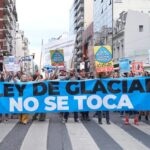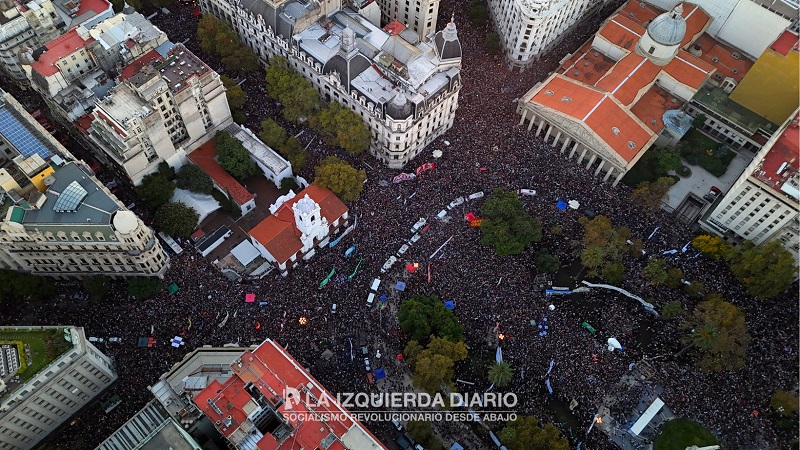
The mobilizations of 2024 showed historic support for the public university. More than one hundred faculties were taken over by their students and we held two historic marches, on April 23 and October 2, with which we conquered Law 27,795 and overturned the presidential veto twice.
But after a year of not complying with it, Milei now intends to modify it in three sensitive points:
- The center is the salary, which implies more than 85% of the operating expenses of public universities. According to current law, the Executive must recognize the salary loss due to inflation from December 1, 2023, but the Government project would only recognize the salary loss from 2025 (not a word from 2024), and in three tranches. This specifically means an increase in 12.3% in three parts (March, July, September) compared to the 51% that corresponds by Law (which should actually be retroactive, to recover everything lost).
- Regarding the operating expensesthe Law encourages the government to make up for what was lost due to inflation in the last two years in different budget programs, including, for example, university hospitals, science and technology. But the Government’s proposal does not say about 2024 and 2025, and establishes that it will increase it only if this year annual inflation exceeds 14.5% (that recognized in the budget).
- The Law also requires recomposing the student scholarshipson which thousands of students depend, who should be recomposed by 63.7% to recover the purchasing power of 2023 (not including indexation for inflation, which the Law does not contemplate). The government proposal does not directly contemplate them.
The public university in danger
The situation of the university is suffering an abysmal crisis. The salary drop comes from further back, specifically since 2011, for 15 years, but during Milei’s government it took a leap:
- He budget for higher education fell 28.9% in real terms between 2023 and 2025. 86% of this adjustment is explained by a reduction in teaching and non-teaching salary expenses. According to Report 32 (February 2026) of the ADIUC University Salary and Budget Observatory, The purchasing power of the university teaching salary lost 36.6% between December 2023-2025. And that taking the CPI estimator intervened by the national government, If you take the one from CABA it gives more than 40%. It is the worst fall compared to the falls in real terms compared to 2023 in the private sector (2%), public (26%).
- Las university extension items fell more than 97%.
- He progress program reduced the number of beneficiaries by 62.4% and the purchasing power of the stipend by 46.5%remaining frozen at $35,000 since September 2024.
- If the Law is not applied, the 2026 budget will be between 32% and 39% below 2023 in real terms, at 2006-2007 levels.
What is at stake is much more than a salary or budget percentage: it is the future of the public university in Argentina. Los more than ten thousand teachers who, according to the CIN, stopped teaching in public universities since Milei took office They are an index of this.
The Recomposition of salaries, budgets and scholarships under current law would imply an expenditure of 3.1 billion pesos (US$2,204 million). Meanwhile, the Labor reform implies a transfer from the State to large companies for US$ 7.5 billionand the Elimination of withholdings to the field had an estimated cost of US$1.5 billion. And capital flight from large companies amounted to $13 billion in 2026.
Seen against that background, the supposed “budgetary recomposition” of just over $80 billion (US$57 million) that the government proposes for universities is seen for what it is: a mockery.
The country of Milei and his accomplices (radical and Peronist governors, deputies and senators who guarantee his laws), is that of extractivism, financial scams and capital flight. While they try to destroy the public university, they promote slave labor reform to sweep away any labor rights and worker organizations; and the surrender of the country to extractivism at Trump’s request, for which they are preparing the [reforma de la Ley de Glaciares->https://www.laizquierdadiario.com/Ley-de-Glaciares-jornada-plurinacional-en-defensa-del-agua-y-las-infancias, para entregarle el agua a las megamineras y petroleras. Al mismo tiempo, promueven la baja de la edad de punibilidad con la Nueva Ley Penal Juvenil, para criminalizar a la juventud a la que le arrebatan el futuro con mayor precarización y una muralla al ingreso a una educación universitaria reducida a una pequeña élite.
La ciencia y el pensamiento crítico son ajenos al oscurantismo instrumental de este gobierno. Como señala el docente Rodrigo Quiroga, Ciencia y Educación van a tener los presupuestos más bajos desde… 1993 (incluso peores que 2020).
Pero la universidad pública es hija de la reforma y de las generaciones de trabajadores y estudiantes que la defendieron y sienten orgullo por ella, lo que explica en buena medida fuerza de las movilización con la que conseguimos la Ley de Financiamiento, y allí está sigue fuerza necesaria para imponer su cumplimiento. La foto que ilustra esta nota expresa esa fuerza, y sigue allí. Docentes, estudiantes y no docentes universitarios tenemos planteado organizarnos en cada unidad académica en instancias interclaustros de forma independiente de rectores y direcciones sindicales que le pusieron un freno a la lucha en 2024 (y antes en 2017), especulando electoralmente.
En la audiencia contra la reforma de la Ley de Financiamiento Universitaria en la Cámara de Diputados se expresó un arco muy importante de representaciones gremiales docentes y no docentes de Aduba, Feduba, Fedun, FATUN, Ctera, y las estudiantiles de FUA, FUBA, FULP, FUC, entre muchas otras. Es importante exigir en cada Universidad que quienes allí se expresaron sean consecuentes y pongan todos sus esfuerzos en organizar la lucha por la aplicación de la Ley y una nueva marcha federal universitaria para el comienzo de las clases.
Conadu Histórica definió por mayoría un paro de 24 horas por la aplicación de la Ley de Financimiento Universitario y el pago del 51% de aumento salarial correspondiente para el día 2 de marzo (las asociaciones de base Agd-UBA, Luján y Tucumán habían propuesto un paro de 36 hs). Lo mismo definión CONADU, en coincidencia con el paro nacional convocado por CTERA.
Asimismo, AGD-UBA convocó una asamblea el día siguiente, el 3 de marzo, para definir pasos a seguir. Otras asociaciones gremiales están convocando las suyas. En redes, diferentes sectores universitarios están están expresando su bronca, y debatiendo qué medidas tomar.
El Departamento de Geología de @Exactas_UBA se expresa por unanimidad (52 profesorxs y
docentes auxiliares) por el NO INICIO de las clases hasta conseguir la recomposición salarial y presupuestaria comprometida en la Ley No 27.795 del 2025.— fragi 💫 (@haydeecinha) February 25, 2026
La emergencia del movimiento universitario junto con los jubilados, con los trabajadores que están luchando contra los cierres y despidos como en Fate y Lustramax y con el ejemplo del Hospital Garrahan, y con los pueblos que luchan por el agua contra el extractivismo, como en Mendoza, puede frenar el conjunto del plan destructivo de Milei. No hay margen para especular hacia 2027, como dijo Myriam Bregman frente al congreso, la lucha es hoy.
Source: www.laizquierdadiario.com