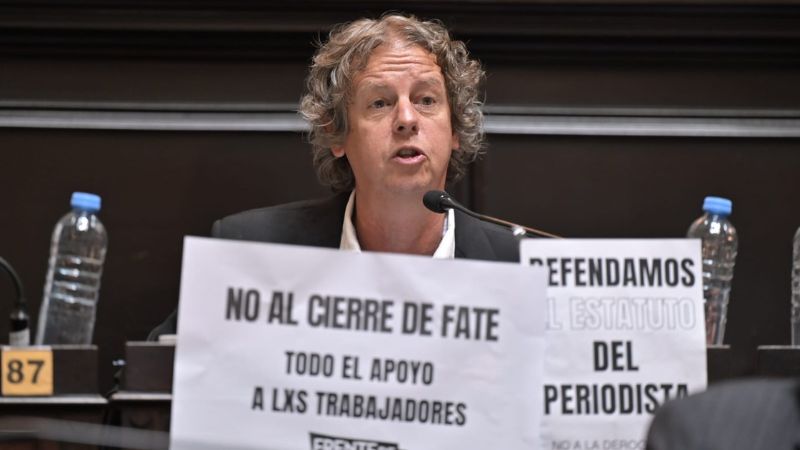
This Tuesday, the Chamber of Deputies of the Province of Buenos Aires resumed activity with a session crossed by the treatment of the labor reform at the national level promoted by the government of Javier Milei, already voted in Deputies at the national level and on the way to the Senate, which ordered the debate in the chamber with clear positions between those who seek to advance with flexibility and those who denounce a direct attack on the historical achievements of the working class.
The Left–Unity Front (FIT-U) presented projects to reject the reform and denounce its regressive nature. They also presented projects to repudiate the layoffs and the closure of Fate that were blocked from being processed by the La Libertad Avanza bloc and the PRO.
In @HCDiputadosBA We present a project rejecting the labor reform approved in the Chamber of Deputies of the National Congress pic.twitter.com/kEMI9TSvG4
— Christian Castillo (@chipicastillo) February 23, 2026
“It is not modernization: it is regression”
In his speech, deputy Christian Castillo (PTS FITU) pointed to the core of the labor reform project: enabling extended working hours and discipline, “Today you stay 12 hours and if you don’t like it, you leave,” and dismantling protection against dismissal. Thus he denounced that the liberals want to create an illusion where the worker chooses how he will work on equal terms with the country’s billionaires and argued that the problem is not technology but the power that they want to give to the employers: “Technology does not say the number of hours you have to work or whether or not you can hold an assembly in the workplace.” He pointed out that the project directly seeks to sweep away rights—especially working hours and agreements—and that it is part of a “war” by large corporations against work and collective rights: “217 articles, none in favor of the worker.”
“There were complicities”
Castillo denounced the CGT leadership for not calling to mobilize and promote a sustained plan of struggle despite the fact that “there was social strength” to stop the reform and pointed out the political responsibilities of those who facilitated its advance with a quorum, votes or absences at key moments, such as the deputies of Tucuman and Catamarca.
The La Libertad Avanza bloc (LLA) and allies defended the reform with the discourse of “modernization.” Unión por la Patria rejected it as flexibility, but the left warned that speeches are not enough if action is not taken in the province. Deputy Castillo pointed out that Governor Kicillof, who spoke against the reform, should begin by ending precarious contracts in the State of Buenos Aires: “All workers on a permanent basis now.” He demanded to regularize thousands of health workers (he estimated about 20,000 scholarship recipients), increase salaries in education, set a floor for municipal employees and restore income. And he concluded: “Shield against precariousness? Let’s start at home.”
Castillo closed by calling to face it “in every place” and to surround the FATE workers with solidarity. The session left a clear postcard: those pushing for flexibility seek to shield it in Parliament, while from the left there was a call to stop it with mobilization, coordination and a fight plan until the entire adjustment of the government and its accomplices is thrown out.
That the Chamber of Deputies reject the United States blockade on Cuba
Another urgent issue that was raised from the Left benches is about the advance of imperialism in the region and in particular the oil blockade of Cuba.
As Christian Castillo pointed out, the blockade of Cuba is part of a plan to discipline the entire continent and so that Latin American countries are nothing more than part of a new Viceroyalty. “Milei assumes himself as a colonial official,” he insisted, “the possibility of stopping the blockade depends on the political will to confront Donald Trump’s impositions.
Source: www.laizquierdadiario.com