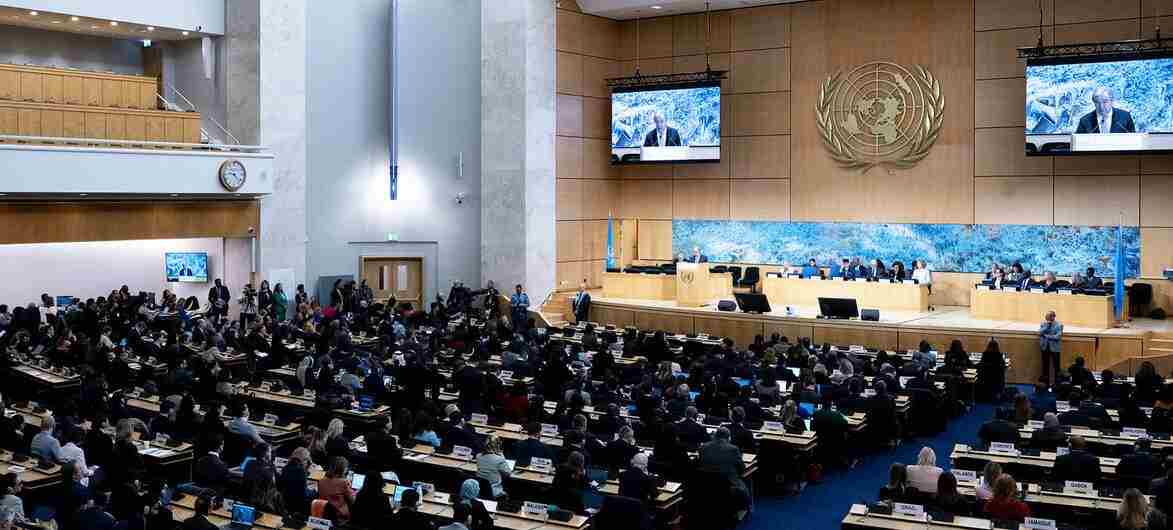
António Guterres, UN Secretary-General, spoke at the opening of the new session of the Human Rights Council, in Geneva, criticizing the weakening of the rule of law and the growth of impunity.
This Monday, the leader of the United Nations, António Guterres, declared that human rights are being attacked around the world, and often by States and regions that hold more power.
In a speech at the opening of the new session of the Human Rights Council in Geneva, the secretary-general spoke of “deliberate weakening”, impunity and how they affect peace, development, social cohesion, people’s trust and solidarity.
Featured conflicts and violations
Guterres said he is expected to speak to the Security Council this week on the fourth anniversary of Russia’s large-scale invasion of Ukraine, indicating that more than 15,000 civilians have been killed since the start of the conflict.
The secretary-general also mentioned violations of human rights and international law in the Palestinian Territories, stating that the two-state solution is being progressively weakened. Guterres stated that the international community cannot allow this scenario.
During the recent African Union conference, he indicated that crises in Sudan, the Democratic Republic of Congo and the Sahel were at the center of discussions.
Growing impunity and multiple global crises
According to the secretary-general, conflicts are multiplying and impunity has become recurrent, not due to a lack of instruments or institutions, but as a result of political choices.
The UN leader highlighted that the human rights crisis is linked to other global fractures, including the increase in humanitarian needs, the worsening of inequalities, the indebtedness of countries, the acceleration of climate change and the use of technology, with emphasis on artificial intelligence, in ways that can suppress rights and deepen discrimination.
Guterres pointed to restrictions on civic space, arrests of journalists and activists, closure of non-governmental organizations, setbacks in women’s rights, exclusion of people with disabilities and repression of the right to peaceful assembly, again referring to the violent repression of protests in Iran.
He mentioned situations involving migrants, refugees, Lgbtiq+ communities, minorities, indigenous peoples and religious communities, as well as the spread of misinformation and hate speech on digital platforms.
Three priority action fronts
In his speech, the secretary-general identified three urgent fronts of action. The first consists of defending the common bases, including the United Nations Charter, the Universal Declaration of Human Rights and the instruments of international law, which he described as indivisible and interdependent.
The second front involves strengthening international institutions. Guterres advocated updating the Security Council to reflect current realities, as well as reforms in the international financial architecture to ensure greater participation by developing countries.
Guterres spoke of the UN80 Initiative, which aims to strengthen the link between human rights, peace, sustainable development and humanitarian action, including the creation of a Human Rights Group across the United Nations system.
The third front, he said, is to unlock the potential of human rights as a basis for more stable societies and fairer economies, advocating support for the International Court of Justice and the International Criminal Court, the implementation of the Sustainable Development Goals and the acceleration of climate action.
Final appeal to the Council
Recalling his personal experience growing up under dictatorship in Portugal, Guterres stated that the denial of human rights corrodes all aspects of society.
In his tenth year as Secretary-General, he declared that human rights are non-negotiable and do not belong to a specific region of the world, being the basis of a more peaceful and secure world.
He highlighted the importance of the Human Rights Council’s mechanisms, including Special Procedures, Special Rapporteurs, investigative mechanisms and the Universal Periodic Review, highlighting the role of these tools in the context of the body’s 20th anniversary.
In his latest intervention at the Council’s opening session, he called on States not to allow the erosion of human rights to become an acceptable price of political expediency or geopolitical competition, arguing that the Human Rights Council must act as a voice and shield for the most vulnerable.
The secretary-general leaves office this December 31st after 10 years at the helm of the United Nations.
Originally published by ONU News on 02/23/2026
Source: https://www.ocafezinho.com/2026/02/23/onu-direitos-humanos-estao-sob-ataque-em-larga-escala-no-mundo/