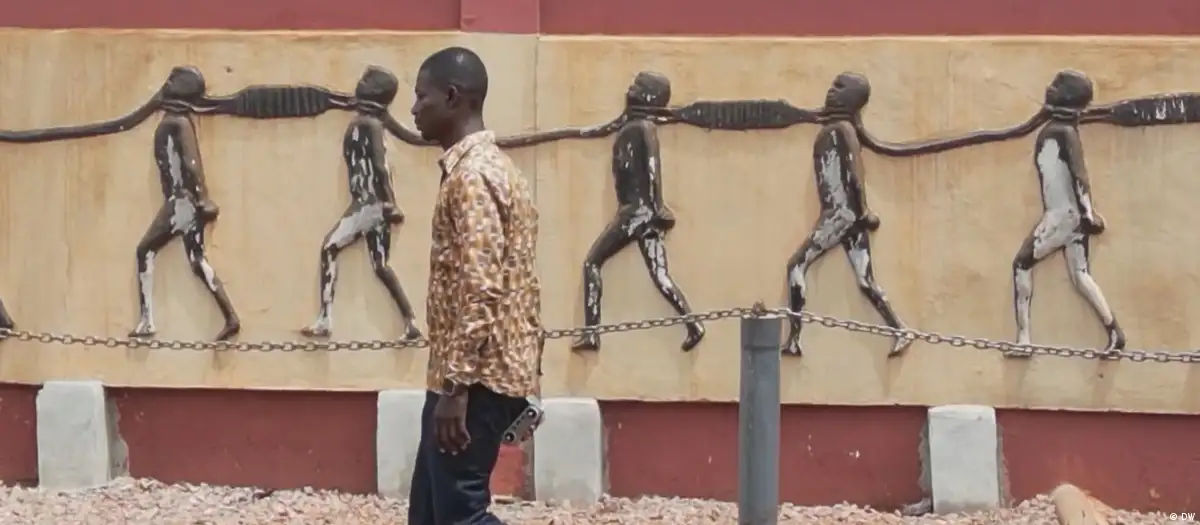
African Union wants the UN to recognize the transatlantic slave trade as the most serious crime against humanity. The proposal is viewed with reservations by countries that have benefited from the practice.
Historians agree: the trafficking of enslaved Africans between the 15th and 19th centuries – when millions were forcibly taken to the Americas – was one of the lowest points in human history.
It is estimated that more than 15 million people were deported over 400 years. Other sources speak of 12 to 12.8 million. Around 10.7 million arrived alive in the Americas. Between 1.5 and 2 million died crossing the Atlantic.
Almost two centuries later, 40 countries of the African Union (AU) ask the United Nations (UN) to recognize transatlantic slavery as the greatest crime against humanity.
There is a solid legal basis for this, says the president of Ghana, John Dramani Mahama, who also speaks of an “unquestionable moral obligation” when remembering those who resisted enslavement and those who, sick and weakened, were thrown into the sea. His country is leading the proposal and will present it to the UN in March.
“The trade in enslaved Africans and racialized forms of slavery are crimes that have shaped the modern world,” Mahama declared in mid-February, during the AU’s annual conference in Addis Ababa, Ethiopia.
“The consequences [desses crimes] continue to manifest themselves in structural inequalities, racial discrimination and economic disparities,” he said. “Recognizing these injustices is not synonymous with division, but with moral courage. This initiative offers us a historic opportunity to affirm the truth of our history.”
Ghanaian President John Dramani Mahama speaks to the UN General Assembly last September | Jeenah Moon/Reuters More
This view is shared by African intellectuals such as Kojo Asante, a human rights expert at the Ghana Center for Democratic Development.
Asante considers the AU proposal valid from a historical and legal point of view. He recalls that African states have long sought recognition and, at least, an apology from those historically responsible.
In Ghana, the issue has been on the agenda for years – Mahama is not the first to support requests for reparation; his predecessor Nana Akufo-Addo also did so. The proposal is also supported by Ghana’s young electorate, especially among the most politicized, according to Asante.
The next step: reparations?
In 2025, the African Union proclaimed the “Year of Justice for Africans through Reparations”. The African entity’s resolution defines reparations as future-oriented instruments, linked to development.
Mahama emphasized that it is not initially about financial values, but rather the recognition of historical truth. Monetary issues would come later.
The idea was not received with much enthusiasm by major global powers, especially countries that benefited economically from slavery and colonialism.
In the United States, Asante points out that members of Donald Trump’s government claim that it is not fair to hold them responsible for the crimes of their ancestors. “The transatlantic slave trade is a very sensitive, delicate and controversial issue, especially for those countries that benefited massively from trafficking and other colonial activities,” says Asante.
A “ranking” of crimes?
Speaking at the AU summit, Mahama said that there had been no greater crime against humanity in recent history than the transatlantic slave trade. Critics question whether this does not mean relativizing other crimes, such as the Holocaust.
Asante rejects this comparison: it is not about creating a “ranking” of tragedies, but about recognizing what the slave trade actually was: a deeply inhumane practice, with global consequences.
Persistent racism shows how current this chapter of history remains, says the human rights expert. Therefore, he argues that what matters is that there is recognition – and that the world learns, so as not to allow such crimes to be repeated.
But for young Ghanaians, Asante warns that it is important not to focus only on the past, but also to offer them good politics in the present, since, according to him, many current problems in African countries cannot be attributed exclusively to colonial powers.
African responsibility
Mahama also said the truth about the history of transatlantic trade needs to be “told in full.” For critics, this implies recognizing the role played by African elites, traders and kingdoms in trafficking, and their alliances with Europeans.
As Asante points out, forms of slavery already existed in African societies before the transatlantic trade, as they did in other parts of the world and at other historical moments. However, Asante points out that transatlantic trafficking had disproportionately large economic, political and social impacts along Africa’s Atlantic coast, with consequences that affect the world order to this day.
Originally published by DW on 02/23/2026
By António Cascais
Source: https://www.ocafezinho.com/2026/02/23/gana-leva-a-onu-o-caso-da-escravidao-transatlantica/